
2026-09-22 Author : ZCS
● A POS terminal management system is the control layer used to register, group, configure, update, monitor and retire payment-capable devices after they leave the factory.
● TMS, MDM, the payment application and the acquiring host manage different parts of the environment; treating them as one system creates gaps in ownership and incident response.
● Safe fleet operations depend on staged releases, version visibility, role-based access, audit records and a tested recovery path—not a single fleet-wide update button.
● Most current ZCS Android POS product families can support ZCS TMS, although availability may be standard or optional depending on the model, firmware and project configuration.
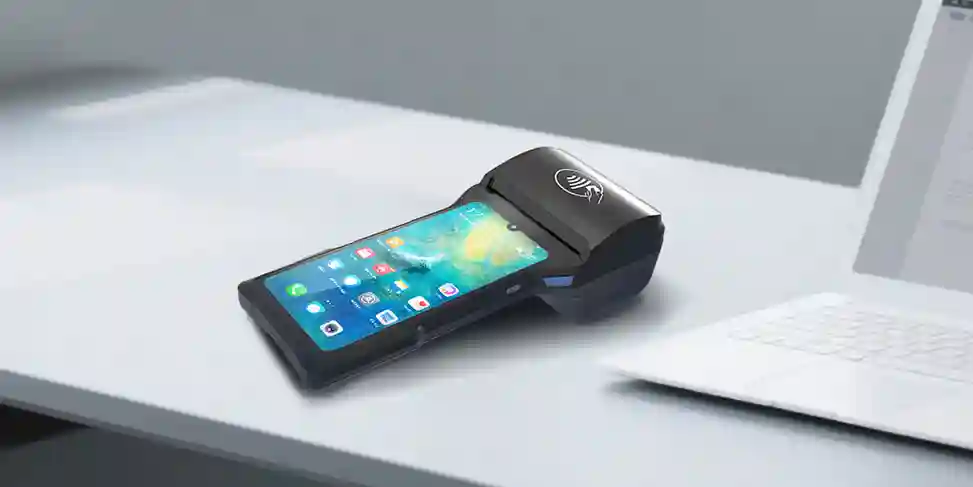
A POS terminal management system, commonly shortened to TMS, is the software control plane for a fleet of deployed payment or business terminals. It gives an authorized operations team a central way to identify devices, assign them to groups, distribute approved software, apply configuration, check status and manage changes without visiting every merchant location.
The need appears as soon as a project grows beyond a few devices. Updating five terminals by hand is inconvenient. Updating five thousand terminals in different cities, merchant groups and regulatory environments is an operating risk. The team must know which devices received the correct package, which are still pending, which failed, and whether the fleet can continue trading while a problem is investigated.
TMS is therefore more than remote maintenance. It connects the terminal's physical identity with its deployed owner, software state and support history. For a closer look at ZCS's existing platform, see the overview of cloud TMS for distributed POS terminals. This guide explains the wider operating model a buyer should evaluate before choosing any platform.
2.Why terminal management starts after hardware delivery?
A terminal that passes factory inspection is only at the beginning of its working life. It s/till has to be associated with the correct customer or merchant, receive the right application and settings, connect to the intended services, stay within a supported software state, survive field faults and eventually be replaced or retired. Each stage changes who may control the device and what evidence the operator needs to keep.
Without centralized control, fleets gradually become inconsistent. Stores run different application versions, support teams cannot reproduce a fault, security patches reach only the merchants who remember to install them, and returned devices remain assigned to old accounts. The immediate symptom may be downtime, but the deeper problem is loss of configuration authority: nobody can prove which software and policy a particular terminal is running.
This is why TMS capability should be evaluated alongside the hardware SDK and after-sales model. ZCS's open SDK and ODM platform guide describes how hardware integration, application development, remote management and support fit into one deployment lifecycle rather than becoming separate supplier relationships.
Android has made the boundaries less obvious because the same terminal may run a payment application, an ordering app, device-management software and general enterprise services. The systems can exchange information, but they do not have the same responsibility.
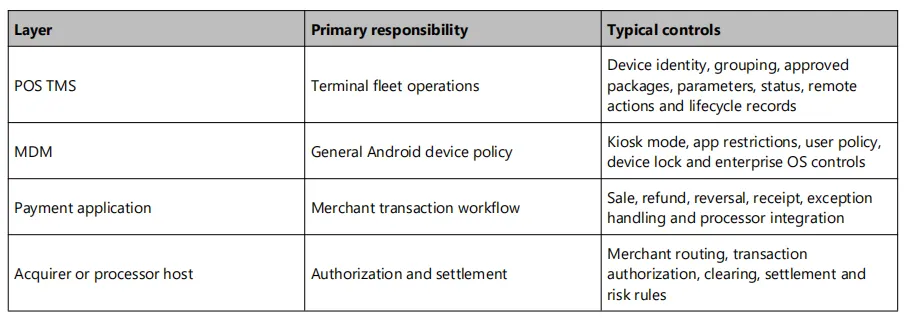
A generic MDM may install an Android application or lock a device into kiosk mode, but it may not understand terminal-specific firmware, printer components, payment parameters or the support relationship between a serial number and a merchant. Conversely, a TMS should not be assumed to replace every enterprise policy function of a full MDM. The project architecture should state which system owns each action and which one holds the audit record.
4.The POS terminal lifecycle a TMS should manage
The platform first needs a trustworthy record of the device. Depending on the implementation, enrollment may use a serial number, hardware identifier, factory record, certificate or activation code. The goal is to prevent an unknown device from joining a production group simply because it can reach the server.
Enrollment should also create an ownership trail. Operations teams need to know whether a unit is in stock, assigned to a customer, installed at a site, held as a spare, under repair or retired. That status prevents a returned terminal from receiving live merchant configuration after it has changed hands.
A useful TMS manages devices through policy groups rather than one terminal at a time. Groups may represent a country, customer, merchant chain, store type, device model, pilot population or application channel. One device can require several attributes, but the resulting configuration must remain predictable.
Configuration includes more than a company logo. It can include approved applications, language, receipt format, peripheral settings, update windows and environment endpoints. Payment routing, fiscal settings and encryption-key operations require their own authorized systems and compliance controls; buyers should not assume that every value shown in a TMS dashboard can be changed safely or legally by a general administrator.

Remote distribution is one of the most visible benefits of TMS. It lets an operator send a tested application or firmware package to selected terminals, track download and installation status, and identify devices that remain on an older release. The platform should preserve package version, target group, administrator, schedule and result.
The correct question is not whether the platform can push an update. Buyers should ask whether it supports a pilot group, staged expansion, installation windows, prerequisite checks, interruption recovery and rollback. Adyen's public terminal documentation, for example, describes testing software on selected devices and then updating the remaining fleet in batches. That operating discipline matters regardless of terminal brand.
A TMS should help support teams distinguish an individual fault from a fleet pattern. Useful signals may include last contact time, installed versions, update status, available storage, power state and reported application or peripheral errors. The exact telemetry depends on the device and platform, so procurement documents should separate required metrics from desirable ones.
Monitoring is valuable only when it leads to action. Alerts need thresholds, ownership and escalation rules. A terminal that has not contacted the platform for an hour may be normal for a mobile field team; the same event at a busy checkout could require immediate support. Context from the merchant, site and device group turns raw status into an operational decision.
When a terminal fails, the platform should preserve enough information for triage and replacement. Support teams need the model, firmware, installed applications, recent events, customer assignment and warranty or repair status. If a replacement is issued, the old device must be removed from active policy groups before the new unit receives the merchant configuration.
Retirement should revoke access, clear assignments and record final disposition. Physical disposal and data handling follow the organization's security policy, but the TMS supplies the evidence that the unit is no longer authorized to participate in the fleet.
5.How to release POS updates without causing downtime?
A safe update begins with a defined package and a known target state. Test it in a lab on every relevant model and peripheral configuration, then release it to a small pilot group that represents real operating conditions. Monitor installation success, restart behavior, transaction readiness and support tickets before expanding the rollout.
The next stages should grow gradually rather than jump directly to the full estate. Schedule around local trading hours, and avoid assuming that all terminals are online at the same time. The TMS should distinguish downloaded, installed, activated, failed and pending states. If the package cannot complete, the device needs a defined retry or recovery path rather than an endless loop that consumes storage and connectivity.
Rollback also has to be designed before release. Some firmware changes cannot be reversed in the same way as an application update, and database or configuration changes may make an older app incompatible. A buyer should therefore ask the vendor to demonstrate a failed update and recovery sequence during the pilot, not only a successful dashboard demonstration.

Central control makes operations efficient, but it also concentrates authority. An administrator who can target every terminal with a package or configuration change has significant operational power. Access should follow defined roles, strong authentication and least-privilege rules. A support agent may need to view device status without being allowed to publish firmware; a country manager should not automatically control another market's fleet.
The platform should record who performed an action, what changed, which devices were targeted, when the action ran and whether it succeeded. Sensitive operations may require a second approver. Packages should be authenticated and checked for integrity before installation, and communication between the platform and terminal should use protected channels.
A TMS supports security operations but does not, by itself, make a business compliant with PCI DSS or certify a payment application. The broader controls are explained in our complete guide to POS security. SoftPOS teams face an additional device-attestation layer, covered in the article on hardware platforms for SoftPOS products.
7.Multi-country and multi-customer deployments
A single-country fleet can often use one application channel and a small number of device groups. International deployments introduce different languages, time zones, software releases, payment partners and regulatory configurations. The TMS needs clear partitions so an update intended for one market cannot reach another by mistake.
Multi-customer platforms require similar separation. A PSP, distributor or ISV may manage devices for several merchant organizations from one service. Each customer's administrators should see only their authorized estate, while the platform operator retains a controlled support view. Reporting, API access and exported logs must respect the same boundary.
For projects crossing regulatory and language boundaries, our multi-country Android POS deployment guide examines country profiles, targeted firmware and regional configuration in more detail.
TMS terminology is used loosely, so project documents should define scope. A device-management platform does not automatically authorize or settle payments, provide merchant acquiring, certify a terminal, create fiscal compliance, or guarantee that a payment can be completed without a live connection. Those functions belong to payment applications, processors, acquirers, fiscal systems and approved transaction policies.
It also does not eliminate field service. Remote diagnosis can reduce unnecessary visits and show technicians what to bring, but broken printers, damaged screens, depleted batteries and physical tampering still require a repair or replacement process. TMS is most effective when it connects with spare-parts, warranty and support workflows rather than being treated as a dashboard separate from operations.
9.ZCS POS products and TMS support
TMS is available across most of the current ZCS Android POS product line, covering compact handheld, payment, mobile printing, desktop and tablet-style terminal families. Published ZCS materials identify TMS support for products such as the Z90 and Z93, while models including the Z92 list TMS as an optional configuration. The wider portfolio includes the Z81, Z90, Z92, Z93, Z100, Z101 and Z108 families, together with biometric variants used in identity-sensitive projects.
This broad product coverage allows a project to apply a common management approach across different form factors. A bank may manage handheld agent terminals, a retailer may combine mobile and counter devices, and an integrator may supply different printer or display configurations without creating a separate manual support process for every model.
Support should still be confirmed for the exact model, hardware revision, firmware build and commercial configuration being ordered. 'TMS optional' may require a selected software package or project service, and available telemetry or remote actions can vary by device generation. Buyers should request a model-specific capability matrix and test the intended functions on samples before approving a fleet rollout. ZCS provides a dedicated TMS support channel alongside SDK downloads, technical assistance, repairs and OEM/ODM services.
10.How to evaluate a POS TMS before procurement
Begin with the operating model. Define who owns the fleet, who publishes software, who supports merchants and which systems already manage Android policy or payment configuration. Then create a capability matrix covering enrollment, grouping, package management, monitoring, roles, audit records, API access, recovery and retirement. Mark each requirement as mandatory, optional or outside the TMS scope.
The pilot should exercise failure as well as success. Enroll a new device, move it between groups, interrupt an update, let one terminal remain offline, publish an invalid package to a protected test group, revoke an administrator, replace a damaged unit and retire the original. Verify that the dashboard state matches what actually happened on the devices and that every action leaves a usable audit record.
Finally, evaluate lifecycle ownership. Ask how long the device receives compatible firmware, which team maintains the TMS agent, how server and terminal versions remain compatible, what support response applies to a failed deployment, and how data can be exported if the platform changes. A low unit price does not compensate for an unmanaged estate that becomes expensive after launch.

11.From terminal inventory to operating infrastructure
A POS fleet is not a collection of boxes once it enters production. It is distributed infrastructure with software versions, merchant assignments, security states and support obligations. A capable terminal management system keeps those relationships visible and controlled from provisioning through retirement.
ZCS supports TMS across most of its Android POS portfolio, giving payment providers, ISVs, banks, distributors and enterprise operators a path to manage different terminal form factors under a shared operational model. The final selection should be based on the exact device configuration and demonstrated management functions required by the project.
Q1.What is the difference between a POS TMS and a POS system?
A POS system handles checkout functions such as products, orders, payments and receipts. A TMS manages the devices running those functions, including enrollment, software versions, configuration, monitoring and lifecycle status.
Q2.Can a TMS manage different POS terminal models?
Yes, when the platform and device software support those models. Available functions may vary by hardware revision and firmware, so the buyer should obtain a model-specific capability matrix.
Q3.Does TMS replace Android MDM?
Not always. TMS focuses on terminal fleet operations, while MDM manages broader Android device and user policy. Some deployments use both, with clearly separated ownership.
Q4.Do all ZCS POS terminals support TMS?
Most current ZCS Android POS product families can support ZCS TMS, but the feature may be standard or optional depending on the model, firmware and project configuration. Confirm support for the exact ordered configuration.
Q5.Can TMS prevent every on-site service visit?
No. It can resolve software and configuration issues remotely and improve diagnosis, but physical damage, worn parts and some security events still require repair or replacement.
Q6.What should a TMS pilot test?
Test enrollment, grouping, staged updates, interrupted downloads, offline devices, role restrictions, audit records, replacement and retirement. A failure-and-recovery test is more useful than a successful update alone.






 Home
Home  Walmart Finally Adds Tap to Pay: What It Means for Retail POS
