
2026-09-23 Author : ZCS
● An EV charging payment terminal must be selected as part of the complete charger, enclosure, processor and back-office architecture—not as a generic NFC accessory.
● Outdoor suitability depends on the installed enclosure, ingress and impact protection, temperature range, condensation control, sunlight readability, mounting and service access.
● In the EU, AFIR requires ad hoc payment at public charging points and sets specific card or contactless acceptance rules based on deployment date, power and location.
● A shared payment terminal can serve several chargers in one charging pool, but it creates different availability, routing and user-interface requirements from one terminal per charger.
A payment terminal at an EV charging site may sit outside every day, operate without staff, serve unfamiliar users and depend on several remote systems before a session can begin. It must identify the correct charger, present pricing, accept an ad hoc payment method, handle authorization and link the final amount to the completed charging session. A normal countertop terminal is not automatically suitable simply because it can read a contactless card.
The first decision is architectural. A charger manufacturer may embed a secure payment component inside each charger, install a complete unattended payment terminal on the enclosure, or use one shared payment device for a group of chargers. These designs affect certification, mechanical tooling, transaction routing, maintenance and what happens when one component fails.
Our explanation of unattended payment terminals versus POS systems covers the basic distinction between a finished UPT, an embedded secure component and a staff-operated POS. This article applies that decision specifically to public EV charging.
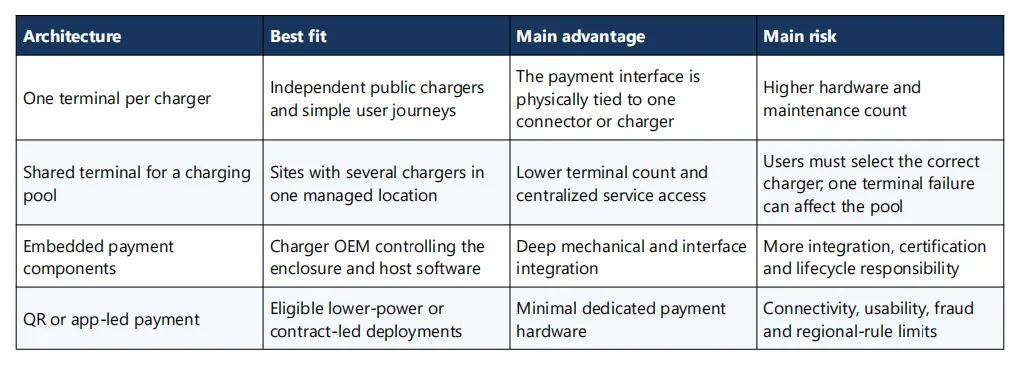
A shared terminal is expressly recognized in the EU Alternative Fuels Infrastructure Regulation: one payment terminal or device may serve multiple publicly accessible charging points within the same charging pool. That does not make the software simple. The screen must identify the selected charger clearly, prevent payment against the wrong connector and return the user to a recoverable state if the charging unit becomes unavailable.
For public charging in the European Union, Regulation (EU) 2023/1804 requires operators to let users recharge on an ad hoc basis. At publicly accessible points deployed from April 13, 2024, operators must accept a widely used payment instrument through at least a payment-card reader, a device with contactless functionality capable of reading payment cards, or—at points below 50 kW—an internet-connected device enabling secure payment, such as a session-specific QR code.
From January 1, 2027, public charging points rated at 50 kW or above along the TEN-T road network or at safe and secure parking areas must meet the card-reader or contactless-device route even when installed before April 13, 2024. AFIR also requires clear ad hoc pricing and preserves an ad hoc option when automatic authentication is offered.
These are EU rules, not a universal global specification. Charger operators should map each target country against payment, accessibility, tax, receipt and consumer-information requirements. A terminal that fits one market may need different software, approvals or user flows elsewhere. The multi-country POS deployment guide explains why country profiles and controlled configuration matter once a project crosses borders.
An IP or impact-resistance claim is useful only when it applies to the final installed assembly. A reader module can be tested in isolation, yet the charger may still admit water through a poorly sealed cutout, cable entry or service door. Ask which face, connectors and mounting conditions were covered by the test and whether the rating remains valid after installation.
Temperature is equally specific. Compare operating and storage ranges with the site's real enclosure temperature, including direct sun, winter start-up and heat produced by charging electronics. Condensation can be more damaging than rain because moisture forms inside a sealed enclosure when temperature changes. Drainage, ventilation, heaters or conformal protection may be required by the complete charger design.
The customer-facing surface must also work in bright light, rain and with gloves. Evaluate display brightness, viewing angle, touch behavior, card-tap guidance, tactile or audio feedback and the height and reach of the interface. Contactless antenna performance should be retested after final mounting because surrounding metal, glass thickness and enclosure geometry can change the read zone.
PCI PTS POI distinguishes complete unattended payment terminals from components such as encrypting PIN pads and secure card readers. A complete UPT can be deployed as a finished payment device, while an EPP, SCR or related module is intended to be integrated into a larger machine. The correct path depends on whether the charger OEM is buying a deployable terminal or building the secure payment interface into its own enclosure.
Certification claims need to identify the exact approval class, model, hardware version and firmware. Generic phrases such as 'PCI compliant' or 'EMV supported' do not show that a device is approved for an unattended environment. The broader layers are explained in our POS terminal certification guide, including PCI PTS, EMV testing, market access and scheme approval.
Physical security remains part of operations after installation. The design should make tampering visible, restrict access to secure components and protect cables and service ports. Inspection frequency, incident escalation and replacement responsibility should be included in the site operating plan rather than left to the payment vendor alone.
Charging differs from a fixed-price retail purchase because the final amount may not be known when the session starts. The solution may request a pre-authorization, begin charging after approval, measure energy and time, and then complete the transaction for the final amount. If the session fails or the final amount is lower than the hold, the system must complete or release the authorization correctly.
The charger, payment terminal, charging management system and processor must share a reliable session identifier. That identifier connects the user-selected connector, authorization, meter record and final transaction. If systems create separate identifiers without a documented mapping, support teams may be unable to explain a charge or resolve a dispute.
Error design matters as much as the successful path. The interface should distinguish a declined payment from an unavailable connector, a communication timeout and a charger fault. Repeated taps must not create duplicate sessions, and a power interruption should not leave an authorization without a traceable charging record.

An unattended site needs at least one dependable route to the payment and charging services, with monitoring that can distinguish a local charger fault from a wider network outage. Redundant connectivity may improve availability, but it does not automatically permit offline card authorization. Payment rules, processor configuration and risk controls determine whether a transaction can continue when the host is unreachable.
Do not confuse offline charger operation with offline payment. A charger may cache telemetry or continue an already authorized session while disconnected, yet still be unable to start a new card transaction. The project should document which functions remain available, how uncertain authorizations are reconciled and how the interface informs the driver.
A field technician should not be the first person to discover that a payment device is offline. The operating platform needs visibility into last contact, software version, update state and relevant error conditions. Charger status, payment status and site connectivity may live in separate systems, so alerts need a shared incident workflow rather than three disconnected dashboards.
Software releases should move through lab devices, a representative pilot group and staged deployment before reaching the full estate. Recovery and rollback must be tested, particularly when chargers cannot be visited quickly. The complete POS terminal management system guide covers fleet grouping, remote updates, role control, monitoring and terminal retirement in more detail.

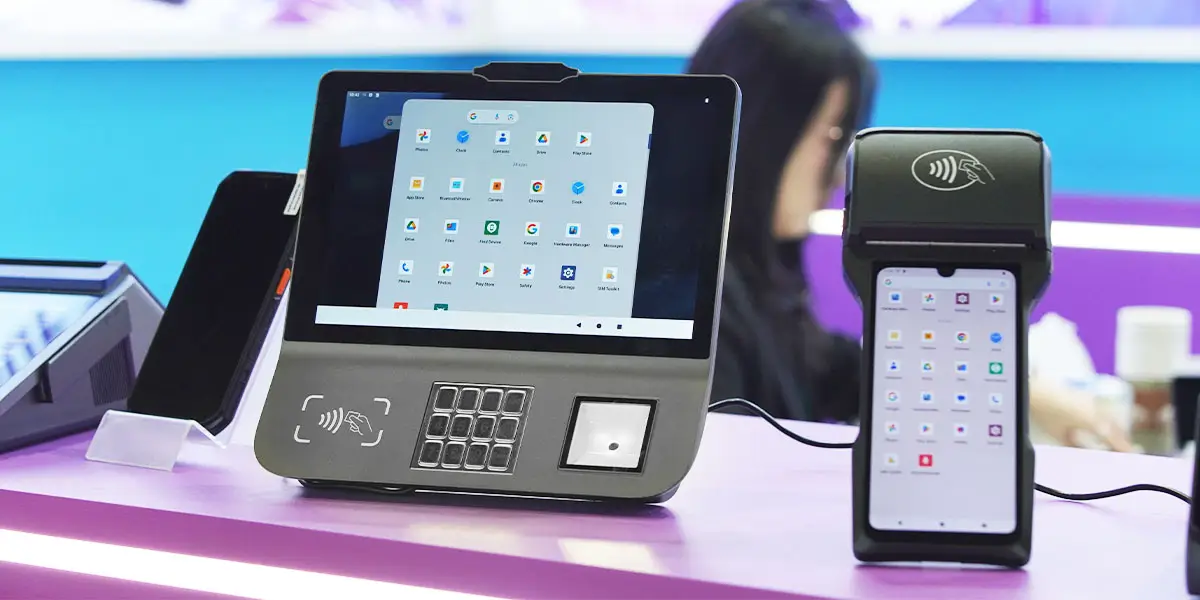
ZCS manufactures Android POS hardware and provides OEM/ODM, SDK and TMS support for payment and self-service projects. The wall-mountable ZCS Z101 Android terminal, for example, offers a 10.1-inch interface, Android NFC, multiple ports and optional peripherals that may suit a sheltered self-service user interface or charger-management controller.
That does not make the Z101, or any standard Android NFC terminal, a certified outdoor UPT. An EV charging project must separately confirm outdoor enclosure ratings, unattended PCI approval, EMV and scheme acceptance, payment application, processor integration and regional rules. ZCS's value in this type of project is its customizable Android platform, interface options and remote-management support; the secure payment component must be selected and approved for the actual unattended architecture.
For charger OEMs, the productive engagement begins with an interface and compliance specification rather than a request for a generic POS. The ZCS open SDK and ODM guide describes how enclosure, peripheral, firmware and application requirements can be scoped before tooling and pilot production.
Build a pilot using the final enclosure and representative site conditions. Test payment cards and wallets, charger selection, pre-authorization, final completion, failed sessions, refunds or reversals, power interruption and loss of back-office communication. Repeat contactless tests after mounting and with the user standing where the final parking layout requires.
Environmental tests should include water exposure appropriate to the installation, dust, temperature cycling, condensation risk, sunlight readability, glove use, impact and attempted tampering. Operational tests should cover remote update failure, terminal replacement, processor outage, accessibility, customer support and reconciliation between charging records and payment settlement.
Finally, confirm lifecycle ownership. Identify who maintains the enclosure seal, payment firmware, charger software, certificates, keys, processor relationship, spare stock and field service. A technically compatible terminal can still become the wrong choice if no party owns it after the warranty period.

The right unattended payment terminal for an EV charging station is the one that remains readable, secure, serviceable and correctly integrated after years outdoors. Start with regional payment obligations and the charger architecture, then validate the complete installed enclosure, transaction flow and remote operating model.
A contactless logo and an outdoor-looking housing are only the beginning. The procurement decision should connect certification, environmental evidence, payment processing, charging-session logic, monitoring and field support in one testable specification.
Q1.Does every public EV charger need a card terminal?
Requirements vary by jurisdiction, charging power, installation date and location. In the EU, AFIR defines ad hoc payment routes and specific card or contactless requirements; operators should check the exact rule for each site.
Q2.Can one payment terminal serve several EV chargers?
Yes. EU AFIR expressly allows one payment terminal or device to serve multiple public charging points within a charging pool. The interface must reliably associate the payment with the selected charger and connector.
Q3.Is an IP-rated enclosure enough for outdoor deployment?
No. Verify the final installed assembly, temperature and condensation control, impact resistance, sunlight readability, cable sealing, service access and certification conditions.
Q4.Can a charger accept payment when the network is unavailable?
Only if the payment solution, processor and risk rules explicitly support the required offline behavior. Offline charger telemetry or cached sessions do not automatically permit offline card authorization.
Q5.Can the ZCS Z101 be used as the payment terminal in an outdoor charger?
It can be evaluated as a customizable Android interface or controller for a sheltered installation, but Android NFC alone is not an unattended payment approval. The project still needs an appropriately certified payment architecture and environmental enclosure.






 Home
Home  POS Terminal Management System: Complete TMS Guide
