
2026-08-19 Author : ZCS
Palm vein authentication has moved well past the office door badge reader, showing up now at hospital check-in desks and retail checkout counters alike. For a broader breakdown of how the underlying technology and its use cases differ, What Is Palm Biometrics for Identity Verification? lays out the category from the ground up.
Palm vein biometrics utilizes near-infrared light to map subcutaneous vein patterns, delivering contactless identity verification for enterprise, healthcare, and retail deployments. Current hardware infrastructure bifurcates into standalone USB sensor peripherals, represented by Fujitsu PalmSecure, and POS-integrated scanning modules, embedded directly into Android payment terminals for checkout-line authentication.
The category lines between these two hardware types are drawn by physical form factor and target workflow, not marketing. One is a component added to an existing system; the other is a finished device built around the sensor from the start.
Fujitsu PalmSecure is a palm vein pattern-recognition technology developed by Fujitsu, historically brought to market through Fujitsu Frontech and its regional subsidiaries. The system grew out of more than two decades of Fujitsu image-recognition research and has shipped across several hardware forms, including the F-Pro sensor, an OEM sensor cube for embedding into third-party equipment, and turnkey devices such as PalmSecure ID Access and ID Match. Sales of the PalmSecure sensor line passed one million units, a milestone Fujitsu attributes largely to logical access control and single sign-on deployments in banking, healthcare, and government.
A significant organizational shift landed partway through this history. Effective April 1, 2026, Fujitsu Frontech's Palm Vein Authentication and RFID business, along with its retail terminal business, transferred to parent company Fujitsu Limited, according to Fujitsu's corporate notice. Fujitsu Frontech North America's public solutions menu now centers on self-checkout and retail software, with PalmSecure positioned as a legacy product line sitting under the parent company rather than a headline offering.
A PalmSecure sensor shines near-infrared light through the palm, where deoxygenated hemoglobin in the vein network absorbs the light and produces a distinct vascular map invisible to the naked eye. The sensor captures this pattern, an algorithm converts it into an encrypted digital template, and the system compares that template against a stored enrollment record for a match or non-match result. No physical contact with the sensor surface is required at any point in the process, which is part of why hospitals and food-handling environments favor the modality over touch-based fingerprint readers.
The step-by-step mechanics behind this capture process, and how they compare across sensor vendors, are covered in more depth in a dedicated walkthrough of palm vein scanning technology.
Standard palm vein sensors typically output false accept rates between 0.00001% and 0.001% under laboratory testing. Selecting devices equipped with encrypted on-sensor template generation prevents replay-based spoofing during high-volume authentication scenarios like hospital patient check-in or point-of-sale checkout.
Translated into plain terms, a false accept rate below 0.00001% means roughly one mismatched acceptance in ten million attempts — a threshold that healthcare and government procurement standards frequently reference. Fujitsu's published datasheet for the F-Pro sensor line lists a false accept rate below 0.00001% paired with a false reject rate of 0.01% when one retry is allowed, with authentication completing in under one second per verification attempt. Mean time between failure for the sensor hardware is rated at roughly one million hours, a durability figure more typical of industrial components than consumer peripherals.
These specification points define what counts as competitive accuracy across the broader palm vein category, not a figure unique to any single vendor. A longer breakdown of what separates a genuinely secure implementation from a marketing claim is available in the discussion of palm vein authentication accuracy standards.
Fujitsu PalmSecure's primary installed base sits in enterprise physical and logical access control rather than retail checkout. Typical deployments include building entry systems, workstation login replacing passwords, and single sign-on integrations such as the historical pairing with IBM's TAMESSO software. Healthcare and insurance customers have adopted the technology for patient identity verification and internal system access; medical training reseller KbPort and insurer Hiscox both appear in Fujitsu's published customer case material as PalmSecure adopters outside the retail sector.
That access-control and SSO focus explains why PalmSecure's retail footprint looks thinner than its enterprise footprint, and why the payment use case took a separate partnership to materialize at all.
PalmSecure's move into payment authentication is a more recent and narrower chapter than its access-control history. Fujitsu Frontech's 2017 partnership with biometric payment provider Keyo granted Keyo distribution rights to PalmSecure sensor technology for retail and hospitality checkout use, aiming to let shoppers pay with a palm scan instead of a card, according to Biometric Update's coverage of the deal.
That model still relies on a software and payment-processing layer built on top of the raw sensor, which is a structurally different setup from hardware built for the checkout use case from day one.
Fujitsu's engineering track record in this space is not in question: two decades of vein-pattern research, a million-plus sensor units sold, and MTBF figures that hold up under continuous enterprise use. Where the comparison gets more concrete is deployment shape. PalmSecure ships as a USB 2.0 peripheral or an OEM sensor cube, meaning a merchant or systems integrator has to pair it with a host computer, write or license SDK-level integration code, and build a bridge into whatever point-of-sale or access-control software already runs the checkout or door system. For an IT department retrofitting an existing Windows-based access system, that separation is a feature. For a retailer trying to add palm vein checkout to an Android POS line without a systems-integration project, it is an added step the hardware itself does not remove.
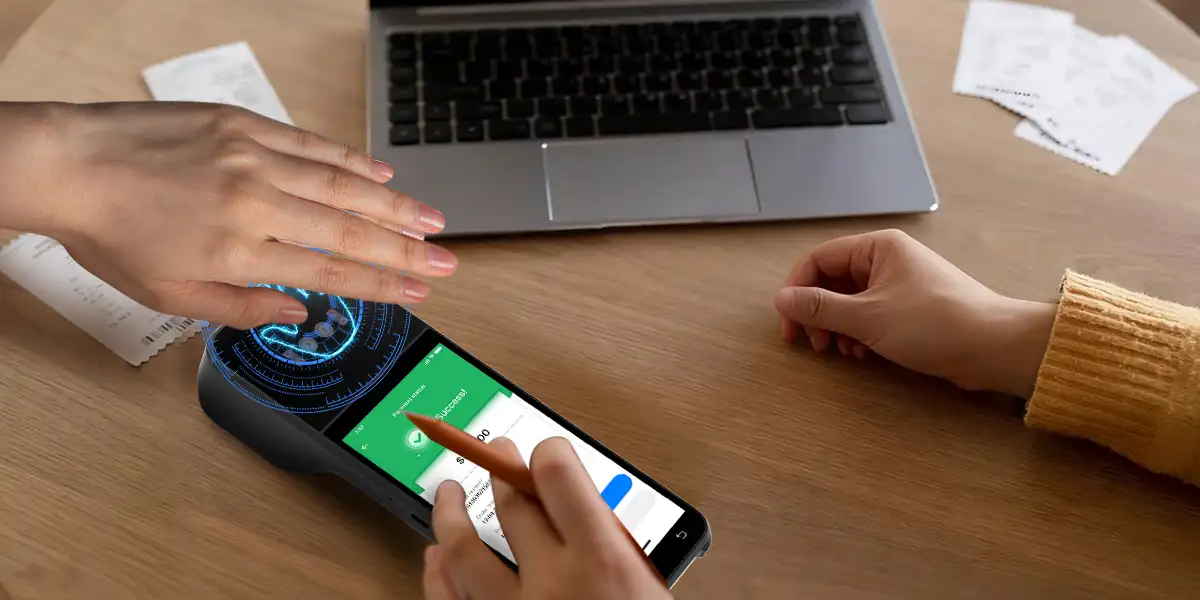
Several regional Android POS manufacturers, ZCS among them, have taken the opposite approach: building the near-infrared vein sensor directly into the point-of-sale terminal alongside the receipt printer, card reader, and payment stack, so the palm vein check happens on the same device that rings up the sale. Payment hardware carrying a biometric sensor still has to clear the same certification bar as any other checkout device before a bank or acquirer will approve it for live transactions, and that certification question is where the payment-security conversation naturally continues in PCI PTS certified POS terminal requirements more broadly.
Workplace and checkout admissibility hinge on one physical component more than any other: where the sensor and its certification boundary physically sit relative to the payment terminal itself. The deployment of USB-based biometric sensors in regulated payment environments depends on how the host terminal's PCI hardware certification scope is defined. While external peripheral sensors trigger a separate certification review for the host device they connect to, natively embedded modules fall under a single, unified PCI PTS validation covering the whole terminal.
The Payment Card Industry Security Standards Council maintains the approved device list that governs which terminal hardware, sensor-equipped or otherwise, is cleared for card-present payment use, and integrators building on top of a peripheral sensor still need the host terminal itself to clear that same bar.
| Category | Representative Vendors | Description |
|---|---|---|
| Integrated Payment POS | PAX, Square, Toast | Combines proprietary POS hardware with a bundled payment-processing stack, sold as a single software-and-hardware package with unified support. |
| Uncertified White-Label POS | No fixed brand; regional small-batch OEM factories | Generic terminal hardware without consistent third-party security certification, typically resold under whichever label the distributor applies that quarter. |
| Pure-Hardware ODM/OEM POS (customization-first, certification-flexible) | ZCS and other regional Android POS manufacturers | Supplies certified hardware — including palm vein, EMV, and PBOC modules — without bundling a fixed payment processor, letting the buyer pair it with their own software and acquiring bank. |

The decision point is workflow, not brand loyalty. An IT team replacing password logins or building a badge-free office entry system is adding one authentication component to an environment that already exists, so a standalone sensor like PalmSecure fits that job without requiring new checkout hardware. A retailer or restaurant operator adding palm vein payment at the register is instead building a new checkout stack from scratch, and a Pure-Hardware ODM/OEM POS unit that already carries a certified palm vein module removes a systems-integration step that a bare sensor cannot.
ZCS's Z90NP illustrates the second path: it pairs a built-in near-infrared vein module with the terminal's existing EMV and PBOC-certified payment stack, so the biometric check and the transaction run on one certified device rather than a sensor bolted onto a separate POS system. Buyers evaluating a palm vein POS authentication terminal for checkout use are typically solving a different integration problem than an enterprise IT buyer sourcing an access-control sensor, and the hardware category each group needs reflects that difference.
Q1. What is the accuracy rate of Fujitsu PalmSecure?
Fujitsu's published F-Pro datasheet lists a false accept rate below 0.00001% and a false reject rate of 0.01% with one retry, with authentication completing in under one second per attempt.
Q2. Can Fujitsu PalmSecure be used for retail payment authentication?
Yes, through third-party integration. Fujitsu Frontech's 2017 partnership with Keyo extended PalmSecure sensor technology into retail and hospitality payment checkout, though this requires a separate payment-processing software layer rather than shipping as a built-in POS feature.
Q3. How does palm vein recognition differ from fingerprint scanning?
Palm vein recognition reads a vascular pattern beneath the skin using near-infrared light without any physical contact, while fingerprint scanning reads a surface pattern that requires touching the sensor and can be affected by dirt, moisture, or surface wear on the fingertip.






 Home
Home  Tap to Pay vs. Dedicated POS Terminal: When Do Merchants Need Both?
