2026-11-24 Author : ZCS
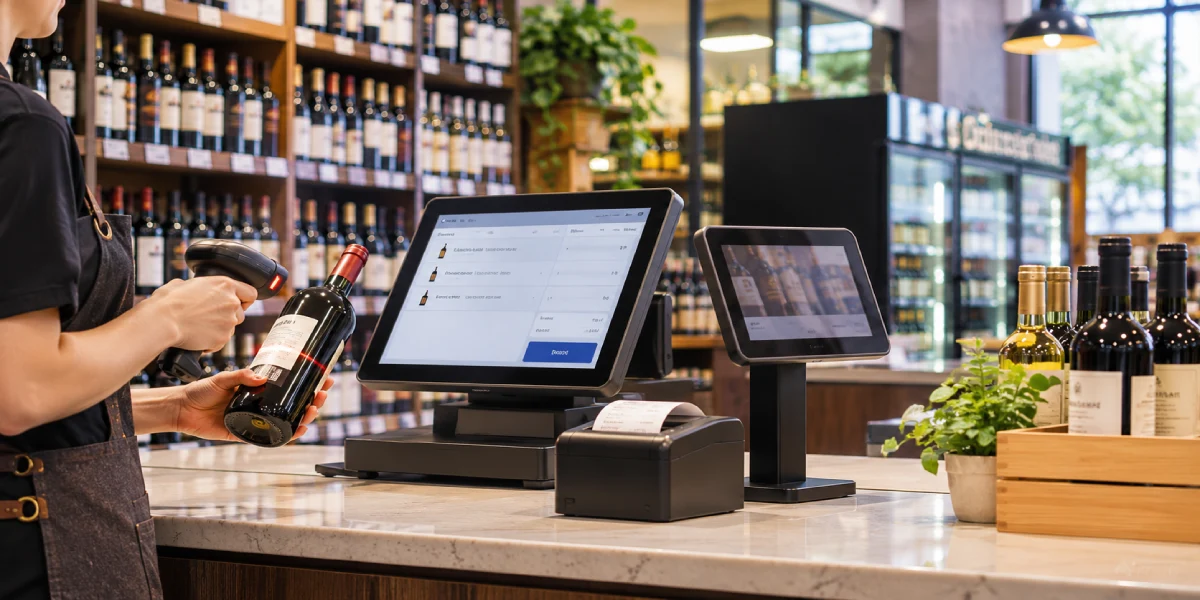
This is not a list where every system is interchangeable. Bottle POS already covers core liquor-store needs, including age verification, purchasing, inventory and dual pricing. Start with our Square POS platform guide if you first need to understand how software, payments and hardware can be sold as one system. For the operational requirements unique to alcohol retail, see our liquor-store POS guide.
| Alternative | Best for | Main advantage | Main point to check |
|---|---|---|---|
| WinePOS | Stores wanting the closest specialist alternative | Unit, pack and case inventory with liquor-specific workflows | External processors incur a gateway fee |
| KORONA POS | Retailers prioritizing processor choice | Processing-agnostic subscriptions and strong inventory tools | Liquor-ready features may require a higher plan or configured workflow |
| mPower Beverage | Multi-store beverage retailers | Guided migration, training and beverage-focused operations | Pricing requires a proposal |
| Lightspeed Retail | Growing retailers with broad catalogs | Multi-location inventory, purchasing and ecommerce | Confirm alcohol-specific workflows during the demo |
| Square for Retail | Small single-location stores | Fast setup, integrated payments and accessible hardware | Less specialized case-break and distributor workflow |
| Shopify POS | Online-first wine and spirits retailers | Strong store-and-ecommerce connection | POS Pro and payment costs add to the base plan |
| FTx POS | Liquor, convenience and mixed age-restricted retail | Detailed age-verification controls and centralized store settings | Request a complete project quote and integration map |
If your top requirement is bottle-to-case inventory, begin with WinePOS, KORONA and mPower. If online sales are central, compare Shopify and Lightspeed. If you need a straightforward counter system for one store, consider Square. If the store combines alcohol, tobacco, convenience items and other restricted products, put FTx on the shortlist.
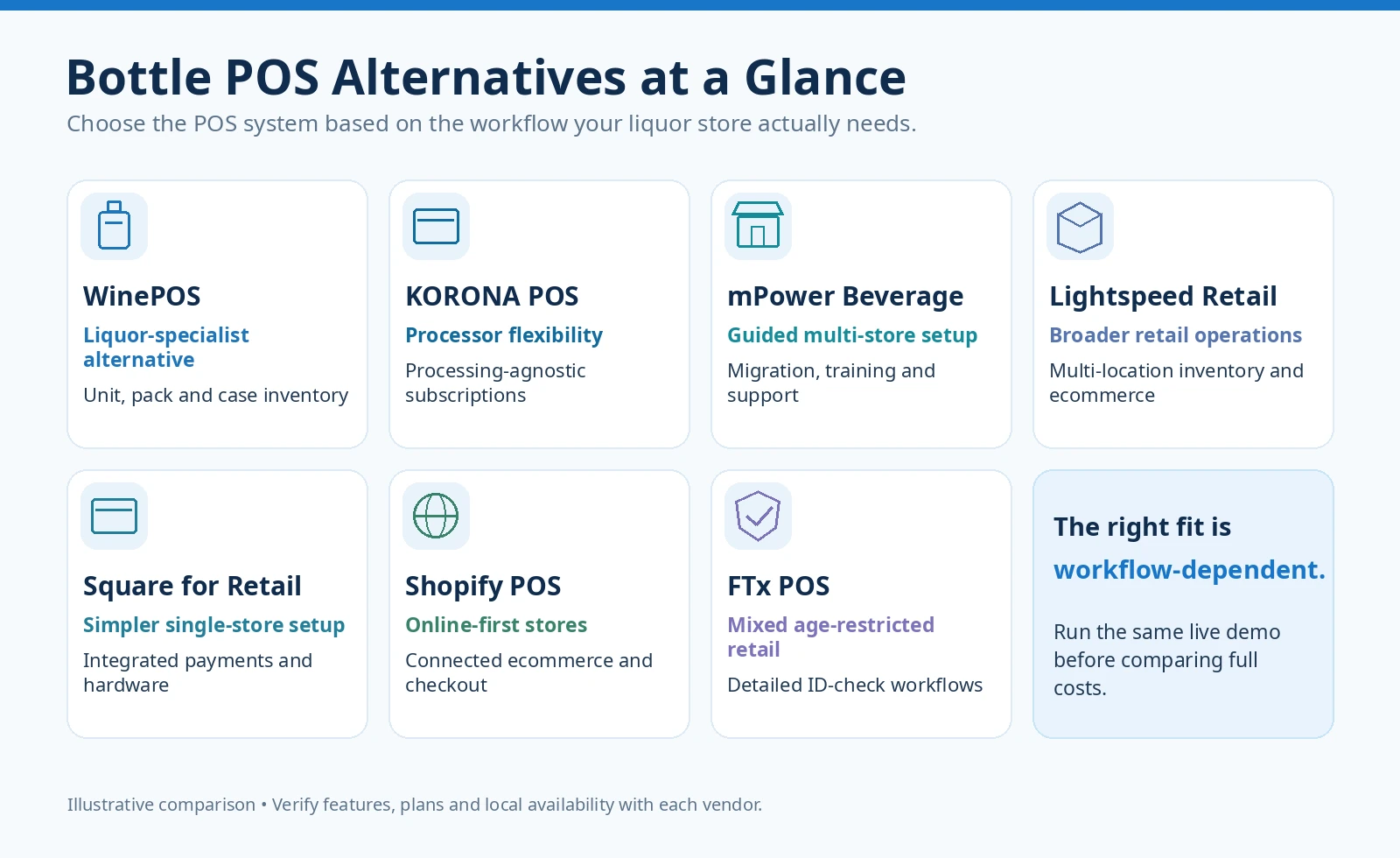
A Bottle POS alternative is a retail system that can sell and track alcohol in the units a store actually buys and sells. It should connect checkout, receiving, age checks, payment records and stock movement instead of treating every bottle as an isolated generic SKU.
The minimum evaluation list is concrete:
Federal recordkeeping is another reason receiving data matters. The U.S. Alcohol and Tobacco Tax and Trade Bureau says retail alcohol dealers must keep records of the quantities received, the supplier and the date of receipt. It also sets additional records for certain large-volume sales. A POS helps organize those records, but state and local rules still determine licensing, hours, delivery and age-control requirements. The TTB retailer guidance is the federal starting point.
Bottle POS remains a credible option rather than a system that every liquor store needs to replace. Its current Starter plan is listed at $59 per month and includes purchase orders, reporting, a mobile back office, age verification and dual pricing. Higher packages add functions such as customer loyalty, mix-and-match discounts, automated invoicing, multi-site transfers and targeted marketing. The official Bottle POS pricing page makes clear that complete pricing depends on the package and store requirements.
That baseline matters because an alternative should solve a defined business problem. A store might want more payment-processor flexibility, a stronger ecommerce platform, different multi-location controls, an existing hardware strategy or a migration path for its own POS software. Changing brands without identifying that reason creates cost without improving operations.
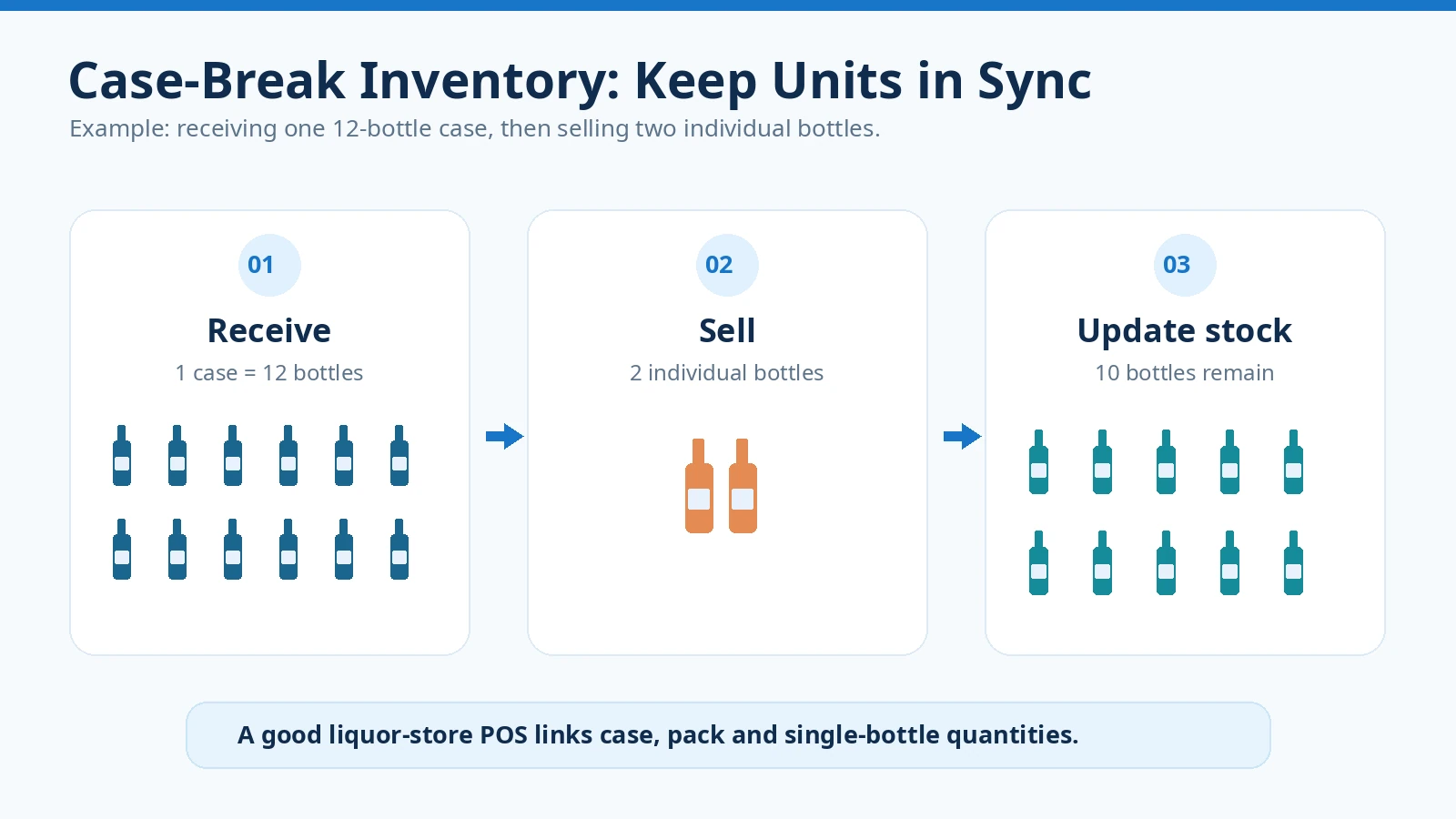
WinePOS is the most direct comparison for a liquor, wine or spirits retailer that wants category-specific software. Its Lite tier includes unit, pack and case management, purchase orders, suggested ordering and age verification. Higher tiers add parent-child item structures, vendor pricing, ecommerce, delivery integrations and multi-site controls.
The public starting price is $79 per month. WinePOS also states that a retailer can bring an external credit-card processor, although a gateway fee applies. That makes processor choice possible, but the store should compare the full processing and gateway cost against the integrated WinePayments route. The WinePOS pricing page provides the current tier structure.
Choose WinePOS when liquor-specific inventory is the priority and the store wants a close functional alternative. During the demo, test the exact case-break rules, vintage or size structure, invoice import and returns workflow used by your distributors.
KORONA POS is a strong option when a retailer does not want the software subscription tied to one mandatory processor. Its subscriptions are processing-agnostic, and the current Core plan starts at $59 per terminal per month. The Retail and Plus tiers add inventory controls and deeper automation.
For liquor retail, the useful functions include real-time stock tracking, barcode automation, shelf and price labels, supplier ordering, promotions and multi-store controls. KORONA also markets a dedicated liquor-store configuration, so it sits between a general retail platform and a beverage specialist.
The main buying decision is plan scope. Checkout and a product database are not enough for a serious liquor operation. Confirm that inventory counts, supplier ordering, case relationships, age verification and the required ecommerce connection are included in the quoted configuration. KORONA's official pricing table currently lists Core at $59, Retail at $79 and Plus at $99 per terminal per month.
mPower Beverage is built specifically for beverage retail and positions implementation as part of the engagement. Its current pricing page does not publish a flat monthly figure. Instead, mPower prepares a proposal based on the number of locations, operational requirements, migration, training and hardware.
This approach fits a retailer that values hands-on transition work over self-service setup. mPower supports single-store and multi-location operations, with beverage-focused inventory, reporting and compliance workflows. It also states that merchants can choose among three vetted processing partners rather than use one forced processor.
Choose mPower when data migration, store configuration and staff onboarding are central to the project. Ask the proposal to separate recurring software, implementation, hardware, payment services and future-location costs so the five-year ownership model is clear.
Lightspeed Retail is not a liquor-only platform. It is a broader retail system with multi-location inventory, purchasing, supplier management, barcode labels, ecommerce and detailed reporting. Its U.S. X-Series pricing currently starts at $89 per month for the Basic plan when paired with Lightspeed Payments; Core and Plus add more capabilities.
Lightspeed makes sense for a wine merchant that also operates a gift assortment, tasting accessories, specialty foods or a substantial online catalog. Its strengths are unified inventory and retail management rather than a narrow alcohol workflow.
The demo must prove the category-specific details. Ask staff to receive a case, sell one bottle, sell the remaining case, apply a mixed-bottle promotion and then reverse one item. Also confirm how age prompts, ID-scanner support, delivery restrictions and local compliance settings are handled. Broad retail capability does not automatically equal liquor-store readiness.
Square for Retail combines POS software, Square payment processing and a range of countertop or mobile hardware. It supports item catalogs, barcode-based item creation, stock alerts, purchase orders on eligible plans, bottle deposits and common retail reporting.
Square is attractive for a new or small liquor store that wants to get a counter running quickly and prefers one provider for software and payments. Its interface and hardware ecosystem reduce the number of vendors the owner must coordinate.
The trade-off is specialization. A store with complex case-break inventory, distributor invoice automation, allocated products or advanced multi-store purchasing should test those workflows before choosing Square. Payment processing is part of the Square ecosystem, so processor freedom is not its main advantage. Our Square card reader guide explains the payment hardware side of that model.
Shopify POS is the strongest candidate in this list for a merchant whose online store drives the technology decision. Every paid Shopify plan includes basic in-person selling, while POS Pro adds advanced staff, inventory, customer, returns and omnichannel features for each selected retail location.
Current U.S. pricing starts at $39 per month for Shopify Basic, with POS Pro listed as an additional $89 per month per location. Payment rates and third-party provider fees depend on the selected plan and region.
Choose Shopify when the same catalog must support online ordering, store pickup, customer profiles and physical checkout. Then verify the alcohol-specific layer: age-gating, delivery-zone controls, carrier rules, local pickup restrictions and bottle-case relationships may require apps, custom work or operating procedures beyond the standard POS subscription.
FTx POS deserves a place that older comparison lists often give to legacy general-retail products. Its current documentation shows detailed controls for age-restricted merchandise, including item-based age prompts, forced driver-license scanning, expired-license handling, manager overrides and customer-facing verification prompts.
Those controls suit stores that sell alcohol alongside tobacco, convenience goods, lottery or other regulated categories. Central configuration is also useful for operators managing multiple locations with consistent checkout rules.
FTx does not publish a simple liquor-store price that supports a fair one-line comparison. Request a quote covering software, hardware, payment processing, support, deployment and required integrations. The most important demo is a live restricted-item transaction followed by a return, shift reconciliation and audit-log review.
The reference list treated POS Nation as a separate liquor-store alternative. POS Nation's current liquor pages now direct retailers to Bottle POS and describe Bottle POS as its package-store solution. Listing the two as independent competitors would therefore misrepresent the present relationship.
NCR Silver also appears in older POS comparison content, but it is not a leading current choice for a new liquor-retail deployment. A modern shortlist should prioritize actively documented products with clear inventory, deployment and support paths. That is why FTx and Shopify are more useful additions to this updated comparison.
POS projects commonly follow three different supply models:
| Supply model | What the merchant buys | Typical fit |
|---|---|---|
| Integrated payment POS | Software, payments and approved hardware from one platform | Merchants wanting fewer vendors and faster setup |
| Uncertified white-label POS | Generic branded hardware or software without a clearly documented payment and certification owner | High-risk projects where responsibility can become unclear |
| Pure-hardware ODM/OEM POS | Commercial POS hardware integrated with the buyer's software and payment partners | ISVs, distributors and multi-market deployment teams |
Square, Shopify and Lightspeed follow the integrated payment POS model most closely in supported markets. WinePOS, KORONA, mPower and FTx combine specialist software with selected hardware and payment options. A pure-hardware ODM/OEM POS route is different: the buyer chooses the application, acquiring relationship and deployment controls, then selects hardware that supports the required peripherals.
This distinction changes the buying question. A merchant comparing subscriptions wants to know which software is easiest to operate. An ISV or distributor may already own the liquor-retail application and need reliable countertop hardware without adopting another vendor's software stack.
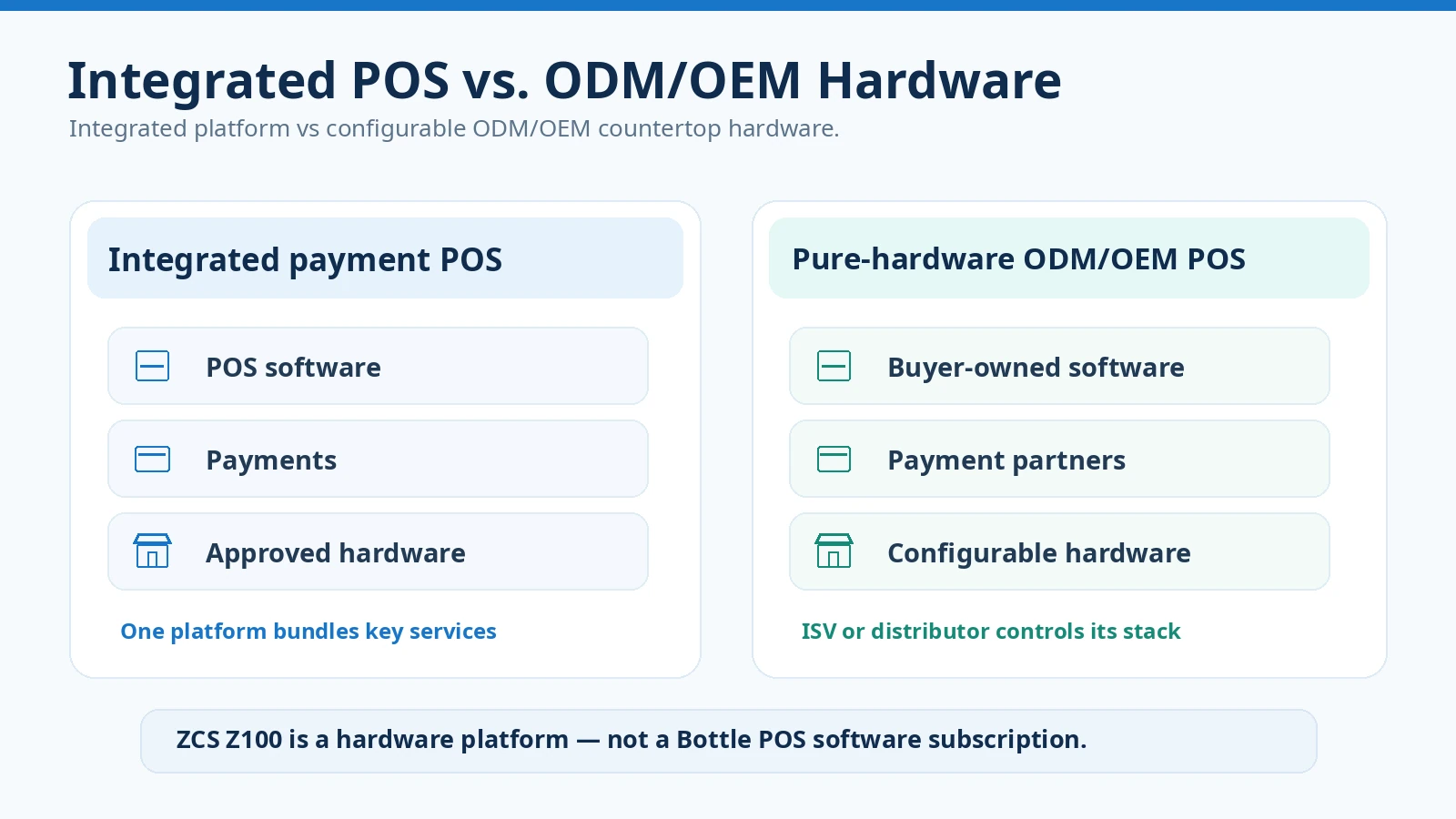
The ZCS Z100 is a pure-hardware ODM/OEM POS for teams deploying their own retail software. It is not a replacement subscription for Bottle POS. It is the counter terminal on which an integrated liquor-retail solution can be built.
The Z100 provides a 10.1-inch capacitive touchscreen and a 3.95-inch or 2.6-inch secondary display. The two displays support same-screen and different-screen presentation, allowing the cashier to operate the sale while the customer sees items, totals, loyalty prompts or payment instructions. Integrated 58mm printing is available, with an optional 80mm printer configuration. Camera scanning handles barcodes and QR codes, while NFC, magnetic-stripe and IC-card interfaces support project-specific identification and payment functions.
Four USB-A ports, USB-C, RJ45, RJ11 and RJ12 connections support the wider counter setup. A software provider can connect a scanner, cash drawer or PIN pad according to the project design. Explore the ZCS Z100 Android POS terminal when your liquor solution needs a configurable countertop platform rather than another bundled software subscription.
For an ISV, the pure-hardware ODM/OEM POS model keeps the software brand, merchant relationship and integration roadmap under its own control. For a chain or distributor, it also supports a consistent hardware design while local software and payment partners manage market-specific requirements.

Receive one case, sell two individual bottles, then sell the remaining case quantity. The parent and child stock figures must stay correct without manual adjustment.
Scan a restricted item, use the normal ID-check process, test an expired ID and review the manager-override record. Confirm what data is stored and who can access it.
Use a real distributor invoice containing new items, changed costs, deposits and mixed units. Measure how much staff correction is required before inventory becomes accurate.
Return one bottle from a mixed promotion and void a transaction before settlement. Check the customer balance, stock quantity, cashier report and payment record.
Close a shift containing cash, card, refunds, discounts and an interrupted payment. The POS sales total, tender report and processor records should explain every difference.
Confirm that products, quantities, suppliers, customers and transaction history can be exported in usable fields. A migration plan is incomplete until the exit path is understood.
This practical test reveals more than a feature checklist. It shows whether staff can operate the system, whether inventory stays trustworthy and whether the supplier can support the store after launch. The same transaction data can later feed AI inventory management, but automation only works when the underlying case, bottle and receiving records are consistent.
WinePOS is the best starting point for retailers seeking the closest specialist alternative to Bottle POS. KORONA is the strongest shortlist candidate when processor choice matters. mPower suits beverage retailers that want guided migration and multi-store support. Lightspeed is better for a broader retail operation, Square for a simpler single-store setup, Shopify for ecommerce-led selling and FTx for mixed age-restricted retail.
Do not choose from a pricing table alone. Run the same case-break, age-check, invoice, return and reconciliation tests in every demo. Then compare the complete cost of software, payments, hardware, migration and support. If you already own the application or are building a branded liquor-retail platform, use the ZCS Z100 pure-hardware ODM/OEM POS route to keep control of the software and deployment model.

WinePOS is the closest direct alternative because it is designed for wine and liquor stores and includes unit, pack and case management, purchase orders, age verification and higher-tier ecommerce and multi-site features.
KORONA POS is processing-agnostic. WinePOS allows an external processor with a gateway fee, and mPower offers three processing partners. Compare the complete processing agreement, not only the software subscription.
Square can work well for a smaller liquor store with straightforward inventory and an integrated payment setup. Stores with complex case-break inventory, automated distributor receiving or advanced multi-location purchasing should test those workflows closely.
Shopify POS is the strongest ecommerce-first option, while Lightspeed also combines physical retail with online inventory. The retailer still needs the age, delivery and licensing controls required in every market served.
No. A POS can enforce prompts, record actions and organize receiving or sales data. The retailer remains responsible for licensing, staff procedures and federal, state and local requirements.
POS Nation's current liquor-store pages promote Bottle POS as its package-store solution. Treating POS Nation and Bottle POS as independent alternatives would create a false comparison.
Yes. ZCS Z100 is a configurable Android countertop POS platform for retail software projects. Its touchscreen, secondary display, printer, scanning functions and peripheral ports support a complete liquor-store counter configuration.
Test case breaking, age verification, supplier invoice receiving, promotions, returns, shift reconciliation, payment interruption and data export. Use the same test script with every vendor.






 Home
 What Are the Best Alternatives to a Traditional Cash Register for a Retail Store?

