
2026-07-16 Author : ZCS
Most palm vein terminals on the market are either lab-grade research hardware or thin white-label repackaging of someone else's sensor module. The Z108P sits in a more practical category: an OEM 8-inch palm vein recognition terminal well suited to installation at access points, attendance stations, and payment counters, with the customization options a system integrator actually needs. This article looks at what the Z108P is built to do, how its recognition process works, how it compares to a lighter handheld alternative, where it typically gets deployed, and what can be customized for a specific rollout.
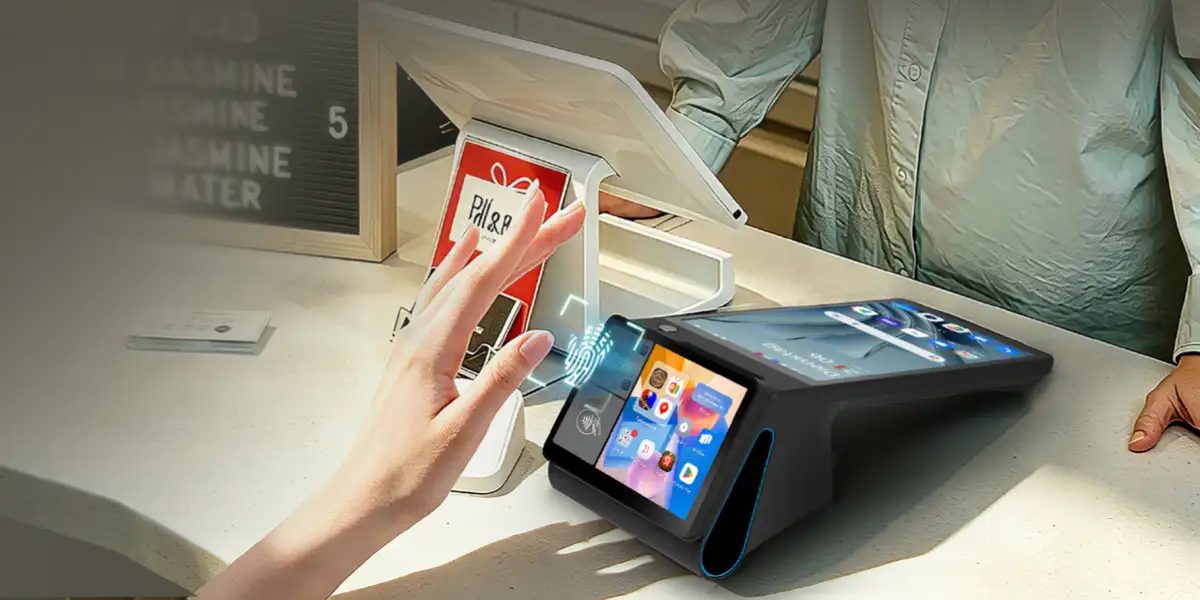
The Z108P is a wall-mount or desktop biometric terminal built around an 8-inch touchscreen and a near-infrared palm vein sensor. Its size and mounting options make it a natural fit for locations where the device stays in one place — a door, a counter, a checkpoint — though nothing about the hardware itself restricts it to fixed installation; it's simply better suited to a stationary role than to being carried around a site. It's positioned as OEM hardware specifically, meaning the interface, functions, and physical branding can be adjusted for a specific deployment rather than shipped as a fixed consumer product.
| Specification | Detail |
|---|---|
| Display | 8-inch touchscreen, 800×1280 |
| Processor | Octa-core, up to 2.0/2.3GHz |
| Memory | 3/4GB RAM + 16/32/64GB ROM (configurable) |
| OS | Android 14.0 Go |
| Battery | 7.6V 3600mAh |
| Recognition speed | Server-side, 1:1,000,000 matching in under 1 second |
| Camera | 5MP / optional barcode scanner |
| Face recognition | Optional, in addition to palm vein |
| Connectivity | 4G (FDD-LTE, TD-LTE), 3G (WCDMA), 2G (GSM/GPRS), WiFi, Bluetooth |
| NFC | ISO/IEC 14443 A&B, Mifare, Felica card |
| Card slots | 1× SIM + 1× PSAM, or 2× SIM (configurable) |
| Printer | 58mm thermal, included with standard accessories |
The underlying process is the same near-infrared imaging approach used across palm vein hardware generally — the sensor captures the vein pattern beneath the skin's surface, converts it into an encrypted template, and matches it against enrolled records rather than storing a raw image. What's specific to the Z108P is where that matching happens: verification runs server-side, and the terminal is rated to complete a 1:1,000,000-scale match in under one second, which matters for facilities enrolling large user populations rather than a handful of employees. Living-body detection runs alongside the matching step, screening out attempts made with a photo, mold, or prosthetic rather than a real hand. For a deeper technical breakdown of how vein imaging and template matching work at the physics level, our guide to how palm vein scanning works covers that process independent of any specific hardware.
Not every deployment weighs the same factors. The Z108P works well as a stationary unit, but its 8-inch display and desktop/wall-mount design also work at a manned counter that occasionally needs to be relocated. ZCS also produces the Z92P palm vein scanner POS, a genuinely lightweight handheld unit purpose-built for constant mobility — field staff, roaming attendants, or checkout counters where the device needs to move throughout a shift rather than occasionally. The table below outlines the practical difference.
| Dimension | Z108P | Z92P |
|---|---|---|
| Form factor | Desktop or wall-mount, relocatable | Lightweight handheld |
| Display | 8-inch | 5.5-inch |
| Best suited for | Counters, checkpoints, semi-fixed stations | Continuous mobility — roaming staff, field verification |
| Printer | 58mm thermal, built in |
Unavailable |
| Battery role | Backup power for a stationary or semi-mobile unit | Primary power source for a full mobile shift |
Neither is a strict replacement for the other. The Z108P's larger screen and OEM customization options make it the better fit where a bigger display or richer interface matters, even in a setup that moves occasionally; the Z92P's smaller footprint makes it the better fit specifically for staff who are moving constantly throughout a shift, where weight and battery efficiency matter more than screen size.
Replacing a card or code with a palm vein credential at a restricted entry point removes the specific vulnerability of a credential that can be lent, lost, or duplicated. The broader security framework this fits into — authentication strength, audit logging, tamper-resistant hardware — extends well beyond the sensor itself; our guide on what actually makes an access control system secure walks through that fuller picture.
For clock-in and clock-out verification, a terminal like the Z108P suits a main entrance or a shared attendance station well, avoiding the credential-sharing problem that badge- and PIN-based attendance systems are structurally exposed to. If a facility has multiple entrances or shift-based stations that occasionally need to be reconfigured, the Z108P's OEM flexibility accommodates that without requiring a different device entirely. If the underlying concept of biometric time tracking needs a plainer definition first, our breakdown of what attendance biometric actually means is a reasonable starting point.
Palm-based payment — linking a vein scan to a stored payment method rather than a card — has already scaled at national level in some markets. In Japan specifically, more than 92% of banks now use vein-pattern recognition at ATMs and teller counters, a level of adoption that took hold after the technology proved it could sharply cut card-related fraud. Retail palm payment builds on the same underlying verification logic, just applied at a checkout counter instead of a bank window.
Linking a vein scan directly to a patient record reduces the misidentification risk that comes with matching by name and date of birth at high patient volumes, and the same accuracy profile is why government checkpoints and financial-sector deployments tend to favor palm vein over lower-accuracy alternatives.

Because the Z108P ships as OEM/ODM hardware, the same base unit can be configured differently depending on the deployment and buyer specifications:

Q1. Does the Z108P print receipts?
Yes — it includes a built-in 58mm thermal printer as a standard accessory, supporting roll diameters up to 50mm.
Q2. Is there a secondary customer-facing display available?
A 3.95-inch secondary display is available as an optional configuration, typically used to show transaction details or promotional content.
Q3. Can the boot logo and device branding be customized?
Yes. Custom boot animation, on-screen branding, and physical device housing labeling are available for OEM orders, generally subject to a minimum order quantity.
Q4. Does the Z108P support NFC payments?
Yes — it includes standard Android NFC support for contactless card reading and mobile wallet payments, compliant with EMV/PBOC PayPass standards.
Q5. How many SIM cards can the Z108P take?
It has two card slots, configurable as either two SIM cards or one SIM plus one PSAM card for transaction security.
Q6. How is palm vein recognition different from fingerprint on a device like this?
Fingerprint sensors read a surface trait that can be affected by dirt, moisture, or worn ridges; the Z108P's palm vein sensor reads a vein pattern beneath the skin instead, which isn't visible or touchable from the outside. For a fuller side-by-side comparison of accuracy and use-case fit across recognition methods, see our guide to palm vein, fingerprint, and face recognition for access control.






 Home
Home  Food Truck Point of Sale Buying Checklist: Specs Your Supplier Must Meet Before You Sign
