2026-06-05 Author : ZCS
Running a restaurant without a point of sale system is a bit like running a kitchen without recipes — possible in theory, increasingly impractical in reality. The average restaurant operates on a net profit margin of around 5%. At that margin, the difference between a good month and a bad one is not usually the food — it is the operational efficiency around the food: how fast orders move to the kitchen, how accurately stock levels are tracked, how well the checkout experience is managed, and how clearly the numbers tell the story at the end of the night.
95% of restaurateurs agree that restaurant technology improves their business efficiency. 52% of restaurants are actively planning to invest in POS systems in 2025, and 83% of US restaurants have already adopted cloud-based POS systems. Those numbers reflect a shift in how restaurant operators think about point of sale technology — not as a checkout tool, but as the operational infrastructure their business runs on. For a full breakdown of what the best systems offer, see Best POS Systems for Restaurants in 2026 to evaluate your options.
This article explains what a restaurant POS system actually does, why it matters across every part of a food service operation, and what a restaurant genuinely risks by running without one or by running on a system that was not built for the specific demands of food service.
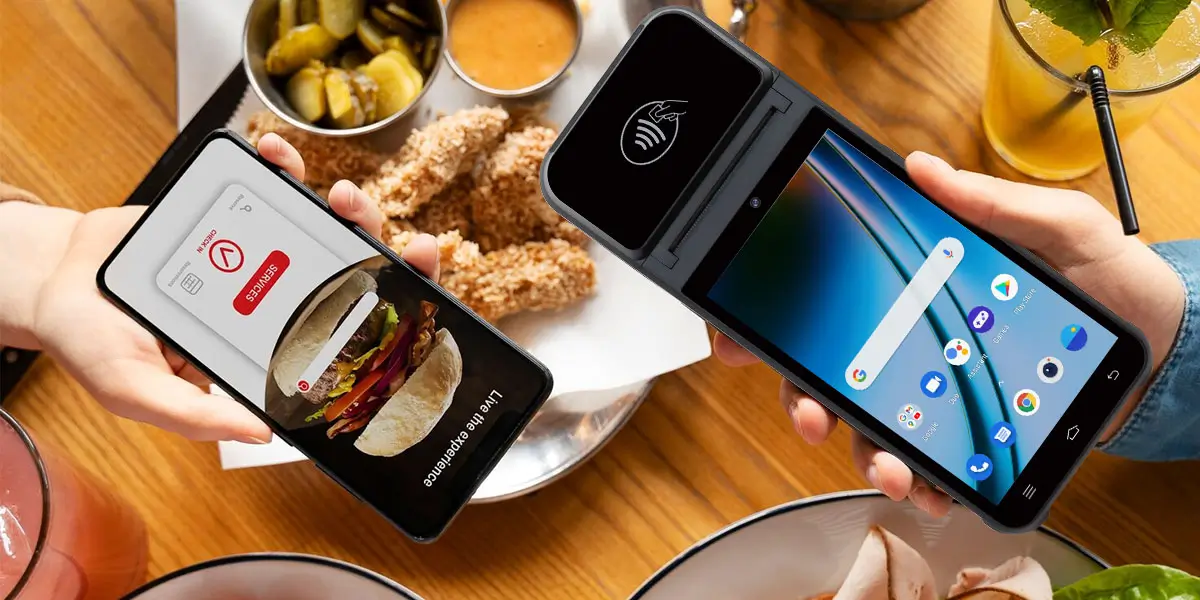
A point of sale system for restaurants is the platform that manages the complete transaction cycle — from the moment an order is placed to the moment payment is settled and the data feeds back into the business. In a restaurant context, that cycle is considerably more complex than a retail transaction.
At the front of house, a restaurant POS handles order entry, table assignment, course sequencing, modifier management ("no onion, extra sauce"), and real-time communication to the kitchen. It tracks which tables are occupied, how long each has been seated, and which server owns which section. At the point of payment, it calculates the bill, handles split payments, processes tips, and accepts cards, mobile wallets, or cash through the same interface.
At the back of house, the same system is updating inventory levels with every item sold, generating sales reports by menu category and time period, logging employee clock-in and clock-out times, and feeding data into any connected accounting or procurement software.
What distinguishes a restaurant POS from a generic payment terminal is precisely this integration across the full service cycle. A payment terminal processes a card and produces a receipt. A restaurant point of sale system manages the order before the card is presented, communicates that order to the kitchen, tracks it through preparation, and generates the data that allows the restaurant to understand and improve its own operations.
One café using an integrated restaurant POS reduced average order-taking time from 20 minutes per table to 3 minutes — a result that demonstrates how much of the friction in a typical service workflow is created by manual processes that POS software eliminates.
The front of house is where guests form their impression of the restaurant, and the POS system is at the center of the interactions that shape that impression — order accuracy, checkout speed, and payment experience.
Order accuracy. When servers enter orders directly into a handheld POS terminal at the table, the order transmits instantly to the kitchen — no handwritten ticket, no verbal relay, no re-entry error at a fixed terminal. The modifier logic is enforced by the system: a server cannot accidentally forget to flag an allergen or miss a special request because the POS prompts for it at the point of entry. Fewer errors mean fewer remakes, fewer comps, and a kitchen that can run at capacity rather than being partially occupied by correcting mistakes.
Speed of service. 71% of restaurant operators use POS data to optimize menus, streamline payments, and boost digital engagement. Restaurants using mobile ordering and payment systems see a 9% boost in average check size — a direct result of the system surfacing upsell prompts and making the ordering process fluid enough that servers spend less time on transaction mechanics and more time on guest interaction.
Tableside payment. Guests increasingly expect to pay at the table rather than waiting for a server to retrieve and process their card at a fixed terminal. A handheld POS terminal handles the complete payment cycle tableside — presenting the bill, processing contactless payment, handling tip selection, and printing or sending a digital receipt. The checkout interaction is faster, the guest's card never leaves their sight, and the table turns faster. For restaurants considering the next step, customer-facing POS terminals are emerging as the defining hardware upgrade for quick-service and full-service environments alike.
Self-ordering and kiosk integration. 30% of restaurants are planning to invest in self-order and self-pay technologies in 2025. A national burger chain reported a 25% increase in sales after implementing kiosks integrated with their POS system, attributing the lift to upselling features that consistently surface add-ons that servers might not always suggest during a busy service.Dual-screen POS technology follows the same logic — learn exactly how it can improve customer experience and sales in both restaurant and retail environments.
The operational value of a restaurant POS system is not limited to the dining room. The data generated at the front of house drives back-of-house efficiency across inventory, food cost, and financial management.
Inventory control and food cost reduction. Every item sold through the POS system should decrement the corresponding ingredients from the inventory database. When a portion of salmon is rung up, the weight of salmon committed to that portion is deducted from stock. Over a service, this produces a real-time picture of what is being used versus what is being wasted — a variance that, when untracked, quietly erodes margin. POS-integrated inventory management systems can reduce food costs by 3–5%, according to National Restaurant Association data, by removing the guesswork from ordering and reducing over-purchasing that leads to spoilage.
Menu optimization. 71% of restaurant operators use data from their POS to optimize menus. Sales velocity by dish, margin contribution by category, and time-of-day performance by menu item are the reports that answer the questions restaurant operators make decisions on: which dishes to keep, which to rework, which to drop, and how to price the menu to maximize contribution margin rather than just revenue.
Labor management. A POS system with clock-in and clock-out functionality produces accurate labor cost data segmented by shift, day, and employee. When matched against sales data for the same periods, it gives operators the information to make staffing decisions based on actual revenue patterns rather than intuition. Knowing that Tuesday lunch historically generates 40% less revenue than Saturday lunch — and staffing accordingly — is a direct cost reduction that compounds across every week of operation.
Financial reporting and accounting integration. 57% of restaurant operators plan to invest in back-of-house technology in 2025, with accounting and payroll cited among the most important integrations to their POS. A restaurant POS that connects to accounting software eliminates the manual data transfer that turns end-of-week financials into a multi-hour reconciliation exercise. Daily sales, payment method breakdowns, tax collected, voids, and comps are all available from the POS without manual entry.
The restaurant industry no longer divides neatly into dine-in and takeaway. A restaurant in 2026 may receive orders from its own website, from two or three delivery platforms, from a QR code at the table, and from a walk-up counter — sometimes simultaneously. Managing those channels without a POS system that integrates them creates the kind of operational fragmentation that generates errors, delays, and a kitchen that cannot manage its own queue.
An integrated restaurant point of sale system consolidates inbound orders from all channels — dine-in entered by servers, delivery platform orders received directly into the system, online pre-orders — into a single kitchen output. The kitchen sees one queue, regardless of where the order originated. Staff do not need to monitor a separate tablet per delivery platform. And the POS data captures the full picture of what the restaurant sold, across all channels, without manual reconciliation.
Online ordering integration typically provides the highest immediate revenue impact for restaurants that add it, with many operators reporting 20–35% sales increases within the first month. The revenue lift reflects not just additional orders but the reduction in friction that causes potential customers to abandon the ordering process on a slow or poorly integrated system.
The POS system is the technical hub that makes multi-channel operation manageable. Without it, each additional channel adds a proportional amount of operational complexity. With it, additional channels add revenue without proportionally adding overhead.
A restaurant's most profitable customers are the ones who come back. The cost of acquiring a new customer is significantly higher than the cost of retaining an existing one, and loyalty programs integrated into the point of sale system are the most direct mechanism for improving return visit rates.
POS-integrated loyalty programs increase customer lifetime value by 200–400% when fully utilized. The mechanics are straightforward: points accumulate automatically with every purchase without requiring staff to manually log anything; rewards are applied at checkout through the POS interface without a separate app or physical card; and the data collected on customer ordering patterns enables targeted offers — a discount on a guest's most frequently ordered dish, a birthday promotion, a notification when a new menu item matches their preferences.
The data advantage is the key differentiator. A loyalty program that runs on paper punch cards tracks visits but nothing else. A POS-integrated loyalty system tracks what each customer orders, at what time, at what frequency, and at what spend level — and makes that data actionable through automated marketing triggers that no manual system can replicate at scale.
The cost of not having a purpose-built restaurant POS system is distributed across every part of the operation in ways that are individually small and collectively significant.
Order errors accumulate. Manual order-taking and re-entry introduces errors that generate remakes, comps, and guest dissatisfaction. Each remake is a food cost event and a kitchen capacity event during the minutes when throughput is most constrained. At scale, an error rate of even 2–3% across hundreds of daily orders produces a material drag on both food cost and kitchen efficiency.
Inventory is managed by guesswork. Without real-time inventory tracking connected to sales, stock levels are estimated — often by visual inspection. Over-ordering leads to spoilage; under-ordering leads to 86ing menu items mid-service. Both outcomes cost money directly, and under-ordering also costs guest satisfaction.
Financial data is manually assembled. Without a POS generating sales reports, operators piece together financial performance from cash counts, card terminal reports, and mental arithmetic. The data is always historical, often incomplete, and rarely granular enough to make informed decisions about menu pricing, staffing, or purchasing.
The wrong POS creates its own problems. A generic retail POS used in a restaurant environment lacks table management, kitchen integration, course sequencing, and tip handling — the operator workarounds around these gaps accumulate into exactly the manual overhead the system was supposed to eliminate. The top features restaurateurs look for when upgrading their POS are ease of use, depth of reporting, and inventory reporting — which reflects how often operators have experienced a system that failed to deliver on at least one of these.If you're at that stage, our choosing the best restaurant POS system guide walks through the five most important decisions before you commit.
The restaurant industry is projected to reach $1.5 trillion in global sales in 2025. The operators capturing disproportionate share of that are the ones running on infrastructure that makes their operation faster, more accurate, and more data-driven than the competition. A point of sale system for restaurants is not the only component of that infrastructure — but it is the one that everything else connects to.

Q1: Why can't I just use a standard retail POS system for my restaurant?
A: The transactional logic of retail and hospitality are fundamentally different. Retail is a linear, static "scan-and-pay" environment. Restaurants manage a highly dynamic, time-distributed lifecycle.
Generic retail systems completely lack core hospitality features such as live table layout mapping, Kitchen Display System (KDS) routing, course sequencing (e.g., holding entrees until appetizers are cleared), and complex bill-splitting or tipping workflows. Forcing a retail setup onto a food service business creates endless manual workarounds for staff, which inevitably leads to high error rates, slow service, and lost margins.
Q2: Can implementing a dedicated restaurant POS system actually lower my food costs?
A: Yes, significantly. According to data from the National Restaurant Association, a restaurant POS system with integrated inventory controls can reduce total food costs by 3% to 5%.
It achieves this through a process called real-time ingredient depletion. When a server rings up a salmon entree at the front of house, the system automatically subtracts the exact raw weight of that protein from your central inventory database. By cross-referencing actual sales against your stock levels, the system instantly exposes variance—the costly gap representing kitchen waste, over-portioning, or theft—without requiring labor-intensive manual stock takes.
Q3: How does a modern POS system eliminate front-of-house chaos caused by third-party delivery apps?
A: Running a restaurant without an integrated hub requires counter staff to constantly monitor four or five different delivery tablets, manually re-typing those orders into the main register. This creates a massive operational bottleneck and introduces a high risk of manual entry errors.
An integrated best restaurant point of sale system acts as a centralized multi-channel gateway. It ingests inbound orders from your website, mobile apps, tableside QR codes, and major third-party delivery platforms simultaneously, instantly formatting and sorting them into a single, chronological kitchen queue. Furthermore, if you need to "86" an item (mark it out of stock), doing it once on the central POS dashboard instantly updates all customer-facing digital channels at once.
Q4: What real financial impact do mobile handheld POS terminals have on check sizes and table turnover?
A: Deploying mobile handheld hardware does far more than just modernize your dining room—it yields a direct financial return. Establishments leveraging mobile tableside ordering see an average 9% increase in check sizes.
This revenue lift is fueled by two primary factors:
● Automated Prompts: The intuitive software interface automatically reminds servers to offer premium modifiers, drink upsells, or sides at the point of entry—prompts that busy human staff frequently overlook during a rush.
● Frictionless Payments: Because secure contactless payments are processed directly at the table, guests tip and settle their bills instantly. This eliminates the traditional multi-step delay of dropping a check, returning with a card, and running back to a fixed terminal, significantly boosting your table turnover rates.
Q5: What hidden costs should I watch out for when calculating the Total Cost of Ownership (TCO) of a restaurant POS?
A: Evaluating a system strictly by the upfront hardware sticker price is a classic buying trap. To protect your margins over a 3-year deployment, you must look closely at three often-hidden cost variables:
● Payment Processing Lock-ins: "Free" or deeply discounted hardware bundles often force you into high, rigid flat-rate credit card processing fees (e.g., 2.6%). Over time, this costs vastly more than investing in an open hardware platform that allows you to negotiate a competitive interchange-plus processing rate.
● Software Feature Walls: Lower-tier monthly SaaS subscriptions look attractive but frequently gate essential modules—like multi-location management, ingredient-level inventory tracking, or CRM marketing engines—behind much more expensive premium tiers.
● Maintenance SLAs: Kitchens are physically hostile environments prone to spills and drops. Verify whether hardware failures require you to mail a unit back for a two-week repair cycle, or if the manufacturer guarantees a 24-hour hot-swap replacement service to keep your floor running.






 Home
Home  What Is POS Security? The Complete Guide for Businesses
