2026-10-21 Author : ZCS
Tencent palm pay answers “where does the money come from?” with a linked Visa card, not a balance stored in the palm. The broader palm biometrics identity guide explains the identity layer that sits beneath this payment use case.
The payment category becomes clearer when identity, credentials and funds are treated as separate layers.
Tencent Palm Pay is a card-linked biometric payment service in Singapore. Tencent palm recognition supplies the identity credential, a Visa payment token represents the enrolled card, and the existing Visa acceptance network carries the payment request to the issuer for authorization and funding.
That separation explains why a hand wave can replace presenting a card without turning the hand into a bank account.
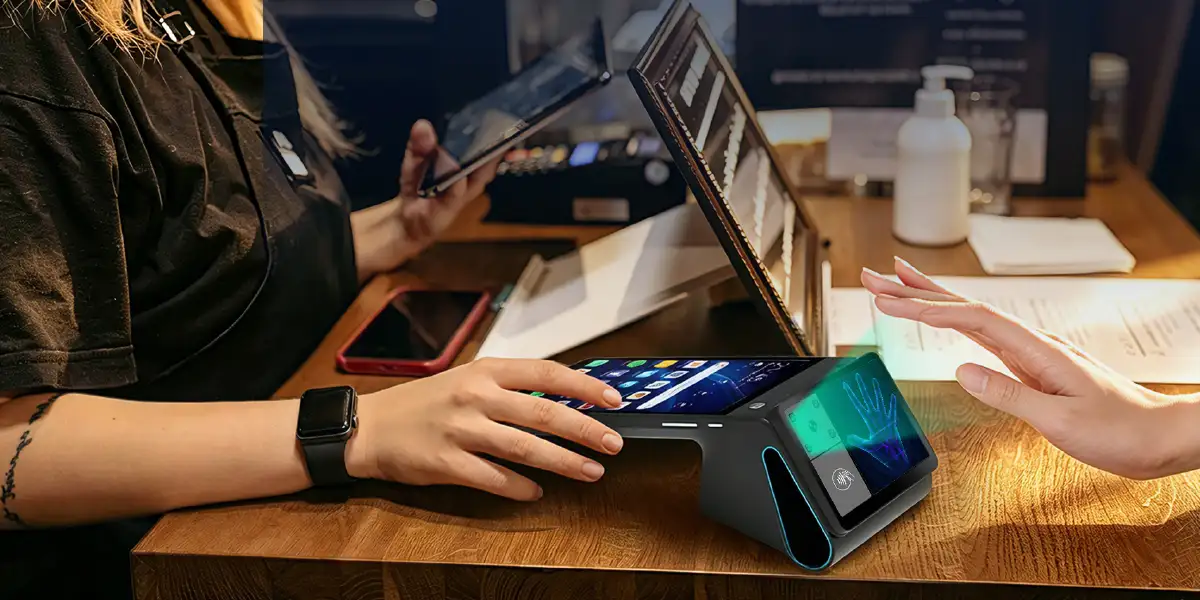
Tencent palm pay in Singapore is a palm-authenticated way to use an enrolled Visa card at participating merchants. Tencent and Visa announced the Singapore pilot on November 6, 2024. Eligible pilot users included Visa cardholders from participating banks such as DBS, OCBC and UOB, and the initial merchant example was Alchemist café.
Tencent described the launch as the first international-market rollout of its palm recognition technology for digital payments. Participants at the 2024 Singapore FinTech Festival could test the service at the Tencent and Visa booths, but an event demonstration and a limited pilot do not mean every Visa merchant in Singapore accepts palm payment.
The original Tencent and Visa pilot announcement establishes the date, participating-bank examples and enrollment sequence. Those facts should remain tied to November 2024 rather than being redated from later PalmAI marketing pages.
Tencent reported a wider operational footprint one year later. The November 17, 2025 Singapore FinTech Festival update said Tencent Palm was operating at high-frequency locations including Resorts World Sentosa’s Adventure Cove and Singapore Institute of Technology campuses through CATES. The update demonstrates movement beyond one café, but Tencent did not publish a complete merchant list, card-eligibility matrix or transaction volume.
Tencent palm pay enrollment creates two records that must remain logically distinct: a biometric identity reference and a tokenized payment credential. Tencent’s 2024 description gives a three-part user flow at the merchant point of sale:
The biometric side does more than photograph the visible lines of a hand. Tencent says its two-step recognition checks both palm prints and vein patterns beneath the skin, and the company says enrollment data is encrypted for storage in an irreversible form. The optical and matching stages are explained separately in the palm vein scanning process; that article describes the biometric mechanism, not the complete Visa payment service.
The enrollment tap does not mean the plastic card number must become the permanent palm identifier. Tencent states that a Visa payment token is bound to the palm biometric template. Visa defines a payment token as a digital identifier that substitutes for the primary account number, allowing payment processing without exposing the actual card number throughout the merchant environment.
The public description supports a relationship between the biometric template and a Visa token, not direct storage of a bank balance or raw card number in a hand scan. A useful conceptual model is:
| Layer | What the system needs | What it does not mean |
|---|---|---|
| Biometric identity | Palm-print and palm-vein template | The palm holds money |
| Account binding | Association between the matched user and a Visa token | The biometric template is a card number |
| Payment credential | Visa token representing an eligible enrolled card | Every Visa card is automatically eligible |
| Funding | Issuer-approved debit account or credit line behind the card | Tencent becomes the card issuer |
Tencent has not publicly documented the pilot’s complete token-requestor role allocation, cryptogram format or merchant/acquirer message flow. Those implementation details should not be invented from the enrollment summary.
A Tencent palm pay transaction starts with identity matching and ends with an ordinary payment authorization decision. The palm reader captures a fresh sample, Tencent Palm compares it with an enrolled biometric template, and a successful result identifies the payment relationship associated with that user.
The matching result is therefore a permission signal, not settlement. A failed match should stop the palm route or send the customer to another payment method. A successful match allows the merchant payment system to continue with the bound credential, subject to transaction rules, issuer controls and network processing.
The authorization boundary can be stated precisely without claiming access to Tencent’s proprietary transaction diagram.
Tencent palm pay does not debit a biometric template. A successful palm match retrieves the relationship to an enrolled Visa payment token; the merchant submits a payment request, Visa routes the tokenized credential, and the issuing bank approves or declines the underlying debit card account or credit line.
The practical answer is simple: the charge lands on the Visa card enrolled during setup, with the exact source determined by whether that card is debit, credit or another eligible Visa product.
Visa’s token provisioning overview explains the general network model: a token request is associated with a card account, the issuer may approve or require step-up verification, and lifecycle controls can suspend or delete the token. The Tencent release confirms token binding, while the Visa documentation supplies the general tokenization framework; neither source publishes every pilot-specific authorization field.
Tencent palm recognition replaces the act of presenting a card or phone, not the institutions that move and authorize card payments. The merchant still needs a supported acceptance path, an acquirer or processor, Visa network connectivity and issuer authorization. Refunds, disputes, card expiration, token suspension and account controls also remain payment-system functions rather than biometric functions.
This distinction separates Tencent Palm Pay from a closed stored-value system. A closed system could maintain its own balance and ledger. The Singapore pilot instead uses a Visa payment token, which preserves the underlying card relationship while reducing exposure of the primary account number.
The main difference is the account relationship established during enrollment. Tencent’s China deployments grew inside the Weixin Pay ecosystem, where palm recognition can identify a user whose payment account already exists within the wallet. The Singapore pilot links the palm directly to a token representing an eligible Visa card, so users do not need a Weixin Pay wallet merely to provide the funding credential described in the pilot.
| Deployment question | China wallet-linked model | Singapore Visa card-linked model |
|---|---|---|
| Account anchor | Weixin Pay user and payment account | Eligible Visa card and payment token |
| Enrollment prerequisite | Wallet account, wallet consent and supported merchant flow | Participating Visa card, card tap, palm scan and one-time authentication |
| Funding selection | Wallet rules and the user’s configured payment sources | Debit account or credit line behind the enrolled Visa card |
| Merchant integration | Weixin Pay acceptance plus Tencent Palm integration | Visa acceptance, token support and Tencent Palm integration |
| Main ecosystem dependency | Wallet identity and wallet payment rails | Issuer participation, Visa tokenization and acquiring path |
| User fallback | QR, wallet or other accepted tenders | Physical card, phone wallet or other accepted tenders |
The China architecture can reduce enrollment friction where users, merchants and payment accounts already operate inside Weixin Pay. The same wallet dependency becomes a barrier in markets where consumers use local bank cards but do not maintain a Weixin Pay account.
The Singapore architecture trades wallet dependence for card-network coordination. Visa card linking broadens the potential funding base, but the deployment must coordinate eligible issuers, token provisioning, merchant acceptance, authentication, token lifecycle management and local biometric-data handling. A Visa logo at the till does not prove that a merchant has installed the palm reader or joined the program.
Amazon One provides a useful comparison because it also linked a palm identity to an enrolled payment method. The Amazon One payment history shows why a working biometric and a working card rail still do not guarantee consumer adoption, service continuity or merchant coverage.
Tencent’s 2025 update confirmed additional locations and newer hardware, not the start date of the Singapore pilot. The company displayed its O4 recognition module and PCI-certified PalmDa POS terminal at Singapore FinTech Festival 2025. Tencent also named Adventure Cove and Singapore Institute of Technology campuses as operating locations.
The dated Tencent SFF 2025 update supports those later developments. It does not replace the November 6, 2024 launch record.
| Public record | What it establishes | What it does not establish |
|---|---|---|
| November 6, 2024 Tencent announcement | Visa partnership, Singapore pilot, enrollment steps, participating-bank examples and Alchemist café | Nationwide acceptance or full commercial scale |
| November 17, 2025 Tencent SFF update | O4 and PalmDa demonstration plus named operating locations at Adventure Cove and SIT campuses | Complete coverage, transaction volume or every supported card |
| May 30, 2026 PalmAI article | A later Tencent product-team retrospective on the Singapore deployment | A new 2026 pilot date |
Publication dates matter because vendor case studies often describe an earlier launch in present-tense product language. The underlying event remains the 2024 Tencent–Visa announcement unless a source identifies a different milestone. The full Tencent SFF 2025 update supplies the later location and hardware details.
Tencent palm pay requires coordinated biometric, payment and operational systems rather than a standalone scanner. A production deployment needs enrollment hardware, matching services, a secure template store, POS integration, token provisioning, issuer authentication, acquiring connectivity, consent records, fallback payment methods and support for account or token changes.
The deployment boundary is therefore wider than the checkout lane.
A Singapore palm-payment deployment requires biometric enrollment, local template governance, Visa token provisioning, issuer identity verification, merchant acquiring integration and card-payment fallback. A China wallet-linked deployment instead depends on Weixin Pay account enrollment and wallet acceptance. The biometric sensor alone satisfies neither payment architecture.
That checklist prevents a common procurement mistake: buying palm-recognition hardware before confirming who owns each payment and data-processing responsibility.
Merchants need both Tencent Palm integration and an approved Visa payment path. The checkout application must receive a valid match result, associate it with the correct transaction and submit the supported tokenized credential through the processor. The merchant also needs clear fallback steps for unenrolled users, poor scans, network interruptions and issuer declines.
Receipt, refund and customer-service workflows must identify the transaction without exposing biometric data. Staff need a supported way to resolve payment questions without searching palm templates or treating a biometric match as proof that an issuer approved the charge.
Issuers need eligibility rules and a cardholder-verification path for token enrollment. Visa’s general token service supports issuer approval, decline or step-up authentication during provisioning, along with later token lifecycle actions. The Singapore pilot’s reference to one-time authentication fits that general control point, but Tencent has not published which verification method each participating bank used.
Card replacement and expiry also need lifecycle handling. A strong design updates or re-provisions the payment credential without forcing the biometric system to treat the same person as a new identity, while a user-requested exit must break the association and address retained biometric data under the applicable policy.
Biometric deployment requires a separate privacy assessment because payment tokenization does not protect every copy of biometric data. Tencent said its Singapore subsidiary, Tencent SenseTech, would provide technical services and comply with data-localization requirements. Tencent also said stored user data would be encrypted in an irreversible manner, but those company statements are not an independent security audit.
Singapore’s PDPC biometric data guide provides a structured way to assess purpose, collection, disclosure, protection and retention. Merchants still need documented answers about consent, template location, access controls, deletion, breach handling and the consequences of withdrawing from the service.
Tencent Palm Pay, Amazon One and Fujitsu PalmSecure solve different parts of the biometric stack. Tencent’s Singapore deployment joins dual-modal palm recognition to Visa tokenization. Amazon One operated a complete palm identity and payment service within Amazon’s retail ecosystem. PalmSecure is primarily a sensor and authentication technology that integrators can place inside a larger system.
| System | Biometric role | Payment relationship | Deployment implication |
|---|---|---|---|
| Tencent Palm Pay in Singapore | Palm print plus palm vein matching | Visa token bound to an eligible card | Requires Tencent, Visa, issuer, acquirer and merchant coordination |
| Amazon One retail service | Palm signature for identification and payment | Enrolled payment method within Amazon One | Service continuity depended on Amazon’s consumer and merchant ecosystem |
| Fujitsu PalmSecure | Palm-vein capture and matching technology | No universal payment rail included | Integrator must supply account linking, payment processing and merchant software |
PalmSecure therefore should not be treated as a drop-in alternative to the full Singapore service. The Fujitsu PalmSecure overview explains the sensor and integration boundary; Tencent Palm Pay adds the account-binding and Visa-network layers that a biometric component alone does not provide.
The Singapore case proves that Tencent can connect palm recognition to a global card-network token in a live merchant setting. The 2024 and 2025 sources establish enrollment, named partners, a first merchant and later operating locations. That is stronger evidence than a laboratory demonstration.
The Singapore case does not prove universal availability, lower fraud or faster checkout across all merchants. Tencent’s public releases do not provide transaction counts, independent false-acceptance testing, issuer-by-issuer eligibility, abandonment rates or a controlled comparison with contactless cards. Those missing measures matter before a buyer treats the pilot as a mature replacement for established tender types.
The most defensible conclusion is architectural. Tencent Palm Pay separates the biometric identifier from the payment credential and lets Visa tokenization connect that identity event to an existing card account. The approach reduces dependence on a China-specific wallet abroad, but it adds coordination across biometric operations, issuers, token services, acquirers and merchants.
Palm payment is more likely to expand through controlled deployments than become a universal checkout method overnight. Campuses, resorts, workplaces, transport environments and membership-based retail can establish enrollment points, repeat-use patterns and clear fallback procedures before opening the model to a wider merchant population.
The next stage will test operations as much as recognition accuracy. A scalable service must manage consent, duplicate enrollments, card replacement, token suspension, biometric-template deletion, device monitoring and customer support across many locations. It must also preserve card, phone, QR or staffed alternatives for people who cannot or do not want to use palm recognition.
Payment-network integration will remain a separate workstream. A capable palm reader can verify identity, but it does not automatically supply issuer participation, token provisioning, acquiring acceptance or approval for a particular card program. Future deployments will therefore favor modular architectures in which the biometric layer, merchant application and regulated payment path can be tested and changed without treating them as one inseparable system.
That direction creates a practical role for configurable palm-vein hardware. The ZCS palm vein terminal portfolio includes the fixed Z108P and handheld Z90NP for different integration environments. The Z108P combines an 8-inch Android terminal with 1:1 and 1:N server-side palm-vein matching for fixed counters, enrollment points and identity-verification stations. The Z90NP combines palm-vein and palm-print capture with a portable Android POS, card acceptance and a built-in receipt printer for mobile or cashier workflows.
| Future deployment need | ZCS hardware starting point | Integration still required |
|---|---|---|
| Fixed enrollment or identity station | Z108P fixed palm-vein terminal | Enrollment application, consent records, template governance and backend matching |
| Mobile or cashier-side biometric payment | Z90NP handheld palm-vein payment POS | Payment application, acquirer approval, token or account binding and customer fallback |
| Multi-location operation | Android devices with remote-management options | Monitoring policy, software updates, incident response and local support |
| Branded or sector-specific workflow | OEM/ODM hardware and interface configuration | Scheme rules, privacy assessment, user testing and production certification |
These ZCS products are not presented as components of the Tencent–Visa Singapore pilot. They are hardware options for system integrators building separate palm-vein identity or payment projects. Any live deployment must verify the required payment certifications, processor compatibility, biometric performance, privacy obligations and local approvals for its exact configuration.
The broader opportunity is therefore not simply to copy one branded pilot. It is to build an architecture in which palm recognition provides a fast identity signal, the payment credential remains governed by the relevant wallet or card network, and merchants retain operational control over enrollment, exceptions and fallback. Hardware such as the Z108P or Z90NP can support that architecture, but commercial success will still depend on trust, integration and repeatable user value.

Tencent palm pay charges the Visa card enrolled during setup. A debit card draws from its linked deposit account under issuer rules, while a credit card uses the associated credit line. The palm supplies identity authentication; it does not contain money.
Tencent’s 2024 Singapore pilot description uses a participating Visa card and Visa payment token, not a required Weixin Pay wallet. Specific merchant and issuer eligibility still applies.
The user taps an eligible Visa card, scans a palm and completes one-time authentication at the merchant point of sale. Tencent then binds a Visa payment token to the palm biometric template for later use at participating merchants.
The public design says a Visa payment token is bound to the biometric template, not that the primary account number is stored as the biometric identifier. Exact storage and system boundaries should be confirmed in the deployment documentation.
No public source establishes universal Visa-merchant acceptance. A merchant needs the Tencent Palm equipment and integration, supported tokenized payment processing and participation in the relevant program.
Tencent announced the Visa partnership and Singapore pilot on November 6, 2024. The November 2025 update documented later locations and hardware, while a 2026 PalmAI article was a retrospective publication rather than the original launch date.
Tencent palm pay is a complete payment application that uses palm recognition. Palm vein recognition is one biometric component; payment also requires enrollment, account binding, tokenization, merchant processing and issuer authorization.






 Home
 What POS Teams Should Restrict When Connecting AI Assistants to Payment Workflows?

