
2026-06-24 Author : ZCS
The POS conversation for food trucks tends to start and end with software: which platform has the best inventory tracking, which charges the lowest transaction fee, which integrates with delivery apps. These are legitimate questions. They are also the wrong first questions.
Before any software decision, a food truck operator faces a hardware constraint that indoor restaurant owners never encounter: the terminal has to work outside — in direct sun, in rain, on a moving vehicle, far from a reliable Wi-Fi signal, and for as long as the truck is open without access to a wall socket. No software solves a screen that washes out in sunlight, a battery that dies at 3 PM, or a payment flow that fails when the cellular signal drops.
This guide focuses on the hardware layer of food truck point of sale systems. What the AI-generated overviews of this category cover less thoroughly is the hardware specification behind the leading solutions, and what to look for when evaluating any terminal for the specific physical demands of mobile food service.
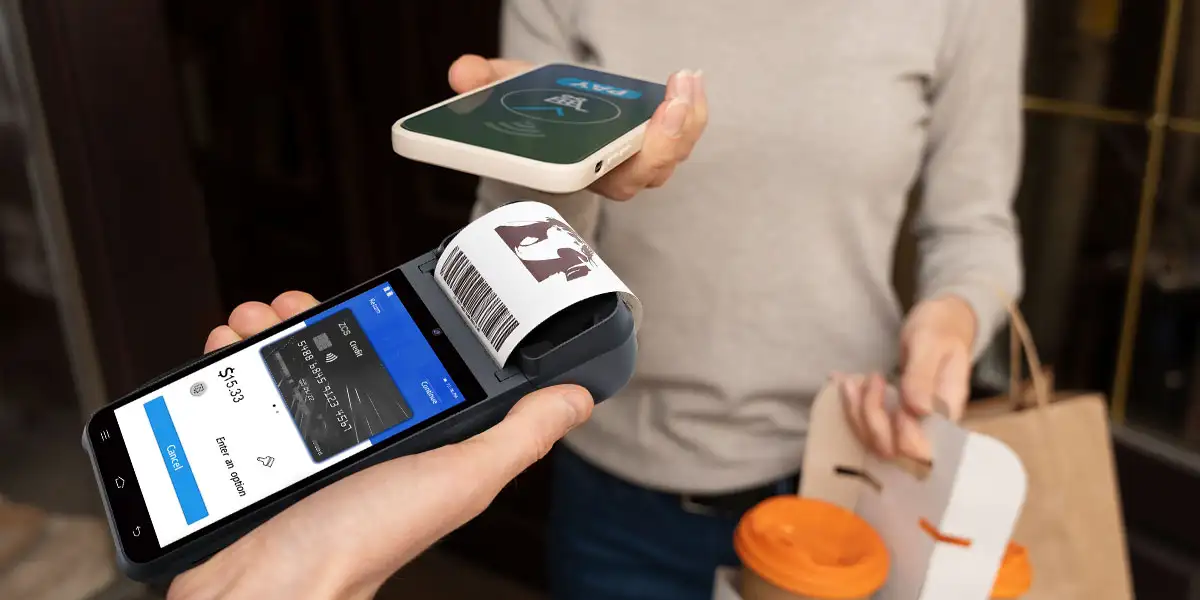
A fixed restaurant terminal lives in a climate-controlled interior, connected to mains power and a wired network, operated by staff who are stationary. A food truck terminal operates in none of those conditions. The hardware requirements that follow from this are specific and non-negotiable:
Each of these is a hardware specification, not a software feature. The sections below address each in turn. These features make mobile POS systems indispensable for food vendors who prioritize speed, efficiency, and customer satisfaction — though even purpose-built terminals carry hardware problems that quietly cost food truck operators sales.
A standard smartphone or tablet display produces 400–500 nits of brightness. In direct sunlight — which produces approximately 100,000 lux of ambient illumination — a 400-nit screen becomes effectively unreadable. Staff squinting at a washed-out menu screen during a lunch service rush is not a minor inconvenience; it directly increases transaction time and error rate.
The minimum viable screen brightness for outdoor food truck use is 500 nits; 700 nits or above provides reliable readability in direct sunlight without shade. This specification is rarely prominently disclosed by POS vendors. Request it explicitly, or look for it in the device's technical datasheet rather than the marketing materials.
Anti-glare screen coatings reduce surface reflection independently of raw brightness. A terminal with both a high-nit display and an anti-glare coating performs materially better outdoors than one that relies on brightness alone. Some purpose-built outdoor terminals also offer automatic brightness adjustment that responds to ambient light — a useful feature for food trucks that move between shaded and exposed positions during service.
Checklist item: Request the display brightness specification in nits before shortlisting any terminal for outdoor use. Reject units that do not disclose this figure or that spec below 500 nits.
A food truck operating a lunch and dinner service — or a full-day market event — may run 8–12 hours without access to a charging point. The battery requirement for the POS terminal in this scenario is not theoretical; it is the difference between completing service and shutting down early.
Published battery capacities must be evaluated against actual use-case load. A terminal running the POS application, maintaining a 4G data connection, driving an integrated printer, and processing NFC payments continuously draws significantly more current than a device in standby. Battery ratings in spec sheets reflect controlled testing conditions; real-world capacity under continuous POS load is typically 20–30% lower.
The practical minimum for a food truck handheld terminal is 3,000 mAh; 4,000 mAh and above is preferable for full-day deployments without a charging break. For devices that cannot reach a charging point during service, confirm whether the battery is hot-swappable — the ability to replace the battery without powering down the terminal is operationally significant for a food truck that cannot interrupt service.
The ZCS Z92 carries a 3,020 mAh removable lithium battery (7.4V) — a meaningful operational advantage for full-day deployments. Unlike sealed-battery terminals that require the entire device to be taken offline for charging, the Z92's battery can be swapped in seconds without powering down the terminal, allowing service to continue uninterrupted. Carrying one or two spare charged batteries effectively eliminates battery life as a constraint for an 8–12 hour operating day. At 364g and running on a Quad-Core 2.0 GHz processor with Android 13.0, the Z92 supports 4G LTE (FDD-LTE and TD-LTE), dual-band Wi-Fi (2.4 GHz + 5 GHz), and BLE 4.0, covering all connectivity modes relevant to a food truck deployment.
Checklist item: Prioritize terminals with removable batteries for food truck deployments. A hot-swappable battery — as found on the Z92 — eliminates the need to take the terminal offline for charging and effectively removes battery life as a service-day constraint when spare batteries are carried.
A food truck kitchen generates oil vapour, cooking steam, and physical splashing from food preparation — more aggressive than a coffee bar environment, and often combined with outdoor dust and rain exposure. A terminal without meaningful ingress protection will show accelerated degradation in a food truck environment, typically manifesting as touchscreen sensitivity loss, port corrosion, or internal condensation damage within 12–18 months.
The IEC IP rating standard defines the certification framework: IP54 covers dust ingress resistance and water splashing from any direction; IP65 adds full dust-tight certification and resistance to low-pressure water jets. For a food truck, IP54 is the minimum specification; IP65 is preferable for trucks operating in rain or with high-pressure cleaning in the service area.
Beyond the IP rating, confirm the screen surface material. A tempered glass overlay provides chemical resistance to cleaning agents and oils that will contact the screen during a service shift. Uncoated plastic overlays degrade visibly within a few months of daily cleaning.
Checklist item: Request IP certification documentation (not just a marketing claim) for any terminal being evaluated for food truck use. Confirm screen surface material and cleaning agent compatibility.
Offline mode is consistently cited as an essential feature for food truck POS systems — and rightly so. The hardware dimension of this requirement is often underspecified: offline capability depends on the terminal having sufficient local storage and processing power to cache transactions and queue them for sync. It is not purely a software feature.
A terminal that "supports offline mode" in the vendor's marketing copy may handle 10 cached transactions before requiring sync, or it may handle 500. Confirm the offline transaction limit explicitly. For a busy food truck at a market event with no cellular coverage, the difference is the difference between a functional sales day and a lost one.
4G LTE connectivity on the terminal itself — rather than relying on a mobile hotspot from a separate device — eliminates one failure point from the setup. The Z92 supports 4G LTE with dual SIM slots, allowing a primary and backup SIM from different carriers. In areas where one network has poor coverage, the backup SIM maintains connectivity without manual intervention.
Wi-Fi remains useful at fixed locations or where the truck operates near a reliable network, but cellular connectivity should be treated as the primary connection for any food truck deployment, with Wi-Fi as supplementary. A POS setup that depends on a consumer-grade mobile hotspot introduces a fragile dependency that fails at the worst possible moment — peak service at a crowded outdoor event.
Checklist item: Confirm the offline transaction cache limit (number of transactions storable without sync). Confirm 4G LTE is built into the terminal itself, not dependent on a separate hotspot device.
At a busy food truck service window, the transaction pace can reach 3–4 orders per minute during peak periods. The receipt printer is the mechanical bottleneck: once the payment is confirmed, the customer waits for the receipt before moving away from the window. Printer speed directly controls how quickly the next customer can step up.
Compact integrated printers on handheld terminals — including the 58mm thermal printer integrated into the Z92 — operate at lower mm/s speeds than standalone countertop units. The 58mm paper width is standard for handheld receipt printers and adequate for most food truck receipt formats, though operators with complex modifier-heavy menus may find that item descriptions wrap across multiple lines, adding marginal print time.
For food truck setups where a separate countertop printer is viable (fixed service window with stable surface space), a standalone 80mm thermal printer at 200–300 mm/s provides faster output. The practical decision depends on whether the operator's setup supports a fixed printer or requires the portability of a fully integrated handheld.
Checklist item: Assess whether your service window supports a fixed countertop printer or requires a fully integrated handheld. For integrated handhelds, confirm 58mm paper support and test print speed against your peak transaction rate.
Contactless payment — NFC tap-to-pay via card, Apple Pay, or Google Pay — represents the dominant transaction mode in most developed markets as of 2026. A food truck that cannot accept NFC payments loses a meaningful proportion of potential transactions, particularly at events and markets where customers may not carry cash or physical cards.
The Z92 is GMS (Google Mobile Services) certified, which enables two payment capabilities directly relevant to food truck operations: SoftPOS, which turns the terminal itself into a contactless payment acceptance device without requiring a separate card reader, and Google Pay, covering the tap-to-pay flows that represent an increasing share of transactions at outdoor and event venues.
The terminal also supports QR code scanning via its built-in scanner module, relevant for markets where QR-based payment (GrabPay, Alipay, and similar platforms) is predominant.
For micro-retailers or alternative setups looking to decouple their card readers from full terminal workflows, choosing the correct peripheral is vital. Explore our specialized guide on Choosing the Right Mobile mPOS Card Reader Device for Your Small Business to evaluate standalone configurations.
Checklist item: Confirm GMS certification for terminals intended to run SoftPOS or Google Pay.
A food truck service window is typically 60–90 cm wide, shared between one or two operators. Every piece of hardware in that space competes for surface area — and a terminal that is too large, too heavy, or too awkward to hand to a customer for PIN entry creates service friction.
The Z92's 364g weight and 214.4mm length put it in the range of a large smartphone — easy to hold one-handed, pass to a customer, and store when not in active use. The 5.5-inch touchscreen provides enough display area for a functional menu grid and order review without requiring the operator to squint at a small screen during fast service.
For food trucks that operate with a fixed terminal at the window and a separate handheld for tableside or queue-busting use, the Z92 works effectively in the mobile role while a larger 10-inch all-in-one handles the main order management function.
| Specification | What to Confirm | Food Truck Minimum |
|---|---|---|
| Screen brightness | Nits rating | 500 nits; 700+ for direct sun exposure |
| Battery capacity | mAh under continuous POS load | 3,000 mAh min; 4,000+ for full-day |
| Hot-swap battery | Removable vs. sealed | Removable strongly preferred |
| IP rating | Certified IP54 or IP65 | IP54 minimum; IP65 for wet environments |
| Offline mode | Transaction cache limit | Confirm maximum cached transactions |
| 4G LTE | Built-in vs. hotspot dependent | Built-in required |
| Dual SIM | Carrier failover available | Recommended for event locations |
| NFC | Built-in reader | Required for contactless payments |
| QR scanner | Built-in vs. external | Built-in preferred for handheld use |
| Printer | 58mm integrated or 80mm external | Match to service window configuration |
| Weight | Grams | Under 400g for handheld deployments |
| Android version | OS version + ISV compatibility | Android 11 min; Android 13/14 preferred |
The best POS system for a food truck is the one where the hardware does not become the limitation during service. Many software platforms offer capable solutions for food truck operations. The hardware question is whether the physical terminal running that software can handle outdoor sunlight, a full-day battery draw, the moisture environment of a working kitchen, and a mobile network that may drop unexpectedly.
The ZCS Z92 addresses the handheld hardware requirements of a food truck deployment: compact at 364g, removable 3,020 mAh battery, 4G LTE with dual SIM, built-in QR scanner, Android 13.0 with open SDK for ISV integration, and GMS certification supporting SoftPOS and Google Pay. For operators evaluating hardware independently of a bundled software subscription, sample units are available before bulk commitment.
For a broader look at mobile POS hardware across all deployment scenarios — including multi-terminal setups, fixed countertop configurations, and chain procurement — see our complete guide to mobile POS hardware for food service operations.

Q1: Why should hardware specifications take priority over software features when choosing a food truck POS?
Excellent software is completely useless if your device cannot power on or be read. While inventory tracking and delivery app integrations are great, they cannot fix a screen that washes out in the sun, a battery that dies at 3:00 PM, or a terminal that fails when a cellular signal drops. The outdoor environment is your ultimate constraint, making rugged hardware the absolute foundation that keeps you taking payments.
Q2: How bright does a food truck POS screen actually need to be for outdoor use?
Standard smartphones and consumer tablets max out around 400 to 500 nits of brightness, which becomes completely unreadable in direct, 100,000-lux sunlight. For a food truck, 500 nits is the absolute bare minimum for outdoor viability, while 700 nits or above is highly recommended to ensure your staff can read the menu quickly without seeking shade. Anti-glare screen coatings are equally critical because they cut down surface reflections independently of raw backlight power.
Q3: What is a "hot-swappable" battery, and why is it vital for mobile food service?
Running a live POS app, maintaining a constant 4G data stream, processing NFC tap payments, and running an internal printer drains power roughly 20% to 30% faster than what standard manufacturer spec sheets state. While sealed-battery devices force you to take the entire terminal offline and plug it into a wall socket when it dies, a hot-swappable battery—like the 3,020 mAh battery on the ZCS Z92—allows you to pop out a dead battery and slide in a fully charged spare in seconds without powering down the unit. This completely eliminates battery downtime during an 8 to 12-hour service day.
Q4: What Ingress Protection (IP) rating does a food truck environment demand?
Food trucks generate a harsh mix of airborne oil vapor, cooking steam, and food splatters indoors, alongside dust and rain outdoors. Without proper protection, terminals usually suffer from failed touchscreen sensitivity or internal corrosion within 12 to 18 months. An IP54 rating serves as the baseline to protect against harmful dust buildup and water splashes from any direction, but an IP65 rating is preferred if you operate in open rainy conditions or need to aggressively clean your service counters with low-pressure water jets.
Q5: Can I just rely on a consumer mobile hotspot or phone tethering for connectivity?
Relying on external hotspots is highly discouraged because they add an unnecessary point of failure and frequently choke or disconnect in crowded areas like food truck markets or music festivals. Your POS terminal should feature built-in 4G LTE connectivity as its primary network. For maximum insurance against network drops, choose devices with Dual SIM slots, which let you load cards from two different cellular carriers so the machine can automatically failover to the stronger network without disrupting sales.
Related Posts
1. Best POS Systems for Restaurants in 2026: Hardware Comparison for Global Buyers






 Home
Home  Coffee Shop POS Terminal Spec Checklist: What Hardware Features Actually Matter at the Counter
