
2026-06-23 Author : ZCS
A hotel's revenue does not flow through a single point of sale. It flows through the lobby café at 7 AM, the pool bar at noon, room service at 11 PM, and the banquet settlement the following morning. Each of those touchpoints runs on hardware — and the hardware decisions made during a property fit-out or technology refresh determine whether those revenue streams operate smoothly as a unified system or as a collection of disconnected transactions requiring manual reconciliation.
This guide focuses on the hardware layer of hospitality point of sale systems: what the physical terminals, display units, and handheld devices need to do in hotel and resort F&B environments, and why those requirements diverge materially from a standalone restaurant or retail deployment. Software selection matters, but software runs on hardware — and in a 24-hour, multi-outlet hospitality operation, the hardware is where operational failure most commonly originates.
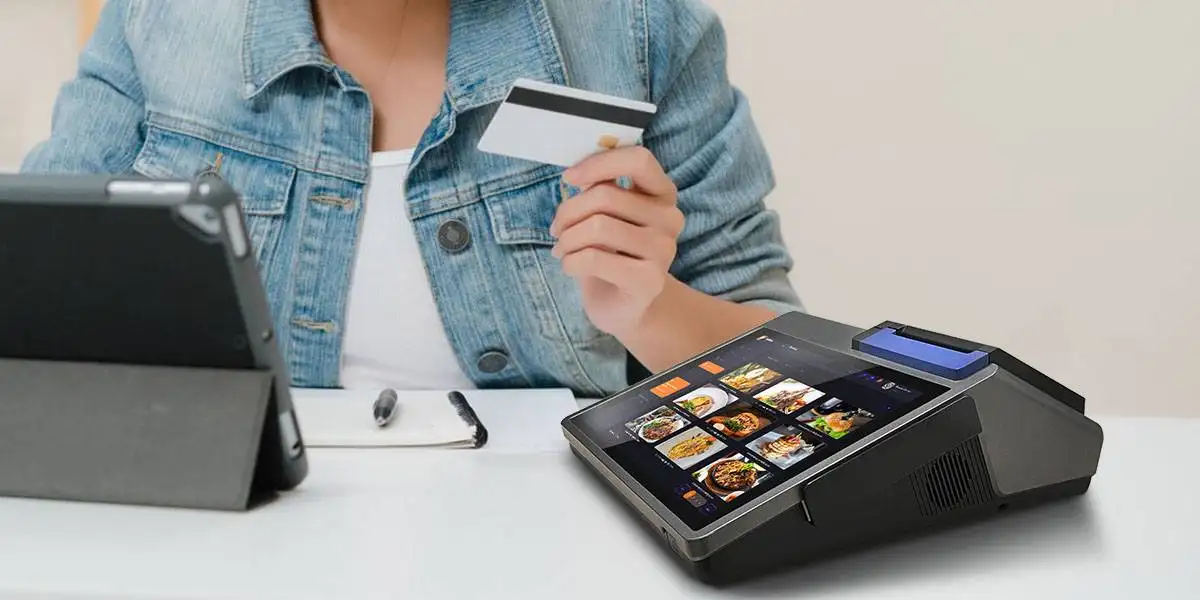
A full-service hotel property may operate five to fifteen distinct F&B outlets simultaneously: a main restaurant, a bar, a café, a pool-side service station, room service, banquet facilities, and potentially a spa or retail outlet. Each requires its own terminal configuration. All of them need to feed into a consolidated sales record.
The hardware requirement this creates is not simply "more terminals" — it is terminals that are architecturally capable of real-time synchronization across outlets. A room service order posted to a guest's folio needs to appear in the front desk system within seconds, not at the end-of-day batch reconciliation. A banquet bar tab needs to close against the event billing in real time. This level of integration depends on the terminal's network architecture, its API compatibility, and whether the hardware supports the ISV layer connecting it to the property management system (PMS).
A standalone café closes at 6 PM. A hotel does not. Hospitality POS hardware operates across multiple shifts, seven days a week, without scheduled downtime for maintenance or reboots. Consumer-grade tablets and entry-level terminals are not designed for this duty cycle. Industrial-grade Android terminals with enterprise firmware management are — and the distinction is measurable in mean time between failures over a 12-month deployment.
Hotels operating across multiple markets, or serving international guests, encounter multi-currency settlement requirements, tax rate variations by outlet type, and service charge structures that vary by jurisdiction. These are software-layer configurations, but they require hardware that can run the ISV integrations capable of handling them — which brings the Android openness question back to hardware selection.
Modern hospitality F&B operations have moved beyond the fixed cashier model. Tableside ordering via handheld terminals, self-service kiosks at quick-service outlets, and QR code payment flows all require hardware that supports these interaction modes natively — not as afterthought add-ons.
For main restaurant terminals, the baseline configuration is a 10–15 inch fixed terminal handling the order management and payment functions, paired with a customer-facing display for order confirmation and bill presentation. The customer display is not optional in a hotel restaurant context: transparent billing — where the guest can see each item as it is added — reduces disputes at checkout and supports the service standard guests expect at that price point.
One of the most hardware-critical integrations in a hotel F&B environment is the connection between the POS terminal and the Kitchen Display System. When a server enters an order, that ticket needs to route instantly to the correct kitchen station — hot section, cold section, pastry, bar — with no manual relay. The hardware requirement here is a terminal with a reliable, low-latency network connection and an open API that allows the ISV to configure multi-station KDS routing.
Kitchens that still rely on printed tickets are not slower because of the printer speed; they are slower because the physical ticket introduces handling steps that a KDS eliminates. The transition from ticket-based to display-based kitchen communication is a hardware investment with a measurable service speed return.
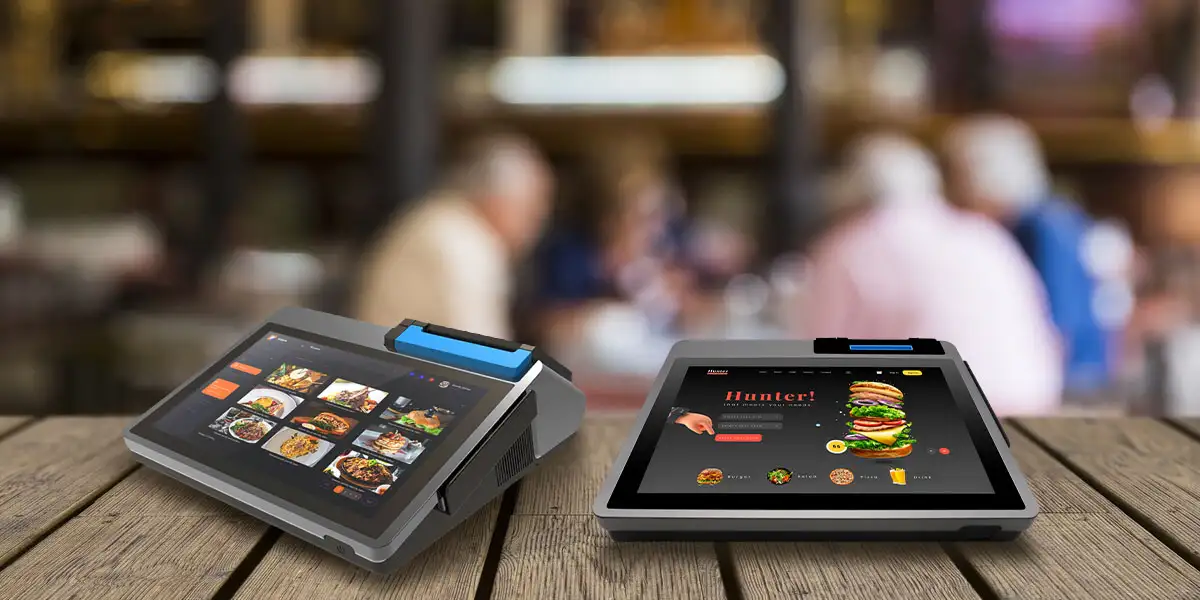
The ZCS Z100 — running Android 14.0 with an open SDK — supports the ISV integrations required for KDS connectivity. Its 10.1-inch operator display and 3.95-inch integrated customer screen handle the front-of-house functions within a compact footprint suitable for bar counters and service stations where space is constrained. Desktop stand and wall-mount installation options allow the unit to adapt to different outlet configurations across a property.
Room service is one of the highest-margin F&B channels in a full-service hotel — and one of the most hardware-underserved. The standard configuration at many properties is still a fixed terminal in the room service office, with orders taken by phone and manually entered. The operational overhead of that workflow — transcription errors, delayed kitchen routing, manual folio posting — is entirely addressable with mobile hardware.
A handheld Android POS terminal used by room service staff enables:
The durability and connectivity requirements for a hotel handheld differ from a cafe queue-busting deployment. Battery life needs to cover a full 8-hour shift without a mid-service charge cycle — a minimum of 4,000 mAh under continuous use. Network connectivity should support both Wi-Fi and 4G LTE failover, since guest floors in large hotel buildings frequently have Wi-Fi dead zones that would cause a Wi-Fi-only device to lose connectivity mid-transaction.
A built-in NFC reader enables contactless payment at the door without a separate terminal. A built-in scanner handles QR code loyalty redemptions or digital menu access. These are integration points, not luxuries, in a full-service hospitality environment.
Outdoor service environments introduce hardware stresses that indoor installations do not: direct sunlight causing screen washout, temperature variation, humidity, and a higher probability of liquid contact. The IP rating specification discussed in general cafe hardware contexts becomes a non-negotiable minimum for outdoor hospitality deployments.
IP54 certification (protection against dust and water splashing from any direction) is the floor. For beach club or poolside environments where terminals may be exposed to salt air or direct water splash, IP65 is the appropriate specification. Confirm independent certification documentation, not spec sheet claims.
Screen readability under direct sunlight is a separate consideration from IP rating. Terminals intended for outdoor deployment should specify screen brightness in nits — 500 nits is a commonly cited minimum for outdoor readability; 700 nits or above provides reliable visibility in direct sunlight.
Banquet and event billing introduces a reconciliation requirement that does not exist in standalone restaurant operations. A wedding reception with a hosted bar, plated dinner, and late-night snack station may run three simultaneous service points, all of which need to consolidate into a single event invoice. The hardware configuration for this scenario requires terminals that can operate as part of a shared session, posting charges to a central event folio in real time rather than generating separate receipts per outlet.
This is where the PMS integration question becomes acute. Hospitality POS hardware needs to be compatible with the property management system in use — whether that is Opera, Protel, Cloudbeds, or a regional equivalent. The integration runs at the ISV layer, but the hardware must support the open API architecture that makes it possible. Locked-down terminals with proprietary software environments create integration ceilings that may not become apparent until the go-live date.
The AI-driven overview of hospitality POS functionality consistently identifies the same integration priorities: consolidated financial visibility across outlets, unified billing that allows room charges to sync directly with the guest's folio, and omnichannel order routing that brings delivery platform orders into the kitchen flow without creating parallel workflows.
These are not software features in isolation. Each depends on hardware that:
A hotel IT team managing 30 terminals across 8 outlets cannot afford to physically touch each device for every configuration change. TMS-compatible hardware that supports remote firmware deployment and device health monitoring is not an enterprise luxury — it is the minimum viable architecture for a property of any meaningful scale.
For hotel groups operating multiple properties, hardware standardization is the single highest-leverage procurement decision. A standardized terminal fleet means:
Achieving this requires an OEM/ODM-capable hardware partner — one that can supply consistent specifications across bulk orders, accommodate property-specific customization (branded boot screens, UI themes), and maintain supply continuity over a multi-year contract period.
The hospitality technology market has historically been dominated by closed-loop POS ecosystems where the hardware vendor and software vendor are the same entity — or where the hardware is locked to a specific software platform. This model creates long-term commercial dependency that limits the operator's ability to change software vendors, integrate new service channels, or negotiate pricing.
Open Android hardware running ISV-agnostic software changes this dynamic. The terminal becomes infrastructure — like a network switch or a server — rather than a point of vendor lock-in. ZCS terminals, including the Z100, run open Android 14.0 with full SDK access, enabling integration with any ISV the operator selects and supporting future integration requirements as the technology stack evolves.
Hotel technology refreshes typically occur on 5–7 year cycles, aligned with major renovation programmes. Hardware TCO in a hospitality context should be calculated across that full cycle, including:
Industrial-grade Android terminals with enterprise firmware support and OEM supply agreements consistently produce lower TCO over a 5–7 year cycle than consumer-grade alternatives, despite higher upfront unit costs.
| Deployment Scenario | Key Hardware Requirements |
|---|---|
| Main restaurant / bar | 10–15 inch terminal, integrated CFD, KDS API, open SDK |
| Room service / tableside | Handheld Android, removable battery, 4G LTE, NFC, built-in scanner |
| Outdoor / pool / terrace | IP54–IP65 rated, 500+ nit screen brightness, Wi-Fi + 4G |
| Banquet / event | Multi-terminal folio sync, PMS API integration, TMS management |
| Multi-property chain | OEM/ODM standardization, TMS central management, Android 14 |
Hospitality point of sale hardware is not a commoditized purchase. The physical terminals, handheld devices, and display units deployed across a hotel or resort property carry operational requirements — 24-hour continuity, multi-outlet synchronization, PMS integration, outdoor durability — that are categorically different from a standalone retail or single-site restaurant deployment.
The hardware decision determines which software integrations are possible, how reliably the system operates across shifts and seasons, and whether the property's technology investment delivers a return over a 5–7 year lifecycle or requires a mid-cycle replacement that was never budgeted for.
For operators evaluating Android-based hardware for hospitality F&B deployments, ZCS offers the Z100 and a wider terminal range with open SDK support, TMS compatibility, and OEM/ODM customization for chain and multi-property procurement. Sample units are available for evaluation before bulk order commitment.
For the broader hardware framework across restaurant and cafe environments — including standalone outlet procurement and independent operator checklists — see our complete guide to best POS hardware for restaurants and food service operations.

Q1. Why can't we just use consumer-grade tablets (like iPads or standard Android tablets) for hotel restaurants or room service?
A: Consumer-grade tablets are not built for the relentless 24/7 duty cycle of a hotel environment, leading to high failure rates. They lack enterprise-grade battery lifespans and dual-band Wi-Fi + 4G LTE failover capabilities, meaning a server walking into a guest elevator or a Wi-Fi dead zone will lose connection, delaying real-time folio posting to the PMS. Furthermore, they cannot withstand the heat and grease of kitchens or the humidity of a poolside bar (lacking IP54/IP65 ratings), and they require clunky, third-party add-ons for NFC and scanning rather than seamless, built-in hardware modules.
Q2. What are the specific hardware benchmarks for screen brightness and ingress protection (IP ratings) in outdoor service stations?
A: Outdoor and terrace environments introduce severe physical stressors. For screen readability under direct sunlight, a minimum of 500 nits is required, though 700 nits or above is highly recommended for reliable visibility in peak daylight. Regarding durability, IP54 (protection against dust and water splashes from any direction) is the absolute floor. For beach clubs or poolside bars exposed to salt air and direct water splashes, hardware with independent IP65 certification is necessary to prevent premature device failure.
Q3. How does the POS hardware layer actually enable real-time, multi-terminal billing consolidation for large banquets and events?
A: Banquet billing relies on a "multiple service points, single invoice" architecture. To make this work, the hardware must feature an open SDK and API architecture that fully supports the ISV (Independent Software Vendor) layer. This allows multiple physical terminals operating simultaneously across a ballroom or convention center to sync with the Property Management System (PMS) like Opera or Cloudbeds in seconds, instantly routing charges to a centralized event master bill rather than generating fragmented, disconnected transactions.
Q4. Why does the operating system version (e.g., Android 14.0) on a POS terminal matter so much for long-term hotel procurement?
A: Hotel technology refreshes typically run on a 5–7 year cycle, usually aligned with property renovations. If you procure hardware running an outdated OS (like Android 9), the terminal will likely reach its end-of-ISV-support within 2–3 years as modern software updates phase out older operating systems. Investing in hardware running a current, open platform like Android 14.0 ensures the terminal remains infrastructure-ready for the entire lifecycle, preventing a costly, unbudgeted mid-cycle hardware replacement.
Q5. How can hotel groups and multi-property chains minimize total cost of ownership (TCO) during a large-scale technology refresh?
A: The solution lies in fleet standardization and selecting hardware that natively supports a centralized Terminal Management System (TMS). Partnering with an OEM/ODM-capable hardware supplier allows hotel groups to lock in unified hardware specifications, reducing replacement part inventory to a single SKU. Crucially, a TMS allows the central IT team to deploy firmware updates, monitor device health, and push configurations remotely across all properties, eliminating the massive operational cost of having physical technicians manually service every individual device.






 Home
Home  Best POS for Food Trucks in 2026: What Mobile Kitchen Operators Actually Need
