
2025-09-10 Author : ZCS
Most portable POS system comparisons rank options by processing fees and monthly software cost. Those numbers matter for choosing a payment processor, but they say nothing about the hardware itself — what a terminal weighs, what it's certified to do, and what happens when a business needs a customized or bulk-sourced device rather than a single off-the-shelf unit. This guide compares portable POS systems by hardware: form factor, certification transparency, connectivity, and offline capability.
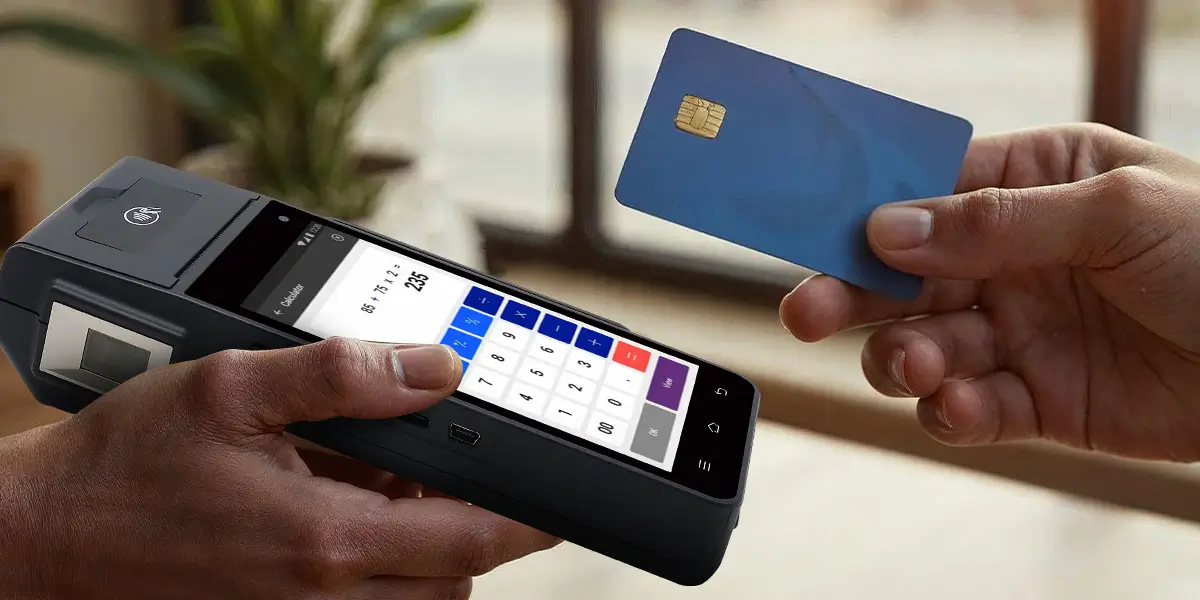
A portable POS system is hardware that processes card payments away from a fixed checkout counter — a pocket-sized card reader, a handheld terminal, or a larger dual-screen device, depending on the deployment. Unlike a countertop POS, a portable POS system typically runs on battery power and connects via Wi-Fi, cellular data, or Bluetooth rather than a wired connection.
Portable POS systems fall into three general hardware categories: pocket-sized card readers that pair with a phone or tablet, standalone handheld terminals with their own screen and operating system, and larger dual-screen terminals designed for higher-volume or customer-facing checkout.
This comparison scores portable POS hardware on four dimensions instead of processing rates or monthly software tiers.
Form factor measures screen size, weight, and whether a device is pocket-sized or a full handheld terminal. Certification transparency measures whether a vendor publicly discloses PCI PTS version, EMV Level 1 and Level 2 status, and other payment certifications — not just whether a device processes chip and contactless payments. Connectivity measures whether a terminal supports independent cellular data or depends on a paired phone's connection. Sourcing flexibility measures whether a buyer can get a single unit off the shelf or needs customized, bulk-ordered hardware — a dimension standard consumer POS comparisons don't cover, because most of them assume a single-location small business buyer rather than a multi-location or cross-border one.
Portable POS hardware splits into three form factors, each with a different trade-off between portability and onboard capability.
A pocket-sized card reader is the smallest option — typically under 200 grams, with a small or no display, and no built-in printer. It depends on a paired phone or tablet for its user interface. ZCS's Z81 falls into this category at 150g with a 3.1-inch screen and no built-in printer.
A standalone handheld terminal has its own screen, operating system, and usually a built-in printer, trading portability for self-sufficiency. ZCS's Z90 is a 5.0-inch handheld terminal with a built-in 58mm thermal printer and full magnetic stripe, IC chip, and NFC card reading.
A dual-screen terminal adds a larger primary display plus a secondary customer-facing screen, suited to order review or itemized checkout rather than pure portability. ZCS's Z108 is an 8-inch dual-screen terminal with a 3.95-inch secondary display.
Certification transparency varies sharply across the market. Most consumer-facing portable POS brands do not publish a specific PCI PTS version on their public spec pages.
| Dimension | Square Terminal | Clover Flex 4 | Toast Go 3 | PayPal Terminal | ZCS Z81 | ZCS Z90 | ZCS Z108 |
|---|---|---|---|---|---|---|---|
| Form factor | Handheld terminal | Handheld terminal | Handheld terminal | Pocket terminal | Pocket/mini POS terminal | Handheld terminal | Dual-screen terminal |
| Screen size | 5.5 inch | 5.99 inch | 6.52 inch | 5.0 inch (third-party confirmed; not on official spec sheet) | 3.1 inch | 5.0 inch | 8 inch + 3.95 inch secondary |
| Weight | 417 g | 480 g (without sleeve; 540 g with sleeve) | 426 g | 210 g | 150 g | 424 g | Not disclosed |
| Built-in printer | Yes | Yes | No (cloud printing to external printer) | No (optional dock) | No | Yes, 58mm | Yes, 58mm/80mm |
| Independent cellular | No (Wi-Fi/Ethernet) | Yes, 4G LTE (3G/2G in select regions) | Yes, 4G | Yes, 3G/4G preloaded SIM | Yes, 4G (1 SIM + 1 PSAM slot) | Yes, 4G/3G/2G | Yes, 4G/3G/2G |
| Payment certification | Not disclosed | PCI PTS 6.x, EMV Contact L1&L2, EMV Contactless L1 3.1, plus Visa, Mastercard, Amex, Discover, JCB, and Interac contactless support | PCI PTS approved (version not specified) | PCI DSS compliant (official); PCI PTS 5.1 per third-party testing, not officially published | None — protocol support only | PCI PTS 5.x, EMV L1&L2, EMV Contactless L1, PayWave, PayPass, UnionPay | None — protocol support only |
| RAM / ROM | Not disclosed | 4GB RAM / 64GB Flash | Not disclosed | Not disclosed | 3GB/16GB (4GB/32GB optional) | 1-2GB / 8-16GB | 4GB / 32GB |
| Removable/replaceable battery | Not disclosed | Not disclosed (separate 3V coin cell exists for tamper detection only, not the main battery) | Not disclosed | Not disclosed | Not disclosed | Yes — 7.4V/2800mAh | Yes — 7.6V/3600mAh |
| Modular hardware options | Fixed configuration | Fixed configuration (barcode scanner/camera built in as standard) | Fixed configuration | Fixed configuration | Optional fingerprint module (FBI/STQC), optional 8MP camera upgrade | Optional face recognition, optional fingerprint module, integrated barcode scanner | Camera or barcode scanner (one or the other, optional) |
| Sourcing model | Direct retail, fixed pricing | Sold through ISOs/processors; pricing tied to a merchant account rather than a single fixed retail price | Direct, quote-based through Toast sales | Direct retail, fixed pricing | Inquiry-based, OEM/ODM customizable | Inquiry-based, OEM/ODM customizable | Inquiry-based, OEM/ODM customizable |
| Starting price | $299 | Varies by processor/ISO — commonly $249–$749+ | Not disclosed (quote-based) | $199 | Not published | Not published | Not published |
ZCS pricing isn't published because these are B2B/OEM hardware lines sold through inquiry rather than fixed retail listings — buyers requesting bulk or customized orders typically get quotes based on configuration and volume rather than a flat sticker price.
Battery swappability is the one row where the four consumer brands compared here and the ZCS Z81 all leave the detail unpublished — a buyer who needs a swappable battery for extended shifts should confirm this directly with any vendor, since a spec sheet's silence on the point isn't a reliable signal either way. The Z90 and Z108 do disclose a removable battery (7.4V/2800mAh and 7.6V/3600mAh respectively), which matters for the outdoor and multi-shift use case covered in Section 5 below. For a fuller picture of what ZCS offers as a POS vendor and manufacturer beyond these three models, see what ZCS offers as a POS vendor and manufacturer.
A comparison table shows what's available, not why a given spec changes how a terminal performs in daily use. Four details — RAM/ROM configurability, removable battery, GMS certification, and TMS support — affect total cost of ownership and operational reliability more than the spec sheet alone suggests.
More RAM does not make a terminal faster at ringing up a single sale, but it does determine how many applications a terminal can run at once without lag. A terminal running only a dedicated payment app needs less memory than one also running inventory sync, loyalty program software, and a delivery platform integration in parallel. A small counter operation using one payment app can typically run on a lower-RAM configuration without any performance loss, while a business layering multiple POS integrations benefits from a higher-RAM tier to avoid app-switching delays during peak hours.
Storage works the same way. A terminal that stores transaction logs offline for extended periods, or runs several installed apps with local databases, needs more onboard storage than a terminal that syncs to the cloud continuously and keeps minimal data on the device itself. This is why offering a RAM/ROM range rather than a single fixed configuration — as with the Z81's 3GB/4GB option or the Z90's 1GB/2GB option — lets a buyer size the hardware to the actual software load instead of over- or under-provisioning it.
A fixed, non-removable battery means a terminal that runs low goes offline until it finishes charging, typically one to three hours depending on capacity. A removable battery lets an operator swap in a charged one in seconds and keep the terminal running, which matters most for deployments without a fixed charging station nearby — delivery fleets, outdoor event vendors, or transit fare collection running across a full shift or longer.
For a business operating outdoors or across multiple shifts, battery swappability is worth confirming directly with the vendor before purchase, since — as the comparison table shows — it's one of the details most manufacturers simply don't publish.
A terminal running Android without Google Mobile Services (GMS) certification can't officially access the Google Play Store, which means installing a third-party app — a delivery platform, an accounting integration, a POS software suite — requires manual sideloading instead of a standard app store install. On a GMS-certified device, software such as Grab Merchant, Odoo POS, Square, or Loyverse is installable directly via Google Play, the same way any certified Android phone installs an app, without requiring a formal partnership between the terminal manufacturer and the software vendor. For a buyer standardizing hardware across several markets or software vendors, GMS certification removes a recurring IT overhead: manually sideloading and updating apps across a distributed terminal fleet instead of managing them through a standard app store. For a closer look at this trade-off, see why GMS-certified Android POS terminals give merchants more software freedom.
A Terminal Management System (TMS) lets an operator push firmware updates, deploy or remove apps, and monitor device status remotely across many terminals at once, instead of physically handling each unit. This matters more at scale than for a single device: a business with one terminal can manage updates by hand, but a distributor or multi-location operator running dozens or hundreds of units depends on TMS to avoid sending a technician to every location for a routine update. Manufacturers that pair TMS with firmware-level customization go further still — see the open SDK and custom ODM guide for what that combination unlocks for private-label or multi-market hardware projects.
Some markets require a hardware-level tax control module — a component that logs and certifies transaction data for fiscal reporting, separate from standard EMV or PCI payment certification. Requirements vary significantly by country: some markets mandate certified fiscal printers or tax control chips, others require software-level fiscal reporting integration instead, and many have no such requirement at all. A device's general support for a tax control module does not automatically mean it holds a specific country's fiscal authorization. A buyer sourcing hardware for a market with fiscal compliance requirements should confirm the exact certification that market requires directly with the vendor, rather than assume hardware-level support and country-specific authorization are the same thing.
PCI PTS is a device-level certification that protects PIN and cardholder data during a transaction. The PCI Security Standards Council maintains the PTS Point of Interaction standard, tested by independent PCI-recognized labs before a device is approved. A terminal without a disclosed PCI PTS version hasn't necessarily failed — but a buyer can't verify compliance without asking the vendor directly.
EMV Level 1 and Level 2 are separate certifications covering different parts of a chip-card transaction. EMVCo certifies Level 1 on the mechanical and electrical protocol between card and terminal, and Level 2 on the software kernel that processes the transaction. A device needs both to process EMV chip payments correctly.
A device can support EMV or PayPass protocols at the hardware level without holding formal certification for either. That distinction matters for procurement: "supports EMV" and "EMV certified" are not interchangeable claims, and a buyer sourcing hardware for a regulated market should confirm which one applies to the specific model under consideration.

Offline capability varies by device and firmware, not just by brand. Some portable terminals can hold transactions locally for a set window — commonly 24 to 72 hours — before requiring reconnection to process them. Others require an active Wi-Fi or cellular connection for every transaction and have no offline mode at all.
Offline processing also carries risk regardless of the device: a transaction approved offline can still be declined once the connection is restored, if the card turns out to be invalid or the account lacks funds. Buyers evaluating offline capability for a specific deployment — a delivery fleet in low-signal areas, for example — should confirm the exact offline window and failure behavior with the hardware vendor rather than assume it matches a similar-looking device.

Retail counters with stable power and Wi-Fi benefit most from a handheld terminal with a built-in printer, since portability matters less than onboard capability.
Delivery and field service work favors a pocket-sized reader or a terminal with independent cellular data and a removable battery, since the device can't depend on the merchant's own network or a nearby outlet. Buyers building specifically around a delivery platform integration should see what to look for in an Android POS terminal for Grab Merchant integration.
Trade shows and pop-up retail favor lightweight terminals with preloaded cellular connectivity, since on-site Wi-Fi setup is often unavailable.
Multi-location or cross-border deployments — franchise rollouts, distributors sourcing for multiple markets — typically need to evaluate OEM/ODM customization, TMS fleet management, and certification documentation before ordering in volume, since a single retail unit's spec sheet doesn't answer questions about firmware customization, branding, or bulk lead times. Businesses standardizing on a single ERP across locations should see how Android POS terminals power Odoo-based unified commerce operations.

Q1: What is a portable POS system?
A portable POS system is hardware that processes card payments away from a fixed checkout counter, typically a pocket-sized card reader, handheld terminal, or dual-screen device connected via Wi-Fi, cellular, or Bluetooth.
Q2: What is the best portable POS system for small business?
The best option depends on deployment. A pocket-sized reader suits mobile or delivery use, a handheld terminal with a built-in printer suits retail counters, and a dual-screen terminal suits higher-volume or customer-facing checkout.
Q3: What's the difference between a portable POS and a portable POS system?
"Portable POS" often refers to the physical device, while "portable POS system" includes the paired software — payment processing, receipt handling, and any inventory or reporting features running on or alongside the hardware.
Q4: Does a portable POS system need PCI certification?
Any device that captures or transmits cardholder data should carry PCI PTS certification. Buyers should confirm the specific PCI PTS version with the vendor directly, since not all portable POS hardware publishes this information.
Q5: Can a portable POS system work without Wi-Fi?
Some portable POS terminals include independent cellular connectivity and can process payments without Wi-Fi, while pocket-sized readers that pair with a phone typically rely on that phone's connection instead.






 Home
Home  Can an EPOS System Reduce Checkout Waiting Times?
