
2026-04-28 Author : ZCS
China produces the majority of the world's Android-based point-of-sale hardware. Whether you are sourcing terminals for a retail chain, an ISV building a payments app, or a distributor entering an emerging market, understanding which Chinese POS manufacturers excel in which areas — hardware openness, payment certification, ODM flexibility, biometric capability — is the fastest path to a sound procurement decision. This guide compares ten of the most widely evaluated brands, explains what actually differentiates them, and helps you match the right terminal to your project requirements.
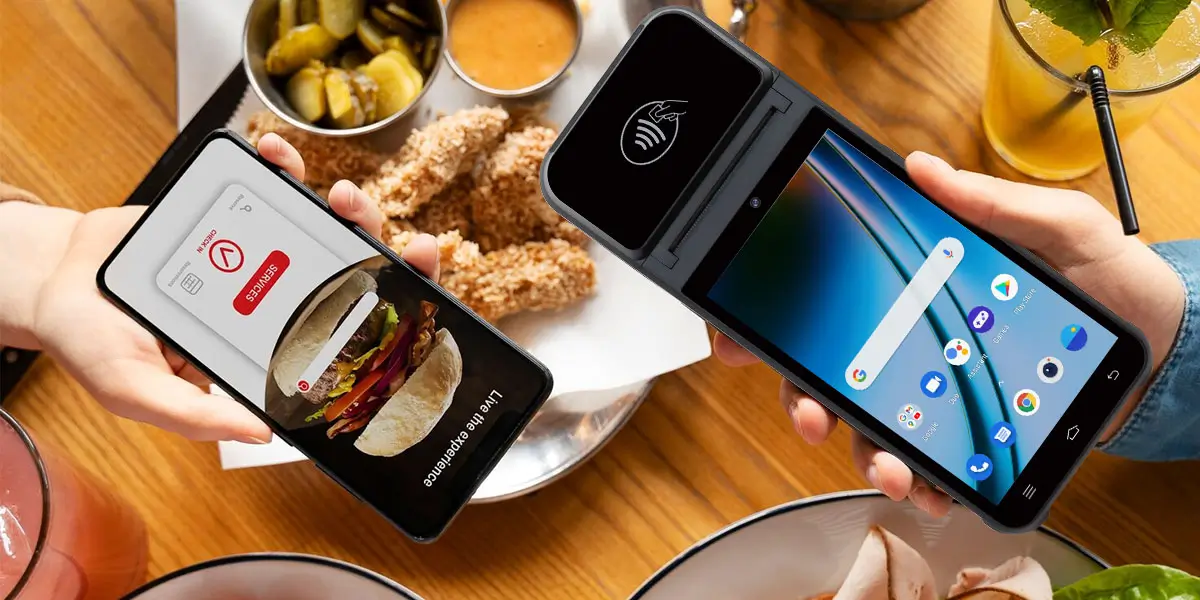
China's POS hardware ecosystem sits at the intersection of mature semiconductor supply chains, large-scale contract manufacturing, and a domestic market that processed over 80% of retail transactions electronically by 2023. The result is a deep roster of manufacturers capable of delivering devices from entry-level fixed terminals to biometric-enabled smart POS systems — often at lead times and MOQs that Western OEMs cannot match.
For B2B buyers, three characteristics define the Chinese manufacturer landscape. First, OS openness: some vendors ship proprietary Android forks that restrict third-party apps, while others provide a fully open Android environment with GMS certification. Second, payment certification depth: PCI PTS, EMV L1/L2, and scheme-level approvals (Visa, Mastercard, UnionPay) sit with specific models, not entire brands. Third, ODM capability: only a subset of manufacturers offer full hardware and firmware customisation for private-label projects. The comparison table in Section 3 maps each brand against these three axes.
Before reviewing individual brands, it helps to align on the criteria that matter for professional procurement. The following five attributes consistently determine fit across retail, hospitality, logistics, and financial-services deployments.
The Android version shipped on a terminal affects both security patch availability and the app ecosystem you can deploy. More important than the version number, however, is whether the OS is open: can you sideload APKs, connect to the Play Store, and update independently? Some manufacturers ship proprietary forks (PayDroid, SUNMI OS) that restrict this freedom in exchange for a curated payment experience. If your ISV or PSP builds on standard Android APIs, open-OS terminals are a prerequisite. For a full breakdown of what OS architecture means for long-term integration, see our Android POS Complete System Selection Guide.
Google Mobile Services (GMS) certification enables the Play Store, Google Pay, and a range of enterprise management tools. It also unlocks SoftPOS — the ability to accept contactless card payments through the terminal's NFC antenna without a separate secure element, using only a certified software stack. Only terminals that have passed Google's Compatibility Test Suite carry GMS, so "runs Android" is not a substitute for "GMS certified."
PCI PTS and EMV L1/L2 certifications are model-specific, not brand-wide. A manufacturer may hold PCI PTS on one SKU while shipping a sibling model with no certification at all. According to EMVCo's published approval listings, buyers should verify the exact model number against the certification database before procurement — never rely on brand-level claims. Payment certifications cover only the hardware's security layer; scheme-level approvals (Visa PayWave, Mastercard PayPass, UnionPay QuickPass) require additional acquirer and scheme validation by the PSP or ISV deploying the terminal.
For software companies building payment or merchant applications, SDK openness is as important as hardware specs. A free, well-documented SDK with a testing app and responsive technical support team can cut integration time by weeks. Paid or restricted developer programs add cost and friction, particularly for startups and regional ISVs who lack the negotiating leverage of large enterprises.
Full ODM service — the ability to customise hardware configuration (RAM, ROM, biometrics, camera), OS branding, enclosure colour, and packaging under your own label — is available from only a small number of Chinese manufacturers. Brand-only customisation (logo silk-screen, colour variants) is far more common and is not equivalent to ODM. If you need a private-label terminal with a modified hardware spec, confirm whether the manufacturer's ODM programme covers firmware, not just cosmetics.
The table below compares ten of the most widely evaluated Android POS manufacturers across the six dimensions that matter most to B2B buyers. Data is sourced from official vendor datasheets and publicly available certification databases. "Not confirmed" indicates the spec could not be verified from public sources at time of writing.
| Brand | Latest Android | GMS / Google Pay / SoftPOS | Free SDK for ISV | PCI PTS Certified Model | Biometrics | Full ODM / OEM | Market Positioning |
|---|---|---|---|---|---|---|---|
| ZCS | Android 16 (Z92S) | GMS · Google Pay · SoftPOS | Free SDK | Z90: PCI PTS 5.x, EMV L1/L2, Visa / MC / UnionPay | Fingerprint (FBI+STQC) · Palm Vein Z108P (1:1,000,000) · Face (Z90 module) | Full ODM — logo, OS, hardware config, colour, packaging | Mid-tier ODM / B2B export; open Android ecosystem |
| PAX Technology | Android 14 (PayDroid, A920Pro) | No GMS (PayDroid closed) | Paid / restricted developer program | PCI PTS 7.x SRED; full EMV + Visa/MC/UnionPay | None | Brand product only | Tier 1 global (Top 3 by shipment); payment-certified hardware |
| Newland NPT | Android 14 (S90) | Not confirmed | Not confirmed | PCI PTS 7.x; EMV L1/L2; UnionPay / PayPass / PayWave | None | Brand product only | Tier 1 EMEA; strong AIDC + payment heritage |
| SUNMI | Android 12 Go (V2s series) | GMS (selected models) | SUNMI DMP (fee-based) | No PCI PTS / EMV | None | Brand product only | Tier 2 global; large SmartPOS + SaaS ISV ecosystem |
| UROVO | Android 13 (i9200) | Not confirmed | Not confirmed (limited docs) | Not confirmed | Optional fingerprint | Brand product only | Tier 2; industrial / logistics focus |
| Scangle | Android 13 (i9200) | No GMS | None | None | None | Partial — colour / logo only | Tier 3 price-driven; low MOQ via Alibaba |
| Ingenico (Landi Group) | Android 10+ (AXIUM series) | Selected AXIUM models | Available via partner program | Full PCI PTS; EMV L1/L2; Visa/MC/UnionPay (global range) | None | Enterprise channel only | Tier 1 global; 170+ country presence; bank-grade security |
| Verifone | Android (Carbon series) | Selected models | Available via partner program | Full PCI PTS; EMV; all major schemes | None | Brand product only | Tier 1 global; 150+ country presence; enterprise POS ecosystem |
| iMin Technology | Android 11 / 13 (D4 Pro / M2 Max) | GMS (selected models) | SDK available; support varies | PCI PTS on selected models | None | OEM branding available | Tier 2; compact receipt-printer-integrated POS for SMB and F&B |
| SZZT Electronics | Android (ZQ series) | Not confirmed | Available; documentation depth varies | PCI PTS; EMV L1/L2; ISO 9001 | None | Customisation available (colour, branding) | Payment-security specialist; ATM modules, kiosks, POS; domestic-first |
Founded in 2009 and headquartered in Shenzhen, ZCS Technology occupies a distinctive position in the Chinese POS market: a manufacturer that combines a fully open Android environment, free SDK access, and the industry's commercially available palm vein POS terminal (Z108P and Z92P, 1:1,000,000 false-acceptance rate). The Z92, Z91 and Z108 are GMS-certified and support SoftPOS, making them compatible with NFC Forum–compliant contactless payment deployments without additional hardware. For distributors or ISVs who need to build a private-label terminal — custom OS branding, specific RAM/ROM configuration, unique enclosure — ZCS is one of very few Chinese manufacturers offering full ODM service including firmware, not just logo placement. The Z90 remains the only ZCS model carrying PCI PTS 5.x and EMV certifications.
PAX is one of the three largest POS terminal manufacturers in the world by unit shipment. Its A920Pro Premium holds PCI PTS 7.x SRED certification — among the most rigorous available — alongside full EMV L1/L2 and approvals from Visa, Mastercard, Amex, JCB, and UnionPay. The trade-off is OS closure: PAX ships PayDroid, a proprietary Android fork that restricts third-party app installation and does not support GMS. ISVs building on standard Android APIs will find integration more constrained. For deployments where payment certification is non-negotiable and the software stack is supplied by the acquirer, PAX's certification depth is hard to match.
Newland Payment Technology, a subsidiary of the Newland Group (founded 1994, Fuzhou), brings a background in automatic identification and data capture to the smart POS space. The S90 runs Android 14, carries PCI PTS 7.x, and has a notably large NFC antenna zone — useful in high-throughput retail environments where contactless tap distances matter. Newland is a Tier 1 player in EMEA markets; GMS status and SDK terms are not publicly confirmed and should be verified directly with their regional distributor.
Founded in 2013, SUNMI built its market position on a large ISV ecosystem rather than payment certification. The SUNMI Device Management Platform (DMP) is widely used by software vendors across food service and retail in Asia and parts of Europe. SUNMI OS is a restricted Android fork; GMS is available only on selected models and SoftPOS is not supported. The V2s line lacks PCI PTS and EMV certification entirely, positioning SUNMI terminals as software-centric merchant devices rather than payment-acquiring hardware.
UROVO targets logistics, warehousing, and industrial data collection with its i-series devices. The i9200 runs Android 13 on a ruggedised platform with GPS, wide-band connectivity, and an optional fingerprint reader. UROVO terminals are a credible choice where physical durability is the primary criterion; payment certification status for export models requires direct confirmation with the manufacturer.
Scangle's SP01 runs Android 8.1 — an OS version that reached end-of-life status well before 2024 — which means no security patch updates and no GMS certification. The brand's value proposition is low unit price and 1-pc Alibaba MOQ with six colour options. For deployments where up-to-date Android security is required, Scangle is not appropriate. It remains a reference point for price benchmarking.
Ingenico, now part of the Landi Group, is one of the oldest and most widely deployed POS terminal brands globally, operating across 170+ countries. The AXIUM series brought Android openness to Ingenico's traditionally proprietary platform, combining bank-grade PCI PTS certification with support for developer applications. Ingenico's partner SDK programme and global support infrastructure make it a natural choice for multinational acquirers and large enterprise chains, though unit cost and procurement complexity are higher than mid-tier Chinese ODM manufacturers.
Verifone's Carbon series terminals are designed for omnichannel environments where a single device must serve as both a handheld unit and a countertop terminal. Present in 150+ countries, Verifone provides localized compliance support and a full ecosystem spanning hardware, software, and managed services. Like Ingenico, Verifone targets large enterprise accounts where total cost of ownership over a 5–7 year deployment cycle justifies the premium.
iMin has gained traction in SMB retail and food service markets with compact, design-forward devices that integrate a receipt printer, touchscreen, and NFC reader into a small footprint. The D4 Pro and M2 Max run Android 11/13 with GMS on selected configurations. iMin terminals are a practical fit for coffee shops, quick service restaurants, and market stalls where counter space is limited and a GMS-open Android environment is needed. For a closer look at how compact smart terminals compare for countertop use cases, see How to Choose the Right Countertop Payment Terminals for Your Store.
SZZT Electronics is one of China's longest-standing payment security hardware companies, with a portfolio spanning PIN pads, ATM encryption modules, self-service kiosks, and POS terminals. Their ZQ-series POS terminals carry PCI PTS and EMV L1/L2 certification with tamper-evident casings and hardware-based key storage. SZZT is primarily a domestic-market and financial-institution supplier; export availability and ODM flexibility require direct manufacturer engagement.
The right terminal depends entirely on which constraint is binding for your deployment. Three common buyer profiles map cleanly to different manufacturer choices.
PAX, Newland, Ingenico, Verifone, and SZZT all hold PCI PTS and EMV certifications on specific models. PAX and Newland offer the most competitive pricing among certified Chinese manufacturers; Ingenico and Verifone add global support infrastructure. ZCS's Z90 is the certified option within the ZCS line for deployments where the ZCS ODM ecosystem is preferred for the rest of the fleet.
ZCS (Z92/Z92S), iMin (GMS-certified SKUs), and SUNMI (GMS-selected models) all offer open or semi-open Android environments. ZCS's free SDK with a testing app and dedicated technical support team offers the lowest barrier for ISVs building custom merchant applications. For a deeper look at how Android architecture affects multi-payment integration projects, see How Android POS Systems Enable Rapid Multi-Payment Expansion.
Only ZCS offers full ODM — hardware configuration, OS branding, firmware, and packaging — at flexible MOQs for B2B export. Scangle offers colour and logo variants at very low MOQs but no firmware customisation. All other brands in this list are brand-product-only suppliers.

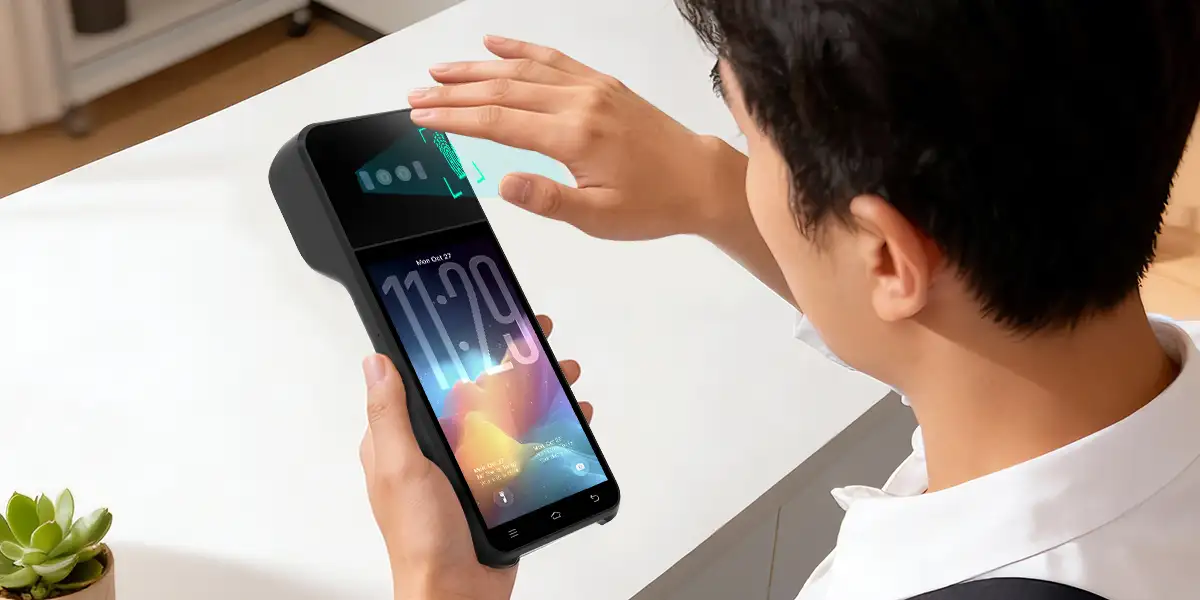
ZCS is the only manufacturer in this comparison with a commercially deployed palm vein POS terminal (Z108P). Palm vein recognition is contactless (hygienic), operates at 1:1,000,000 accuracy, and is suitable for banking, healthcare, and high-traffic member-loyalty environments where fingerprint sensors are impractical. The Z92 also supports fingerprint (FBI + STQC certified) for identity-verification use cases where finger contact is acceptable.
Three structural shifts are redefining what "good" looks like in the china wireless pos terminal market heading into 2026.
Android version cadence matters more than ever. With Android security patches delivered per-OS-version, terminals running Android 8 or 10 on end-of-life branches are increasingly ineligible for enterprise procurement in markets with data security requirements. Manufacturers that ship Android 13–16 and commit to multi-year update paths are gaining preference among financial institution buyers.
SoftPOS is moving from pilot to mainstream. The ability to accept contactless card payments on a standard Android device — without a certified hardware secure element — is expanding the addressable market for GMS-certified terminals into micro-merchant and pop-up commerce segments. Only terminals with GMS certification and NFC hardware can run SoftPOS applications.
Biometric identity verification is entering mainstream POS. Loyalty program authentication, unattended retail, and healthcare patient identification are creating demand for terminals that go beyond PIN entry. Palm vein technology addresses hygiene concerns in high-traffic shared environments where fingerprint sensors are impractical. Understanding what to look for as these capabilities become standard is covered in our guide on key differences between Android POS and Windows POS systems.
China's POS terminal manufacturers span a wider capability range than most buyers initially expect — from price-driven single-model suppliers running end-of-life Android to Tier 1 global companies holding the highest payment certifications available. The most important procurement step is matching your binding constraint (payment certification, Android openness, ODM flexibility, biometric capability, or unit cost) to the manufacturers who are genuinely strong on that dimension, rather than treating all Chinese POS brands as interchangeable.
If your project requires a fully open Android terminal with free ISV SDK access, GMS and SoftPOS capability, palm vein biometric options, or full ODM service for private-label hardware — explore the Full-Stack ZCS Android POS Terminals: The Open SDK & Custom ODM Guide for a deeper technical evaluation framework.
Q1: Which Chinese POS terminal brand offers the most open Android environment for ISVs?
ZCS offers a fully open Android environment with GMS certification (Z92/Z92S), a free SDK bundled with a Testing App and technical support, and no developer program fees. Newland and iMin also offer open Android on selected models, but SDK documentation depth and support response time vary by region.
Q2: Which China POS terminal has the highest payment certification level?
PAX Technology's A920Pro Premium and Newland's S90 both carry PCI PTS 7.x SRED — the current highest security level. Ingenico and Verifone also hold full PCI PTS and EMV certifications across their ranges. ZCS's Z90 carries PCI PTS 5.x with EMV L1/L2 and Visa/Mastercard/UnionPay approvals; the Z92 series is open-Android and does not hold payment certifications independently.
Q3: What is the difference between ODM and OEM for POS terminals?
OEM typically means applying your brand to an existing, fixed product design. ODM goes further: the buyer can specify hardware components (RAM, ROM, NFC, camera, biometric sensors), OS branding and firmware, enclosure colour, and packaging — resulting in a product genuinely differentiated from the base model. Among the ten brands in this comparison, only ZCS offers full ODM at flexible MOQs for B2B export.
Q4: Does GMS certification mean a terminal can process Google Pay?
GMS certification is a prerequisite but not sufficient on its own. The terminal must also support SoftPOS and the deploying PSP must be enrolled in the relevant Google Pay for Business programme. Among the brands listed, ZCS Z92S explicitly supports SoftPOS alongside GMS certification.
Q5: Which Chinese POS terminal supports palm vein biometric authentication?
ZCS Z108P is the only commercially available POS terminal in this comparison with integrated palm vein recognition, operating at 1:1,000,000 false-acceptance accuracy. It requires no skin contact (palm hover only), making it suitable for healthcare, banking, and loyalty authentication. No other manufacturer in this top-10 list offers palm vein capability






 Home
Home  China Best Restaurant Management Software for Enhanced Dining Experience?
