
2026-07-09 Author : ZCS
Businesses still running attendance on paper sign-in sheets or a shared PIN pad are losing more accuracy than most managers realize — every unverified punch is a small crack in payroll data that adds up fast across a full workforce. That's the core driver behind the shift toward modern time and attendance solutions: businesses want a system that's accurate, resistant to manipulation, and easy to maintain across multiple sites. This guide compares the main categories of attendance technology available in 2026 — paper, cards, GPS-based apps, and biometrics — and looks at why palm vein recognition specifically is gaining traction as a next-generation option among biometric methods.
The usual triggers are familiar: buddy punching and manual entry errors that quietly inflate payroll, growing compliance exposure around wage-and-hour recordkeeping, and the operational headache of managing attendance consistently across multiple locations or a distributed workforce. None of these problems are new, but the tools available to solve them have matured considerably — which is why so many businesses are actively re-evaluating their setup rather than sticking with whatever system they started with years ago.
The baseline against which every other option is measured. Cheap to start, but entirely dependent on honesty and manual transcription — there's no mechanism to confirm who actually signed in, and every entry has to be manually keyed into payroll, introducing both error and delay.
An upgrade in speed and record-keeping, but the core weakness is that a card or PIN is a transferable credential — anyone holding it can use it. This gap isn't hypothetical: a growing share of organizations now flag credential spoofing and unauthorized duplication as an emerging risk category for card-based systems specifically.
Well suited to remote or field-based teams, since GPS and geofencing confirm an employee was at the correct location when clocking in. The limitation is identity, not location: an app can confirm where a phone was, but not who was physically holding it — someone else can clock in from a shared or borrowed device just as easily as with a shared PIN.
Fingerprint and face recognition close the identity gap that cards, PINs, and GPS apps all share, since a biometric trait can't be handed off the way a credential can. Adoption has moved well past early-adopter status — the global time and attendance software market has been expanding at roughly an 11% compound annual growth rate in recent years, with biometric capability cited as a central driver of that growth. That said, fingerprint and face recognition each carry their own environmental tradeoffs, which opens the door to the next generation of biometric hardware built specifically to address them.
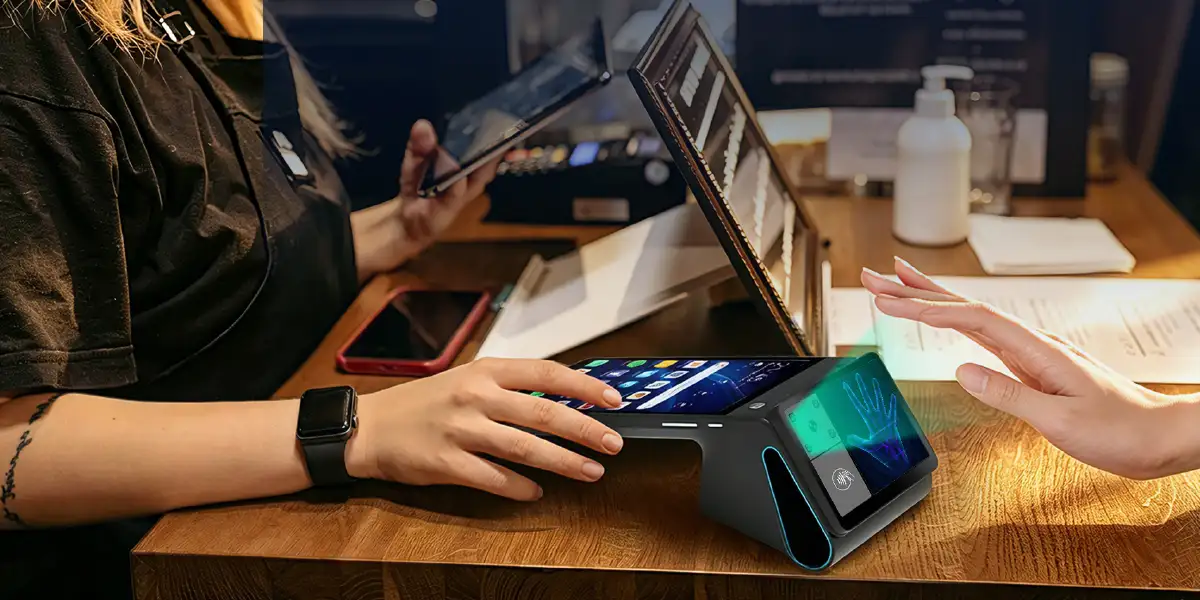
Every option above shares at least one of two weaknesses: a transferable credential, or a surface-level trait that's sensitive to dirt, moisture, lighting, or wear. Palm vein recognition addresses both. Because it reads the vein pattern beneath the skin using near-infrared imaging rather than a surface characteristic, it isn't degraded by dirty or damp hands the way fingerprint sensors can be, and — since the vein patterns cannot be captured externally the way a fingerprint or face can be photographed — it's structurally more resistant to spoofing. It's also fully contactless, which matters in shift-based environments where dozens of employees touch the same terminal every day.
As an example of what this looks like in deployed hardware, ZCS's Z108P is an 8-inch OEM palm vein terminal built for exactly this kind of high-volume, contactless verification — it performs server-side matching at 1:1,000,000 scale in under one second and includes living-body detection to resist spoofing attempts. For businesses evaluating whether palm vein is worth the jump from fingerprint or face recognition, hardware in this category illustrates the accuracy and throughput now available at the terminal level, rather than remaining a lab-only technology.
For a clearer breakdown of what the term "biometric" actually covers before comparing vendors, our definition of attendance biometric systems is a useful starting point. And if your attendance hardware will also double as an entry-point credential, the security considerations shift — see how access control security is evaluated differently from attendance accuracy alone.

Q1. Is palm vein recognition more expensive than fingerprint for time and attendance?
Generally yes, at the hardware level — palm vein sensors are a newer, more specialized technology than fingerprint readers. Many businesses justify the difference through lower long-term false-rejection rates and reduced spoofing risk in high-traffic environments.
Q2. Can GPS-based time tracking replace biometric verification entirely?
Not fully. GPS confirms location, not identity — it can't prevent one employee from clocking in on a coworker's behalf if they have access to the same device or app login.
Q3. Which time and attendance solution works best for multi-location businesses?
Cloud-managed systems generally scale better across multiple sites, since attendance data, scheduling, and payroll sync through one central platform rather than requiring separate local databases per location.
Q4. Is palm vein recognition hygienic enough for healthcare or food-service environments?
Yes — it's a fully contactless method, since the sensor reads the hand's vein pattern from a short distance rather than requiring physical touch, which is part of why it's gained traction in exactly these hygiene-sensitive settings.
Q5. Do employees need to worry about privacy with palm vein attendance systems?
Vein patterns are captured as an internal characteristic that can't be photographed or lifted from a surface the way a fingerprint can, which some employees find reassuring — though businesses should still provide clear notice and, where legally required, obtain consent before enrollment.






 Home
Home  What Can Ticket POS Systems Learn From World Cup Security?
