
2026-11-27 Author : ZCS
A payment API sits between checkout software and the services that authorize and record a transaction. The wider payment processing flow explains what happens among the merchant, processor, acquirer, network and issuer after the integration sends a request.
The interface itself has a narrower job.
A payment API is a documented software interface that lets an application request payment actions and receive structured results. It can create a payment, submit an amount, use a tokenized credential, capture an authorization, issue a refund and report status while the payment provider manages routing to the financial system.
That definition separates an API call from the card transaction it initiates. A successful API response records a specific system state; it does not replace settlement, payout or accounting.
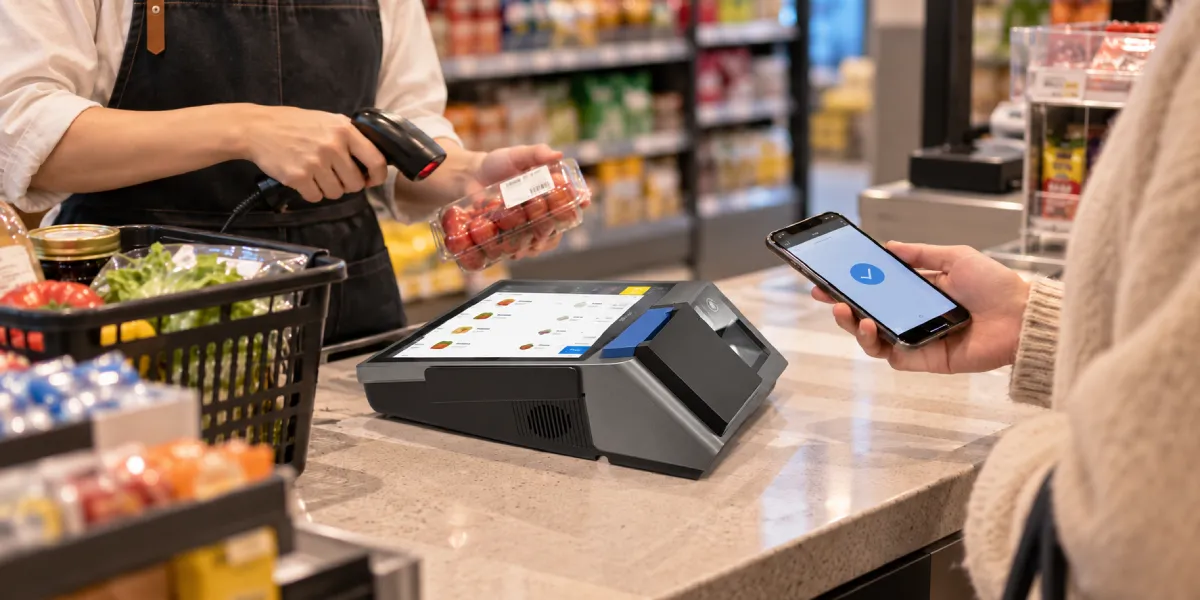
A payment API gives business software a controlled way to communicate with a payment service. The POS, ecommerce site, mobile app or back-office system sends a structured request. The payment service validates the request, performs the permitted action and returns a response containing a status, reference and any next step.
A typical request identifies the merchant, location, amount, currency, order, transaction type and payment method reference. It also carries an idempotency key and reconciliation metadata.
The payment API should not force the merchant application to store raw card numbers. A hosted page, certified terminal or provider-controlled component can collect the credential and return a token for later API calls.
The PCI Security Standards Council describes a token as a surrogate value that can replace a primary account number in merchant systems. Its tokenization security guidance also stresses that the complete path—from credential capture to authorization and later token use—must be considered as one implementation.
Payment API, POS API and payment SDK describe different integration boundaries. Vendors sometimes use the terms loosely, so the integration team should classify each interface by the data it controls and where the code runs.
| Integration component | Main purpose | Typical operations | Where it runs |
|---|---|---|---|
| Payment API | Control and query payment actions | Authorize, capture, cancel, refund, tokenize, retrieve status | Between applications and a payment service |
| Payment processing API | Route payment requests through a processor or gateway | Create transaction, submit credential reference, receive authorization result | Provider or processor environment |
| POS API | Exchange business and checkout records | Products, prices, orders, taxes, inventory, customers, staff, tenders | Between the POS platform and other business systems |
| Payment SDK | Provide prebuilt payment code or device interaction | Launch checkout UI, collect a credential, call terminal functions | Inside a mobile, web or terminal application |
| POS hardware SDK | Control terminal peripherals | Print, scan, read NFC tags, drive a customer display | On the POS device |
A payment API represents the payment as a stateful resource. The application creates or retrieves that resource, then performs allowed actions such as capture or refund. The response should identify the payment and distinguish its current state from the requested action.
For example, `refund_requested` confirms receipt of a request, while `refunded` confirms completion.
A POS API connects the transaction to the commercial context around it. A restaurant integration may create a menu order, add modifiers, route items to the kitchen and close the check after payment. A retail integration may read product data, reserve stock, record a sale and post a return.
The payment and POS records should remain linked but distinct. One order can have several attempts, split tenders, partial refunds or a later chargeback.
An SDK reduces implementation work but does not define the commercial scope of the service. A payment SDK may wrap API calls, render checkout screens or communicate with a card terminal. A hardware SDK may expose a printer or scanner without providing any acquiring connection.
The Android POS SDK guide covers local printers, scanners, NFC readers and customer displays. Those device calls can participate in checkout, but they do not authorize a card payment by themselves.
A reliable payment integration follows one transaction across several related records. The exact endpoint names vary, but the operational sequence is consistent.
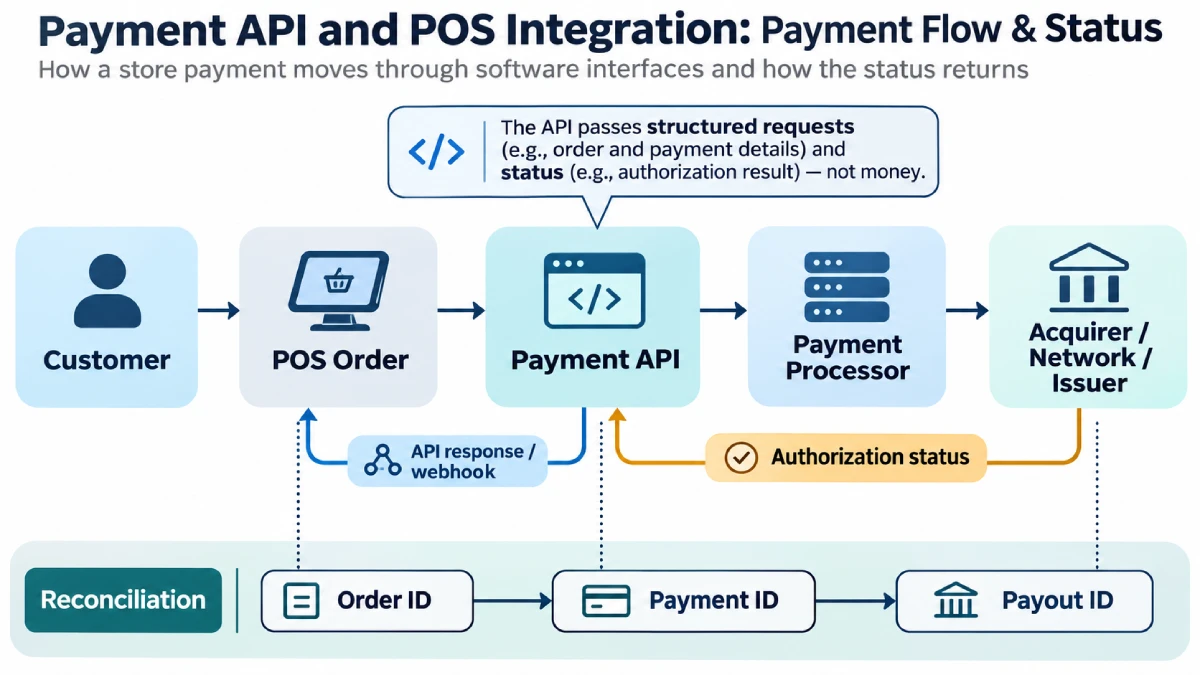
The POS first calculates what the customer owes. The order contains items, quantities, tax, discounts, service charges, currency and a stable order ID. The integration should freeze or version the payable amount before asking for authorization so that later edits do not silently change an active payment.
The application sends the amount, currency, order reference and payment context to the payment API. The provider returns a payment ID and either an immediate result or instructions for the next step, such as presenting a terminal prompt or completing customer authentication.
The order ID belongs to the sales system; the payment ID belongs to the payment service. Both are required for support.
The credential should enter through an approved collection path. In a store, a certified terminal can read a chip, contactless card or mobile wallet. Online, a hosted field or payment component can collect card details without sending them through the merchant’s ordinary application server.
The payment API can receive a token, terminal session ID or payment-method reference instead of a raw account number.
The synchronous response tells the application what the payment service knows at that moment. A result may be approved, declined, pending, cancelled or require another action. The application should store the payment ID, status, amount, currency, timestamps and provider reference.
Some outcomes arrive later. A webhook reports state changes; a status endpoint confirms the record when an event is delayed or the local connection failed.
The POS should close fulfilment only under a defined payment state. An approved authorization may be sufficient for immediate retail fulfilment, while another workflow may wait for capture. Pending and unknown results should enter an exception queue rather than being converted into approvals or declines.
The final record should connect the order, payment, terminal, authorization, refund and payout references.
A modern POS API needs enough coverage to complete a business workflow, not just export yesterday’s sales. The required endpoints depend on the use case, but six capability groups determine whether the platform can support serious integrations.
| Capability | What the API should expose | Why it matters |
|---|---|---|
| Catalog | Products, variants, modifiers, prices, taxes and availability | Keeps channels aligned with the POS |
| Orders | Create, retrieve, update, cancel and fulfil orders | Supports ecommerce, delivery and restaurant workflows |
| Payments | Payment status, tender type, capture, void and refund permissions | Connects checkout action to the financial record |
| Inventory | Location-level stock, reservations, adjustments and movement events | Prevents overselling and supports replenishment |
| Customers and loyalty | Customer IDs, consent-aware profiles, points and rewards | Connects recognition to permitted customer actions |
| Operations | Locations, terminals, staff roles, webhooks, audit events and exports | Supports deployment, support and reconciliation |
Write access matters as much as read access. A platform that exports orders but cannot create or update them may work for reporting but fail for a delivery or cloud-kitchen project. A platform that creates orders but cannot return fulfilment status may force staff to manage two screens.
Event coverage matters as much as endpoint count. An integration needs timely notice when an order is accepted, rejected, modified, paid, refunded or fulfilled. Incomplete webhooks leave connected systems with stale state.
An open ecosystem gives qualified developers practical, documented and durable access to the functions they need. A public documentation page is useful, but openness is determined by the full path from registration to production support.
The OpenAPI Initiative defines a language-neutral format that lets people and tools understand an HTTP service without reading its source code. An OpenAPI description supports documentation, validation and testing, but does not guarantee production access or complete business coverage.
Use this evaluation framework when comparing POS systems with open APIs:
The top POS API is the interface that passes the target workflow test with the least unsupported custom work. A large app marketplace can be valuable for a merchant seeking ready-made tools. Direct API access matters more to an enterprise building proprietary ordering, ERP, loyalty or multi-country operations.
The existing open API manufacturer checklist addresses the supplier and hardware decision. The checklist above evaluates the software contract itself, so the two pages answer different stages of the purchase.
A timeout creates an unknown outcome, not an automatic failure. The server may have completed the payment even though the POS never received the response. Repeating the same request without a recovery rule can charge the customer twice.
An idempotency key gives one intended operation a unique identifier. The client sends the same key when retrying that operation, and the server returns the existing result instead of creating a second payment. The key must not be reused for a different amount or order.
HTTP itself treats GET, PUT, DELETE and safe methods as idempotent, but POST is not automatically safe to repeat. RFC 9110 on idempotent methods explains why a client should only retry a non-idempotent request when the application knows how to preserve one intended effect.
A production recovery sequence should be explicit:
A decline is a completed decision; an unknown status means the application lacks evidence of the outcome.
Payment API security starts with narrow access and controlled credential handling. Each integration should receive only the permissions required for its workflow, such as reading orders without issuing refunds or refunding payments only for an assigned merchant location.
OAuth 2.0 provides a framework for giving an application limited access to an HTTP service through access tokens. RFC 6749 requires access tokens to remain confidential in transit and storage and supports restricted scopes. An implementation must also define token lifetime, rotation, revocation and the identity represented by each credential.
The security review should cover server-side authorization for every merchant, location and object ID; separate test and production credentials; TLS; signed webhooks; secure secret storage; masked payment data; audit logs; and rate limits.
Authentication identifies the client; authorization controls what the client may do. A valid token must not let one merchant retrieve another merchant’s payment by changing an ID.
Payment integration is incomplete until finance can match transactions to fees and payouts. A checkout response proves that a payment reached a defined state. Reconciliation determines whether the sales record, payment record, refund activity and bank payout agree.
The API or export should provide:
Merchant acquiring explains why authorization and bank funding are separate. The merchant acquiring process connects the merchant-side acceptance relationship to clearing, settlement and payout.
A payment API should preserve financial lineage instead of overwriting the original transaction. A refund should create a linked negative event. A partial capture should retain both the authorized amount and captured amount. A fee should remain separate from the customer’s purchase amount.
A POS without a public API requires a supported alternative integration path or a change in scope. Screen scraping, direct database access and unofficial reverse engineering create fragile dependencies and can bypass access controls.
The practical options are:
A single API does not erase differences among POS, ecommerce, invoicing and property-management systems. Middleware must show which functions are native, translated or unavailable.
A small vertical test reveals more than a long feature list. Build one transaction from order creation through payment, fulfilment, refund and reconciliation before committing to a platform rollout.
The release decision should depend on the complete workflow, not a successful demo charge. Production readiness means the integration can recover from uncertainty, protect payment data and explain every financial record.
Choose the POS system whose API can complete your exact workflow with documented access, reliable state handling and usable reconciliation data. Start with the required objects and actions, then test the difficult paths: duplicate requests, delayed events, partial refunds, offline terminals and version changes.
A merchant buying ready-made integrations should prioritize a proven app ecosystem and accountable support. An enterprise should prioritize API coverage, sandbox quality, version stability and data portability. “Open API” should mean the required integration can be built, tested and upgraded without undocumented dependencies.

A payment API is a software interface that lets an application create and manage payment actions through a payment service. It usually returns structured transaction states and references for authorization, capture, cancellation, refund and status queries.
No. A payment API is an interface, while a payment gateway is a service layer that securely transmits payment information. A gateway can expose an API, and one provider can combine gateway, processing and acquiring services.
POS API integration connects a POS platform with another business system. The integration can exchange products, orders, inventory, customers, payments, fulfilment events and reconciliation records according to the permissions offered by the POS.
A payment API defines requests and responses between systems; a payment SDK packages code for a particular language, application or device. The SDK may wrap the API, provide user-interface components or communicate with a payment terminal.
No. Open API usually means the interface is documented and available under defined access rules. Production credentials can still require merchant authorization, partner approval, security review or a commercial agreement.
Webhooks report events that occur after the original API request or outside the requesting application. The receiver should verify the signature, tolerate duplicate delivery and query the payment API when the final state remains unclear.
Idempotency keys, status queries and controlled retry rules prevent one intended payment from becoming several transactions. The POS should treat the result as unknown until it retrieves authoritative status or receives a verified event.
A ready-made connector or middleware service can reduce custom development when the POS and delivery platforms expose the required operations. The project still needs configuration, field mapping, testing and exception handling for rejected, modified or duplicated orders.






 Home
 How Does Just Walk Out Technology Track Shopping and Complete Payment?

