2026-11-27 Author : ZCS
Just Walk Out technology turns in-store activity into structured order and payment records. That makes it part of a wider retail data system: the same sales events can also feed AI inventory management, replenishment and loss analysis after the shopper leaves.
The customer experience is simple because the difficult work happens in the background.
Just Walk Out technology is Amazon’s cashierless checkout system for identifying what shoppers take, maintaining a virtual cart and completing payment without scanning every item at a register. Current deployments use either computer vision with sensor fusion or RFID-tag detection, depending on the merchandise and store format.
The technology removes the conventional checkout stop. It does not make the store, payment network or back office disappear.
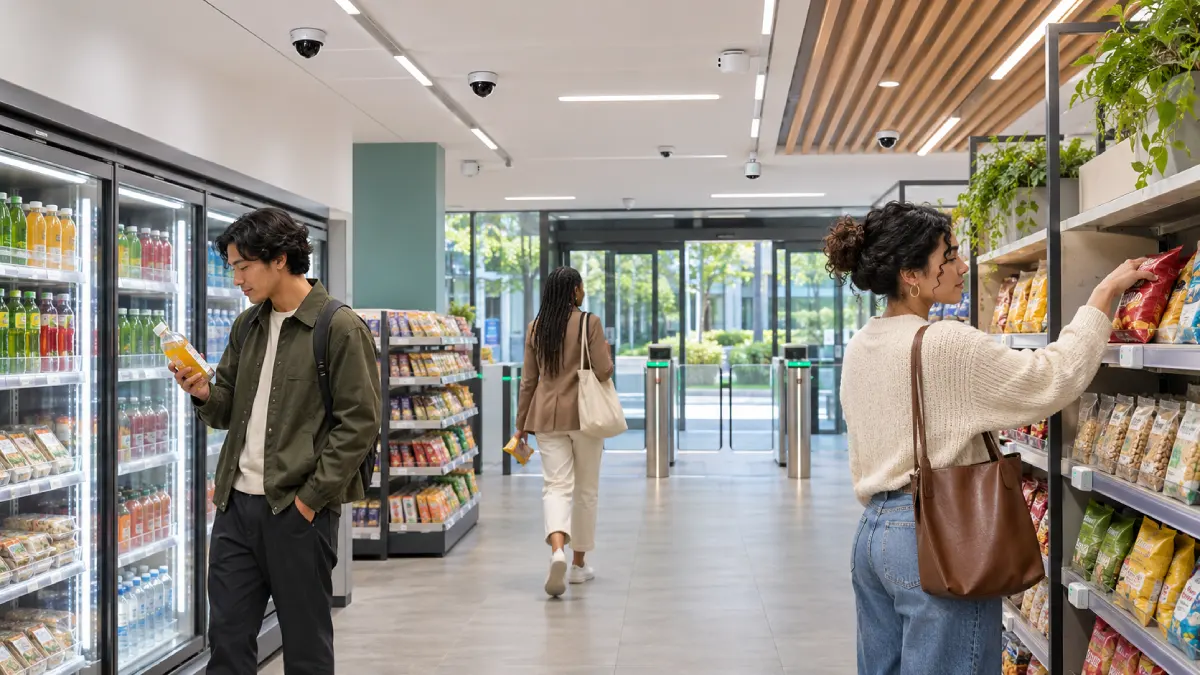
Just Walk Out technology is an automated checkout system built for stores where shoppers enter, select merchandise and leave without visiting a cashier. The system connects an entry credential or payment method to a temporary shopping session, observes which products enter or leave the shopper’s virtual cart and creates the final transaction record.
Amazon currently describes two main technical approaches on its Just Walk Out overview:
Both approaches can produce checkout without conventional barcode scanning, but they solve the identification problem differently. Computer vision interprets activity throughout the store. RFID identifies physical tags at the lane.
Just Walk Out is a product name, while cashierless checkout is the broader category. Other checkout-free stores may use smart carts, scan-and-go applications, RFID gates, vending-style cabinets or a combination of technologies.
A Just Walk Out transaction moves through five operational stages: entry, session tracking, item recognition, cart completion and payment. Each stage needs a reliable identifier so the store can connect physical actions to one digital order.
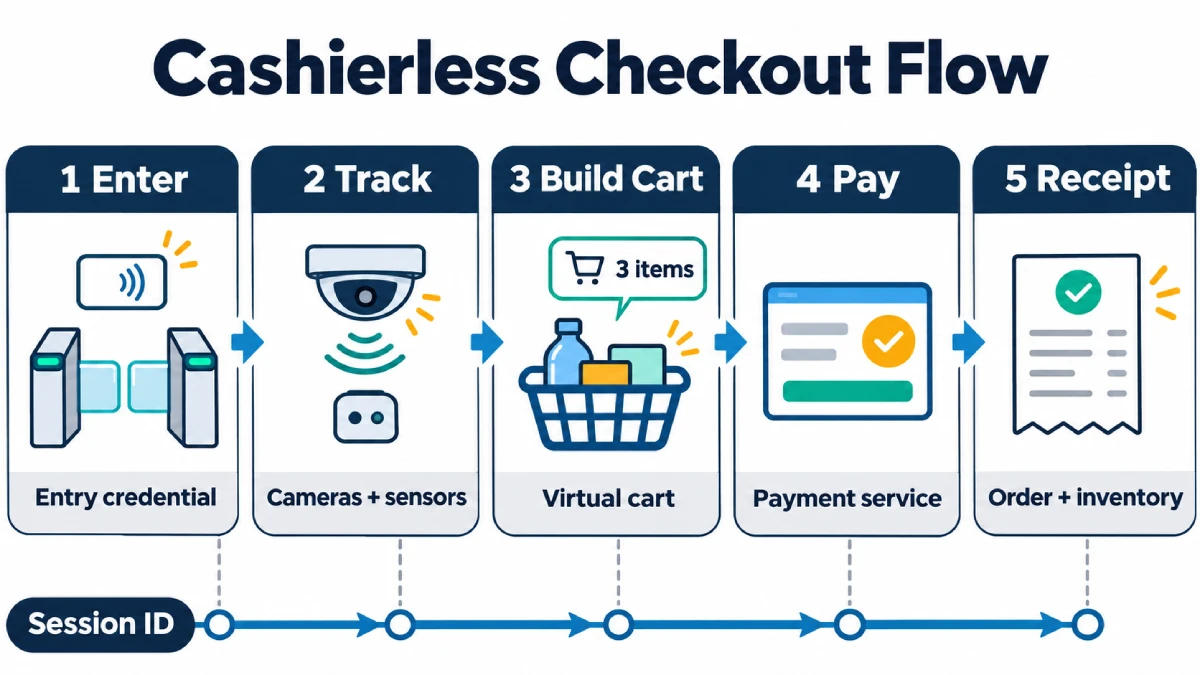
The entry process links the shopper or group to a payment or account method. Depending on the deployment, the shopper may tap a card, scan an application, use an employee badge or enter through another configured access path.
The system creates a temporary session rather than treating every visible person as a named identity. Amazon says its computer-vision approach assigns a temporary numeric code for the visit and does not use biometric information to identify the shopper.
Computer-vision stores follow movement and product interactions across a mapped retail space. Ceiling cameras provide overlapping views. Machine-learning models connect a shopper’s path with hand movements, shelf locations and the store’s product catalog.
RFID deployments read tags attached to merchandise. Each suitable product needs a working tag associated with the correct stock record. The exit lane detects the tags being carried through it and converts those tag reads into a cart.
The virtual cart adds an item when the system attributes a take action to the shopping session. Returning the product should remove it. Taking two units, passing an item to another group member or placing merchandise on the wrong shelf creates a more complex attribution problem.
Amazon’s 2024 system update explains that its multi-modal model processes camera, weight-sensor and other inputs together. The multi-modal Just Walk Out model also uses a 3D store map and merchandise image catalog to interpret product locations and interactions.
The exit event tells the system that the session is ready for completion. The platform resolves the items and quantities attributed to the shopper, calculates the amount and sends the transaction through the configured payment arrangement.
RFID lanes can show the detected cart and total before the shopper completes payment. Computer-vision stores may complete the order after the customer exits and then deliver a digital receipt.
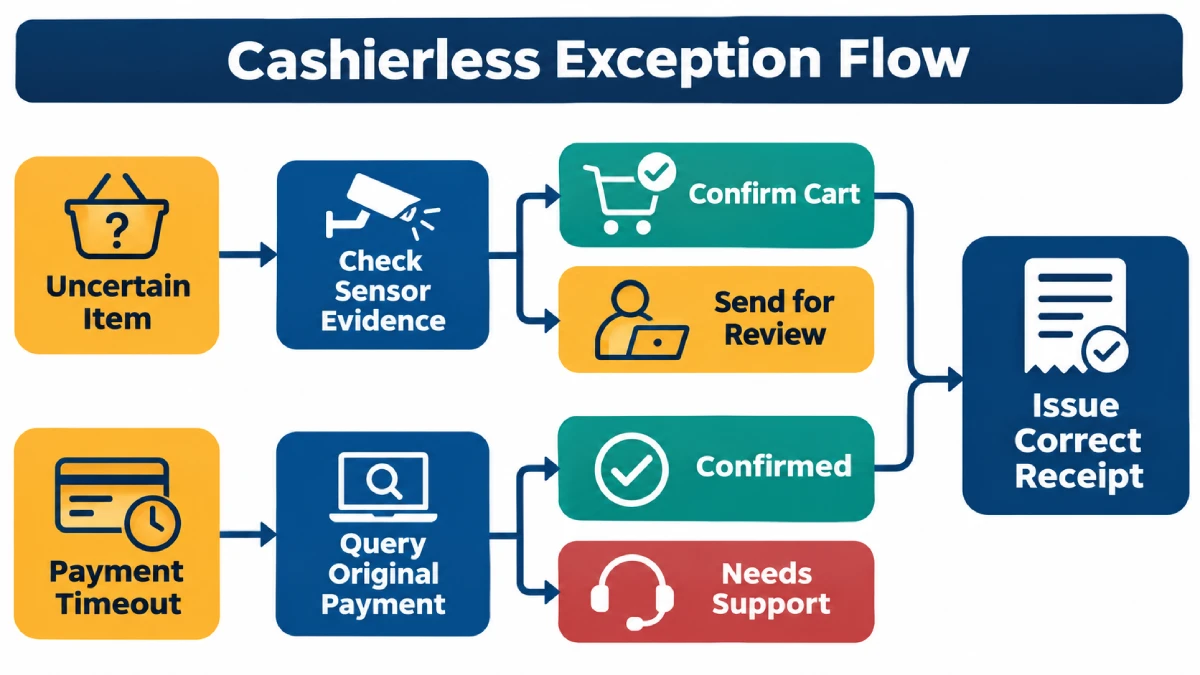
The receipt shows what the automated system concluded the shopper purchased. It should list the products, quantities, prices, taxes, total and payment reference. The retailer also needs a route for receipt questions, incorrect items and refunds.
This final stage matters because a frictionless exit can still produce a post-purchase exception. The operating model must make correction easier than disputing a mysterious charge.
A cashierless store is a coordinated system, not one AI camera. The hardware observes events; the software connects those events to products, orders, payments and inventory.
| System layer | Main job | Typical components |
|---|---|---|
| Entry and exit | Start and close the shopping session | Gates, card reader, badge reader, app scanner, lane display |
| Store sensing | Observe people, products and shelf activity | Ceiling cameras, shelf sensors, RFID readers and antennas |
| Product identification | Determine which SKU and quantity moved | Image catalog, store map, RFID tag database, weight data |
| AI and event processing | Convert observations into cart events | Computer vision, sensor fusion, action recognition, edge and cloud services |
| Commerce system | Price the cart and create the order | Catalog, tax rules, promotions, POS or order-management software |
| Payment system | Authorize, capture and record payment | Payment terminal, processor connection, tokens and transaction APIs |
| Back office | Update stock and investigate exceptions | Inventory, reporting, receipt support and loss-prevention tools |
Store mapping is part of the technical installation. The system needs to know where shelves, refrigerators and products sit. Merchandising changes must reach the digital map or catalog so the recognition layer does not rely on outdated product placement.
Network and power design affect the customer experience. Cameras, readers, gates and local computing require stable power. Payment and cloud-connected services require monitored connectivity, while the store needs a defined response when one component becomes unavailable.
Computer vision and RFID are complementary checkout-free routes, not interchangeable labels. The merchandise, packaging, tagging process and customer flow determine which route fits.
| Factor | Computer-vision store | RFID checkout lane |
|---|---|---|
| Main identification method | Cameras plus sensor fusion | Radio detection of item tags |
| Best fit | Packaged food, drinks and curated convenience ranges | Apparel, fan merchandise and tagged goods |
| Customer action | Take or return products naturally | Carry tagged products through the lane |
| Store preparation | Camera coverage, product images and mapped fixtures | Tag application, tag-to-SKU association and lane tuning |
| Common challenge | Occlusion, similar products and complex group interactions | Missing, damaged, duplicated or incorrectly associated tags |
| Cart visibility | Often shown after or near exit | Can be shown on the lane screen before payment |
The underlying RFID technology identifies tagged objects without requiring a camera to recognize the packaging. RFID therefore shifts part of the deployment effort from visual store mapping to consistent item tagging and tag-data management.
Amazon introduced portable RFID lanes for events and pop-up retail in January 2026. Amazon reported that the latest lanes can be installed in hours and include cart-total displays, dynamic pre-authorization and motorized gates. Those figures describe Amazon’s deployment model rather than an industry-wide installation time.
The system combines several observations instead of trusting one frame or one sensor. A camera may see a hand reach toward a shelf, a weight sensor may detect a change and the store map may identify which products occupy that position. The model then assigns the event to a shopping session.
Four situations make this difficult:
Sensor fusion gives the platform several pieces of evidence for the same action. No single sensor removes every error. The store layout, catalog accuracy, camera coverage, training data and operational discipline all affect the quality of the final cart.
This is also where cashierless stores differ from AI vending machines. A vending machine controls a small cabinet and known release mechanism. An open store must interpret free movement across a larger space with more products and shoppers.
The shopper may present a payment method at entry, but the final amount is determined after the cart is resolved. The entry interaction can identify the payment instrument and support a pre-authorization. The later transaction uses the completed cart total.
The payment flow still contains familiar records:
The payment API integration remains responsible for stable order IDs, transaction status, retries and reconciliation. Cameras can determine the basket, but they cannot replace the processor, acquirer, card network or issuer.
A payment timeout must not be treated as a free purchase or an automatic decline. The system needs to query the original transaction, preserve its identifiers and prevent duplicate charges. The customer-support view should connect the receipt, order, payment and any refund.
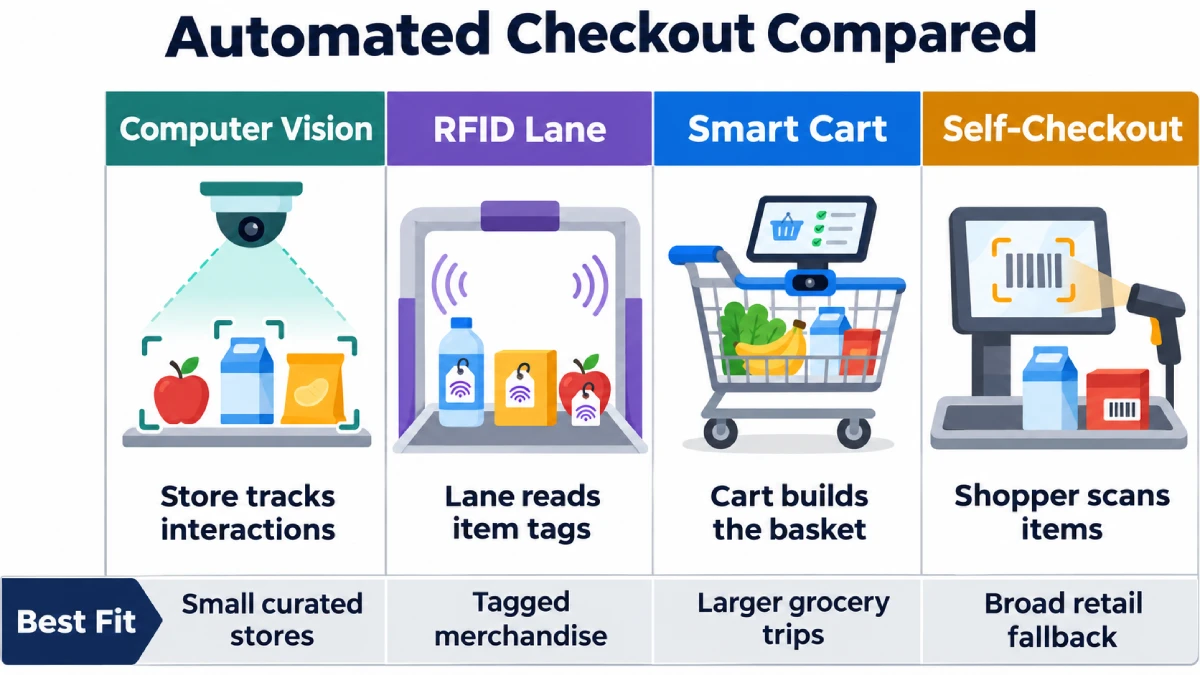
Automated checkout systems reduce different parts of the cashier’s work. The phrase frictionless checkout does not identify one technical architecture.
| Checkout model | Who identifies the products? | Where the cart is built? | Customer still scans? |
|---|---|---|---|
| Just Walk Out computer vision | Cameras, sensors and AI | Store platform | No |
| RFID exit lane | RFID readers detect tagged goods | Lane and retail platform | No individual barcode scan |
| Smart cart | Cart cameras, scales or scanners | Shopping cart | Sometimes |
| Scan-and-go | Customer phone or handheld scanner | Mobile application | Yes |
| Self-checkout | Customer and checkout scanner | Checkout station | Yes |
| AI vending machine | Cabinet sensors and release system | Machine platform | Usually no |
Self-checkout moves scanning to the shopper; checkout-free technology removes the scanning stop. Smart carts keep the running total visible during a larger shopping trip. Scan-and-go lowers hardware requirements but depends on customer scanning discipline.
Biometric identity can also be added to a checkout process without identifying products. The biometric self-checkout workflow explains how payment, loyalty and age checks can share an identity layer while the checkout system still maintains the basket.
Amazon states that Just Walk Out computer vision does not collect biometric information to identify shoppers. The system follows a temporary shopping-session code and product interactions rather than creating a named facial identity.
This distinction does not mean the store has no privacy obligations. Cameras still observe movement, systems still process payment and receipt records, and retailers still need clear notices, access controls, retention rules and incident procedures.
Amazon One is a separate palm-recognition service. A store may use Amazon One as an entry or payment method, but Just Walk Out can also start a session through a card, application or badge. The product-recognition system and identity credential should be evaluated as separate data flows.
Cashierless checkout performs best where queue time is expensive and the shopping mission is short. Stadium concessions, airports, hospitals, campuses, workplace stores and small convenience formats have concentrated demand and curated products.
Strong use cases share several traits:
Large grocery trips create a different customer need. Shoppers may want a running total, produce weighing, substitutions and visible savings before exit. Amazon’s April 2024 checkout update positioned smart carts as a better fit for many large weekly grocery trips while keeping Just Walk Out focused on smaller, mission-driven formats.
The most important failures are incorrect carts, payment uncertainty and unavailable store systems. A launch plan should define what customers and staff do in each case.
| Failure | Customer impact | Required operating response |
|---|---|---|
| Item added incorrectly | Receipt is too high | Review interaction and correct or refund the item |
| Item missed | Receipt is too low | Record the exception and investigate sensing or catalog data |
| Entry method rejected | Shopper cannot start | Offer another supported entry or staffed checkout path |
| Payment status unknown | Receipt or charge is delayed | Query the original payment and block duplicate submission |
| Camera or reader unavailable | Cart confidence falls | Restrict entry, use fallback checkout or close the affected area |
| Product map or tag data is wrong | Wrong SKU or price appears | Correct master data and audit affected transactions |
| Age-restricted item detected | Sale requires approval | Route to staff verification before completion |
Cashierless does not mean staffless. Employees still replenish shelves, correct product data, assist customers, approve restricted sales, clean sensors and investigate incidents. Automation changes the work from repetitive scanning to supervision and exception resolution.
Amazon changed its physical-store strategy but did not end Just Walk Out as a retail technology. Amazon’s April 2024 technology update was amended on January 27, 2026 to state that Amazon Go and Amazon Fresh physical stores were closing or being converted. That store decision is separate from third-party deployments.
Amazon reported in January 2026 that Just Walk Out operated in more than 360 third-party locations across five countries and processed 36.7 million items across 17.7 million shopping sessions during the preceding year. The same 2026 Just Walk Out update reported more than 150 new stores in 2025 and continued expansion through computer-vision and RFID formats.
The deployment pattern has moved toward specific formats rather than one universal cashierless supermarket model. Stadiums, healthcare facilities, universities, workplaces, events and small-format retail match the technology’s speed advantage more directly than every grocery environment.
All deployment counts, cost reductions and customer performance figures in Amazon announcements are Amazon or project-partner data. They establish current commercial activity but are not an independent comparison of every cashierless platform.
The buying decision should start with products and customer flow, not the AI label. A retailer should test the complete operation from store entry to refund.
A pilot should include real shopping complexity. Test groups, product handoffs, returns to the wrong shelf, similar packaging, crowded aisles, interrupted connectivity, declined payments and refunds. A perfect single-shopper demonstration proves little about daily operation.
Just Walk Out technology automates checkout by connecting a temporary shopping session to product-recognition and payment systems. Computer-vision deployments infer who took what from cameras, store maps and sensors. RFID deployments identify tagged merchandise at controlled lanes.
The technology works best when checkout speed has high value, the product range is controlled and the retailer can maintain strong payment, catalog and exception workflows. It does not eliminate retail operations; it moves the hardest work away from barcode scanning and into sensing, data quality, integration and customer support.
Just Walk Out technology is Amazon’s automated checkout system for tracking selected products, maintaining a virtual cart and completing payment without a conventional cashier scan.
The store links an entry credential or payment method to a shopping session, finalizes the detected cart at exit and sends the amount through its payment service.
Computer-vision Just Walk Out stores use ceiling cameras and may combine them with shelf sensors. RFID lane deployments identify tagged products through radio readers instead.
Amazon states that Just Walk Out does not use biometric identification. It assigns a temporary code to the shopping session. Amazon One palm recognition is a separate service that can be used as an entry or payment method.
The system should detect the return action and remove the item from the virtual cart. Cameras, shelf sensors, store maps and product data help resolve the event.
No. Self-checkout requires the customer to scan or enter products at a checkout station. Cashierless checkout identifies products during shopping or at an automated exit lane.
The standard checkout-free flow is designed around electronic payment or an account-linked credential. A retailer that must accept cash needs a separate staffed or self-service payment path.
No. Just Walk Out is deployed at third-party locations including stadiums, hospitals, universities, workplaces, travel sites and event stores.






 Home
 How to Accept Apple Pay in a Store: Merchant Setup, Readers, Testing and Fees?

