2026-11-25 Author : ZCS
An AI vending machine is a self-service retail system that uses connected sensors, software and sales data to make product recognition, payment, stock control or replenishment more automatic. Some models still dispense one selected item through a traditional mechanism. Others use cameras, shelf sensors or weight data to identify several products taken from an unlocked cabinet.
The intelligence does not replace the basic vending workflow. The machine still has to identify a sale, request payment, release the correct product, confirm the result and record what happened. Buyers planning the payment side should therefore start with an unattended payment terminal buyer’s guide, then decide which AI functions solve a real operating problem.

An AI vending machine adds data-driven decision-making to automated retail. Depending on the design, it can recognize what a customer selected, detect low stock, recommend a restocking route, flag unusual activity or adjust the product mix using sales history.
This creates three common machine types.
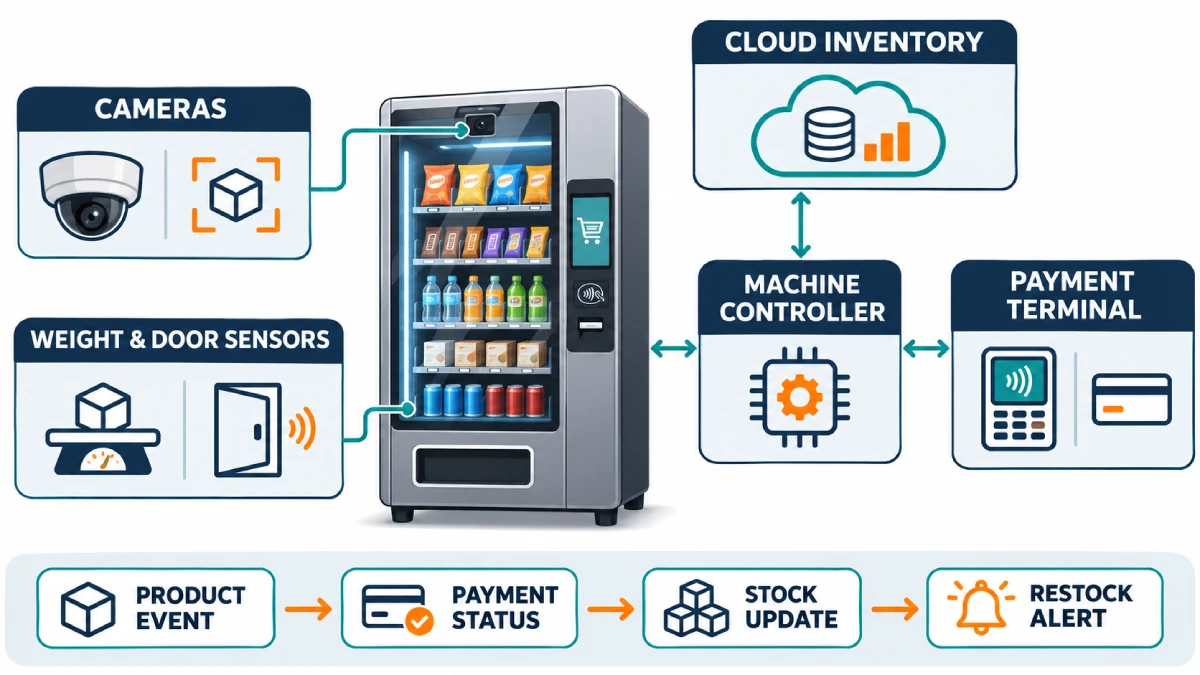
The customer selects a numbered product, pays and waits for a motor or other dispensing mechanism to release it. Connectivity sends sales, stock and fault data to a management platform. Algorithms can forecast demand or recommend replenishment, but product selection remains explicit.
This design adds tools such as drop sensors, temperature monitoring, shelf sensors or cameras. The extra signals help confirm delivery, monitor product conditions and improve the accuracy of inventory records.
The customer authenticates or presents a payment method, opens a door and removes one or more products. Cameras and shelf data determine which items were taken. The system then calculates the basket and completes the transaction. This resembles compact autonomous retail more than a conventional spiral machine.
The label matters because these designs have different costs, risks and integration requirements. A connected drink machine may need dependable telemetry and a contactless reader. A smart cabinet also needs product-recognition logic, camera placement, lighting control and a method for resolving uncertain baskets.
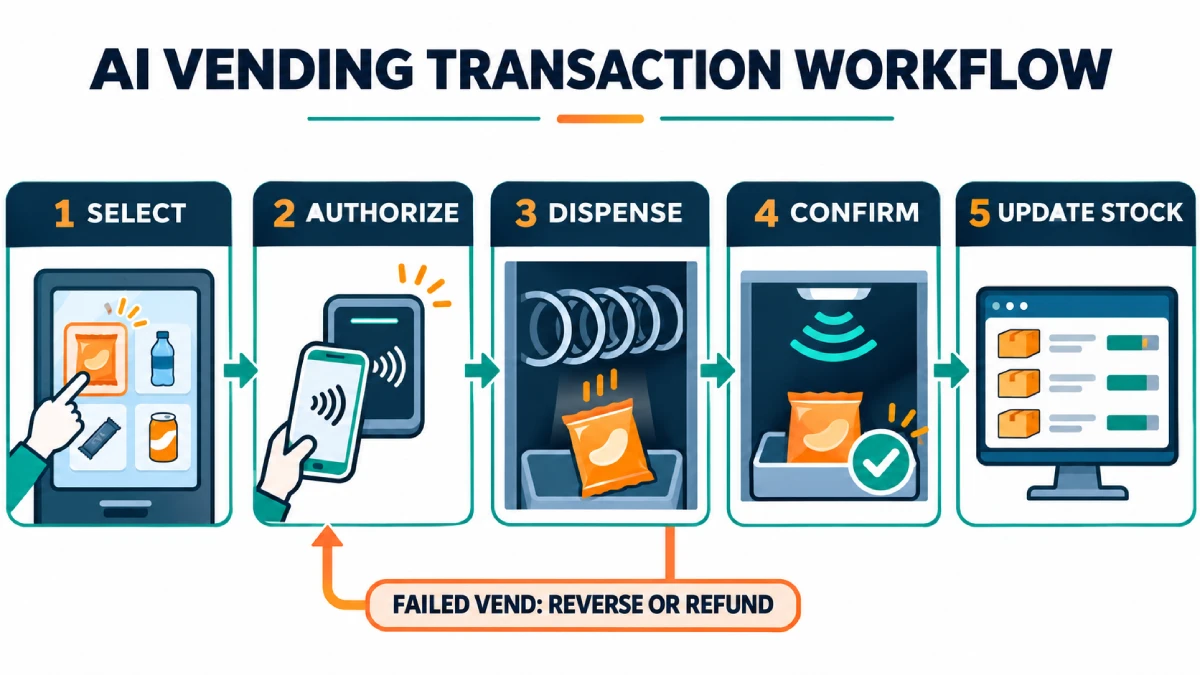
A successful sale can be understood as a sequence of connected decisions.
In a traditional machine, the action may be a product code entered on a keypad or touchscreen. In a smart cabinet, it may be a card tap, QR scan or app action that unlocks the door.
A numbered selection directly maps to a product slot. A vision system must recognize packaging, position and quantity. Weight sensors can show that an item was removed or returned. Door sensors define the period in which the customer interacted with the cabinet.
NVIDIA’s smart self-checkout reference workflow illustrates why product recognition often combines computer vision with barcode or other product data. The model produces a result, while business rules decide whether the confidence is high enough to continue or whether the transaction needs another check.
For a card or mobile wallet, the payment device sends the transaction through the configured payment service. For a QR payment, the customer may scan a merchant-presented code or show a customer code to the machine. The exact message flow depends on the payment provider and market.
A dispensing machine activates a motor only after receiving the expected approval signal. A smart cabinet may authorize access before the final basket is known, then calculate the amount after the door closes.
Payment approval alone does not prove that a can, snack or other item reached the customer. A drop sensor, motor response or product-detection event should confirm delivery. If the item does not dispense, the workflow needs a defined retry, reversal or refund path.
The completed sale changes on-hand inventory, updates the machine’s sales log and feeds the remote management platform. This data can then support forecasting and route planning.
AI is useful when it turns high-volume machine data into a practical action. It should not be treated as a decorative label for any connected vending machine.
Computer vision can distinguish packaging, track items removed from a shelf and compare the observed basket with a product catalogue. Performance depends on consistent lighting, camera angles, packaging changes and the similarity between products.
The strongest architecture uses more than one signal. A camera may identify a bottle, a shelf sensor may detect its removal, and a product map may confirm that the item was stored in the expected location. When the signals disagree, the system can flag the event instead of silently charging for the wrong product.
Sales history can reveal which products sell by location, day, time and season. A forecasting model can recommend reorder quantities and help operators avoid sending the same stock mix to every machine.
Forecasting becomes more useful when it includes lead time, machine capacity, promotions, spoilage and service schedules. The goal is not a perfect prediction. It is a better replenishment decision than a fixed route and a fixed quantity.
For a deeper view of the sales-to-replenishment chain, see how AI inventory management connects POS data with forecasting and automated restocking.
An AI system can flag repeated failed dispenses, unusual door openings, inventory changes without matching sales, temperature deviations or transaction patterns that differ from normal activity. Operators can then prioritize machines that need attention.
An alert still needs a clear operational response. A useful platform shows the machine, time, event, likely cause and recommended action. A dashboard full of unexplained scores does not reduce service work.
Machine-level data can show that one location needs more cold drinks, another needs breakfast products and a third performs poorly after office hours. Operators can use this evidence to change the assortment, facings or refill schedule.
Dynamic pricing is also possible, but it requires visible prices, consistent transaction records and rules that customers can understand. Price changes should never create a mismatch between the screen, payment request and receipt.
Payment choice affects customer access, transaction speed and recovery when something goes wrong.
NFC lets a customer tap a compatible contactless card, phone or wearable close to the reader. EMVCo explains that an EMV contactless transaction exchanges payment data at close range and generates transaction-specific security data.
For the customer, the action is simple. For the operator, it requires a payment device, acquiring or payment service, network path, approved software and correct integration with the machine controller. The reader should not be evaluated in isolation.
The underlying technology is covered in more detail in this plain-language guide to NFC technology and Android device modes.
QR payments can work in two main ways. The machine displays a transaction code for the customer to scan, or the customer presents a wallet code for the machine to read. The payment service must return a reliable result to the vending application before goods are released or the door session is finalized.
QR can expand wallet coverage without adding a card interface for every scheme. It also creates practical requirements: screen or scanner quality, code refresh rules, network timing and protection against reusing an old payment result.
Factories, campuses and offices may use employee IDs, stored-value accounts, meal allowances or membership apps. These systems can simplify repeat use and apply organization-specific rules. They also create account-management work for enrollment, lost credentials, refunds and balance reconciliation.
The payment system answers whether the transaction can proceed. The vending system answers whether the product was delivered. Those events must be linked by a unique transaction record.
If payment is approved but dispensing fails, the system should record the machine response and start the configured recovery process. If the customer receives the product but the network response is uncertain, the operator needs a way to check the final payment status before charging again or issuing a refund.
Vending projects often combine components from different suppliers. The machine controller operates motors, doors and sensors. The payment terminal handles the configured payment methods. The management platform stores machine, transaction and inventory data.
MDB/ICP is widely used for communication between vending-machine components, while EVA Data Transfer Standard helps move operational data into management and accounting systems. The European Vending Association maintains an overview of these vending technical standards.
Newer systems may also use serial connections, Ethernet, USB or application interfaces. A modern connector does not remove the need to define messages for approval, cancellation, vend success, vend failure, door state and timeout recovery.
This is why an unattended payment terminal is not the same as a complete POS system. The terminal can take payment, while the wider vending system manages product selection, delivery and inventory.
Every product needs a known identity and location. In a spiral machine, that means mapping a slot to a SKU, price and capacity. In a smart cabinet, it can include shelf position, expected weight, packaging images and permitted substitutes.
A completed sale reduces the recorded quantity. A refill increases it. Product movement without a matching sale should create an exception. This basic discipline is more important than an advanced forecast built on unreliable stock data.
An effective restocking platform can provide:
Operators should also define who may correct inventory and how those corrections are logged. Without an audit trail, manual adjustments can hide recurring recognition or refill errors.
An unattended machine is exposed to customers without a cashier present, so physical and digital controls have to work together.
The payment device should match the required payment program and installation environment. PCI Security Standards Council’s PTS Point of Interaction standard covers device categories used to protect PIN entry and account data, including unattended payment terminals and related components.
The wider system also needs secure configuration, restricted remote access, signed software updates, credential management and event logging. Payment data should stay within the payment architecture rather than being copied into the vending application without a defined need.
Camera-based systems add privacy questions. Operators should define why images are collected, what is stored, how long it is retained, who can access it and whether recognition can work with minimized or event-based data. A product-recognition camera should not automatically become a customer-identification system.
AI vending works best where self-service demand is steady and remote operation has measurable value.
Traditional vending remains the better choice when the product range is simple, dispensing is reliable and the operator does not need camera-based basket recognition. AI earns its place when it reduces stockouts, service visits, product-recognition work or transaction exceptions.
Use a pilot machine and test the complete operating cycle.
Choose an AI vending machine by workflow, not by the number of features on its sales page. First define how customers select products, how payment is authorized, how delivery is confirmed and how inventory changes. Then add computer vision, forecasting or anomaly detection where each function produces a clear operating benefit.
The strongest system is not the one with the most visible AI. It is the one that consistently connects product recognition, payment, delivery, stock records and exception handling from the machine to the operator’s dashboard.

It is a self-service retail machine that uses connected data, sensors and algorithms to automate tasks such as product recognition, inventory monitoring, demand forecasting or fault detection.
No. A machine can be smart because it is connected and remotely managed. It becomes AI-driven when models or data-based decision systems perform functions such as visual recognition, demand prediction or anomaly detection.
Smart cabinets commonly combine cameras with shelf weight, door events, product position or other sensors. The system compares those signals with a product catalogue and creates a basket.
Yes. A compatible unattended payment device can accept supported contactless cards, phones and wearables. The payment terminal must also communicate correctly with the machine controller and payment service.
Yes. The machine can display a QR code for the customer to scan or read a code presented by a wallet. The vending application must wait for a trusted payment result before completing the sale.
The machine should record the failed delivery and trigger its configured retry, reversal or refund process. Payment approval and product delivery need separate status records linked to the same transaction.
Some machine functions can continue locally, but remote monitoring and many payment methods need connectivity. Offline payment behavior depends on the payment service, risk rules and terminal configuration.
Test normal sales, recognition accuracy, failed dispenses, network loss, duplicate actions, refunds, inventory updates, refill workflows, remote support and privacy controls on a real pilot machine.






 Home
 How Clover POS Combines Payment Processing, Hardware and Business Software?

