
2026-05-15 Author : ZCS
Payment fraud is no longer a fringe risk — it is a systemic cost of doing business. According to a 2026 industry outlook report, global e-commerce fraud losses exceeded USD 40 billion in 2024 and are forecast to surpass USD 100 billion by 2029. Meanwhile, the European Banking Authority reported that card payment fraud losses within the EU/EEA reached EUR 1.329 billion in 2024 alone — a 29% year-on-year increase.
Against this backdrop, PIN codes and magnetic stripe cards are increasingly inadequate. The industry is converging on a more robust answer: biometric verification built directly into the point-of-sale terminal. Among available modalities, commercial palm vein recognition stands out for its combination of contactless operation, near-zero spoofing risk, and enterprise-grade accuracy.
Shenzhen ZCS Technology has positioned its BVS (Biometric Verification System)-enabled POS lineup at the center of this shift. This article examines why palm vein recognition has become the preferred choice for commercial deployments, how ZCS hardware is architected, how the authentication pipeline works end-to-end, and what compliance and procurement criteria businesses should evaluate before deploying.
The case for upgrading POS authentication is increasingly hard to ignore. Card-not-present (CNP) fraud now accounts for approximately three-quarters of total payment fraud losses in the United States. In Asia-Pacific, online payment fraud losses were expected to exceed USD 200 billion in 2024, and the region is projected to lead global fraud losses by 2025.
Traditional authentication methods face a converging set of limitations:
● PIN codes can be observed, shared, or extracted via social engineering.
● Magnetic stripe and chip cards can be cloned or physically stolen.
Fingerprint sensors are susceptible to lifted latent prints, and their accuracy degrades with skin abrasion, moisture, or aging — a material concern in retail and industrial environments.
Palm vein recognition directly addresses these gaps. Because the biometric trait is located beneath the skin and requires active blood flow to register, it is inherently resistant to presentation attacks using photographs, silicone replicas, or lifted prints. The vein pattern is also genetically distinct: even identical twins have different vascular structures, and the pattern remains stable throughout adulthood.
From a commercial scaling perspective, the technology is also hygiene-friendly — no surface contact is required — and works regardless of whether a user's hands are dry, wet, or lightly soiled. This makes it substantially more reliable than fingerprint sensors in high-throughput retail and healthcare environments.
The accuracy gap between the two modalities is significant and well-documented. According to the International Biometrics + Identity Association (IBIA), commercial palm vein systems regularly achieve a False Acceptance Rate (FAR) of ≤ 0.0001% — meaning fewer than 1 in 1,000,000 unauthorized attempts are falsely approved. By comparison, standard fingerprint systems typically carry a FAR of 0.01%–0.1%, and facial recognition in uncontrolled environments can reach 1%–2%.
Beyond accuracy, a palm vein scan contains roughly ten times more unique feature points than a fingerprint on the same hand. This data density contributes directly to its lower error rates and greater suitability for large-enrollment commercial deployments where individual-level distinction is critical.
The biometric POS terminal market as a whole reflects this momentum: valued at USD 11.2 billion in 2024, it is projected to reach USD 31.9 billion by 2032, growing at a 14% CAGR.
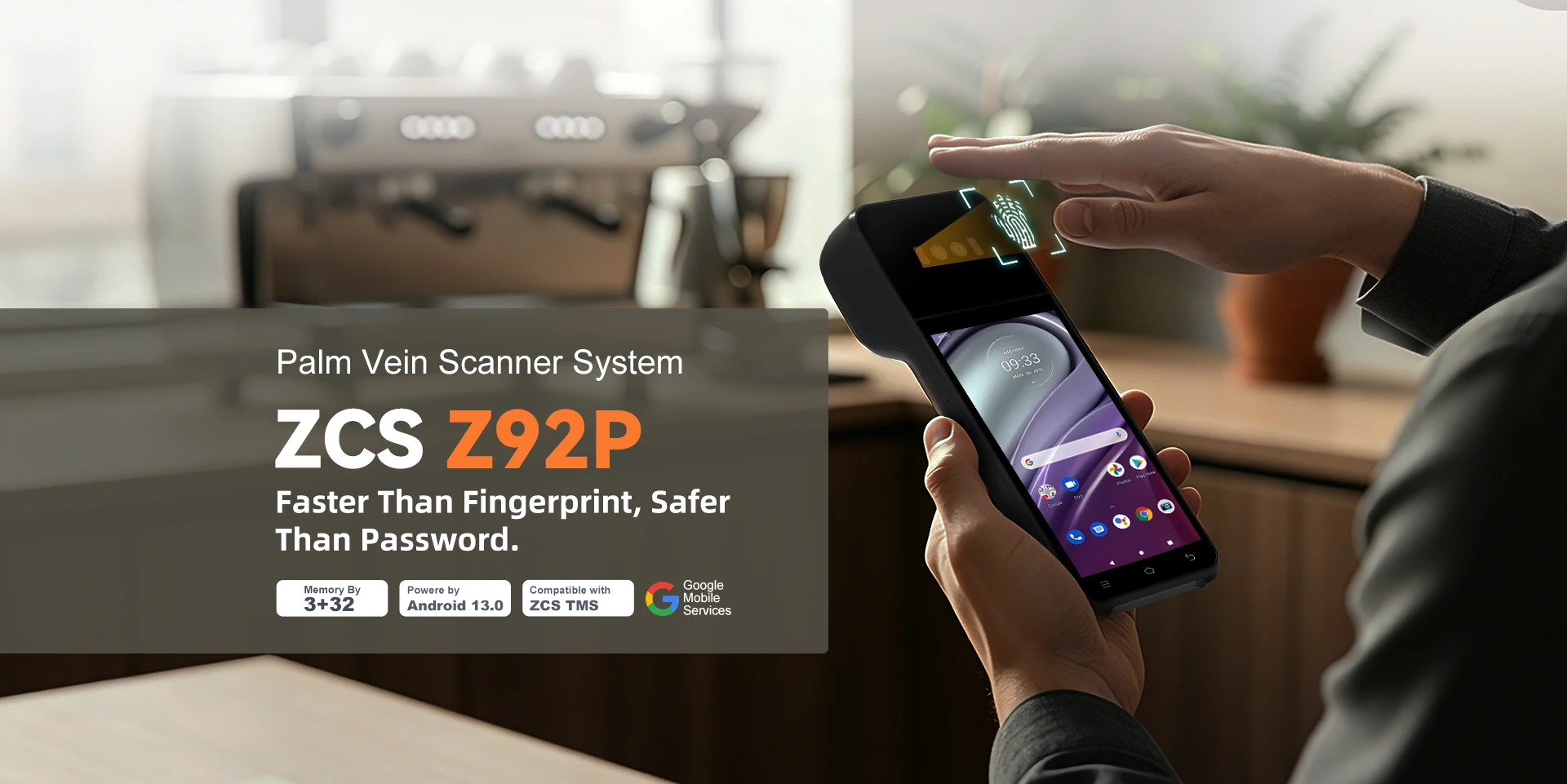
Hardware Architecture and Biometric Stack ZCS's BVS-enabled POS lineup integrates palm vein biometrics directly into a payment-grade hardware platform, rather than treating the scanner as a peripheral add-on. The flagship example is the Z92, a purpose-built biometric terminal that combines palm vein identification, Android 13.0 Go OS, and multi-protocol payment support in a single form factor.
Key hardware components include:
● Near-infrared (NIR) or RGB-IR dual-mode palm vein sensor: Captures the unique subcutaneous vascular pattern using safe infrared light. The sensor requires real blood flow for registration, providing inherent liveness detection without a separate software layer.
● Recognition speed: Sub-second identification — the Z92 is specified at under 1 second per authentication — enabling high-throughput deployment at busy checkout points.
● Multi-modal identity support: The device supports palm vein, palm print, 1D barcode, and QR code on a single unit, reducing hardware complexity for merchants.
● Payment interfaces: NFC, and QR code payment support.
● Connectivity: Dual-band Wi-Fi, Bluetooth 5.0, GPS, and 3G/4G modules for global deployment flexibility.
● Display: 5.5-inch HD touchscreen for operator and customer interaction.
Biometric templates are stored encrypted on-device, not as raw images. The system stores only a mathematical representation of the vein pattern, which cannot be reverse-engineered to reconstruct the original biometric.
ZCS operates as both an OEM and ODM manufacturer, offering hardware customization — casing, screen size, additional modules such as national ID card readers — alongside a developer SDK and dedicated technical support channel for system integrators. The company states a supply capability of 24-hour sample shipping and 15–30-day delivery for bulk orders.
ZCS's approach to next-generation hardware is built on three architectural decisions that distinguish it from first-generation biometric POS concepts.
First, the sensor is embedded rather than externally attached, which eliminates cable failure points, reduces counter footprint, and allows the device to pass as a standard-looking POS terminal in retail environments.
Second, onboard AI chips enable real-time edge inference — biometric matching and risk scoring occur on-device, without mandatory cloud connectivity. This means the terminal can operate in low-latency or offline scenarios without degrading the authentication experience.
Third, the hardware integrates sustainable design practices: recyclable high-grade plastic casings and low-power display technologies are part of the product roadmap, aligned with enterprise ESG requirements.
Understanding the authentication chain is important for both security evaluation and integration planning. In a ZCS BVS terminal, a completed palm vein payment follows this sequence:
● Scan initiation: The customer places their palm over the NIR sensor at a distance of approximately 5–10 cm. The sensor captures the subcutaneous vascular pattern using infrared light, which is absorbed by hemoglobin in the blood.
● Template extraction: The captured image is processed by an on-device algorithm that extracts a unique mathematical feature vector — the biometric template. No raw image is retained after this step.
● Liveness detection: Because the sensor requires active blood flow to generate a valid scan, spoofing with a photograph, silicone mold, or severed limb is not feasible with current methods. This liveness check is hardware-enforced rather than software-only, making it substantially more robust than camera-based facial recognition liveness.
● On-device matching: The extracted template is compared against the enrolled template stored in the device's encrypted local database. Matching occurs on the secure processor — not on a remote server — which eliminates network latency and removes a potential data exfiltration vector.
● Transaction authorization: A successful match triggers the payment authorization signal to the payment application, which proceeds through the standard NFC transaction flow.
● Offline resilience: The ZCS architecture supports local matching in the absence of internet connectivity, with a defined fallback policy for edge cases. This is critical for retail environments with intermittent connectivity or for deployments in developing markets.
The full authentication cycle — from hand placement to authorization signal — completes in under one second under standard operating conditions, making the experience comparable in speed to a contactless card tap while providing significantly higher identity assurance.

Selecting the appropriate BVS-enabled POS configuration requires aligning hardware capabilities with operational context. The following dimensions are the most consequential in enterprise procurement decisions.
Transaction volume and throughput: Sub-second recognition is the baseline requirement for any high-traffic retail or banking application. Verify that the device's specified recognition speed is benchmarked under realistic enrollment database sizes — matching against 10,000 templates is computationally different from matching against 100,000.
Deployment environment: NIR palm vein sensors generally perform consistently across normal indoor lighting conditions. However, for outdoor-facing deployments (kiosk terminals, transit gates), confirm the sensor's operational illuminance range and whether RGB-IR dual-mode imaging is included, as this provides better resilience under variable light conditions.
Integration depth: ZCS supports three primary integration models:
● Standalone: The terminal handles both biometric authentication and payment processing independently, suited for small-to-medium merchants with limited backend infrastructure.
● Semi-integrated: The terminal handles payment processing while communicating authentication events to an existing POS software stack via API, suited for merchants with established software they wish to retain.
● Full integration: The biometric and payment layers are both managed by a central platform via the ZCS SDK and REST API, suited for enterprise retail chains, banking networks, or government programs requiring centralized enrollment management and audit logging.
Enrollment and lifecycle management: For deployments exceeding several thousand users, evaluate whether batch pre-enrollment (via a separate enrollment station) is supported, and confirm the process for template revocation and re-enrollment — for example, if a user's vein pattern changes temporarily due to illness or injury.
Total cost of ownership: Hardware unit cost is only one component. Factor in acquirer qualification fees for certified devices, ongoing TMS (Terminal Management System) support, firmware upgrade cycles, and the avoided cost of fraud. For context, the palm vein scanner market was valued at USD 797.7 million in 2024 and is projected to grow at a CAGR of 6.52% through 2035, reflecting sustained enterprise investment in the category.
OEM and customization options: For regional deployments with specific branding, regulatory, or hardware requirements — such as national ID card readers in certain markets — ZCS's OEM/ODM capability allows hardware and software customization within its established certification framework, avoiding the need to re-certify from scratch.

The convergence of escalating fraud losses, tightening compliance requirements, and rising customer expectations for contactless, frictionless payment experiences has made the transition to biometric POS authentication a commercial imperative rather than a differentiator.
ZCS POS devices with BVS address this convergence directly: palm vein recognition delivers hardware-enforced liveness detection, sub-second authentication, and FAR performance that fingerprint and facial modalities cannot match at commercial scale. For businesses scaling commercial palm vein recognition — whether in retail, banking, healthcare, or government services — ZCS offers a hardware platform that integrates security, compliance, and operational flexibility without requiring organizations to choose between them.
Q1: What is BVS and how does it work with ZCS POS devices?
BVS (Biometric Verification System) is ZCS's integrated palm vein authentication platform built directly into its POS hardware. When a customer places their palm over the NIR sensor, the device captures the subcutaneous vascular pattern, extracts a mathematical template, and matches it against the enrolled record — all on-device, in under one second.
Q2: Is palm vein data stored securely on ZCS devices?
Yes. ZCS BVS terminals store only an encrypted mathematical representation of the vein pattern, never a raw image. The template cannot be reverse-engineered to reconstruct the original biometric, and matching occurs on the secure on-device processor rather than a remote server.
Q3: Can ZCS POS devices with BVS operate without an internet connection?
Yes. The ZCS architecture supports fully local biometric matching without cloud connectivity. A fallback policy — such as PIN override — is available for edge cases, making the terminal suitable for environments with intermittent connectivity or developing-market deployments.
Q4: What integration options are available for businesses adopting ZCS BVS terminals?
ZCS supports three models: standalone (self-contained authentication and payment), semi-integrated (biometric terminal paired with existing POS software via API), and full integration (centralized management via ZCS SDK and REST API). Free SDKs and dedicated technical support are provided, with compatibility across Wiegand, TCP/IP, and REST API protocols.
Q5: Can the hardware be customized for regional or enterprise requirements?
Yes. ZCS operates as both an OEM and ODM manufacturer, offering customization of casing, screen size, and additional modules such as national ID card readers. Customization is available within ZCS's established certification framework, so businesses avoid the need to re-certify hardware from scratch.
Related Posts
1. Palm Vein Payment The Contactless Biometric 'Black Tech' Reshaping Finance Commerce
2. Z92 Palm Vein Scanner POS: Secure Biometric Transactions
3. Palm Vein Recognition: Secure Biometric Authentication for Modern Identity & Access | ZCS






 Home
Home  What is a Mobile Credit Card Machine and How Does It Work?
