2026-11-03 Author : ZCS
Mastercard biometric payments do not describe one universal checkout system. The phrase covers at least two distinct models: device-based authentication for online payments and store-based biometric identification linked to a payment credential. The wider palm biometrics identity guide explains the identity layer; this article focuses on where that layer sits inside a Mastercard payment flow.
The category becomes easier to understand once the location of the biometric check is made explicit.
Mastercard biometric payments use a biological characteristic to support payment authentication or customer identification. A payment passkey unlocks a cryptographic credential on a personal device, while in-store biometric checkout matches a face or palm through enrolled merchant-side infrastructure before a linked payment credential enters the payment network.
The practical difference is simple: a phone can verify its owner without sending the biometric to the merchant, whereas a biometric checkout service must recognize an enrolled shopper at the store.
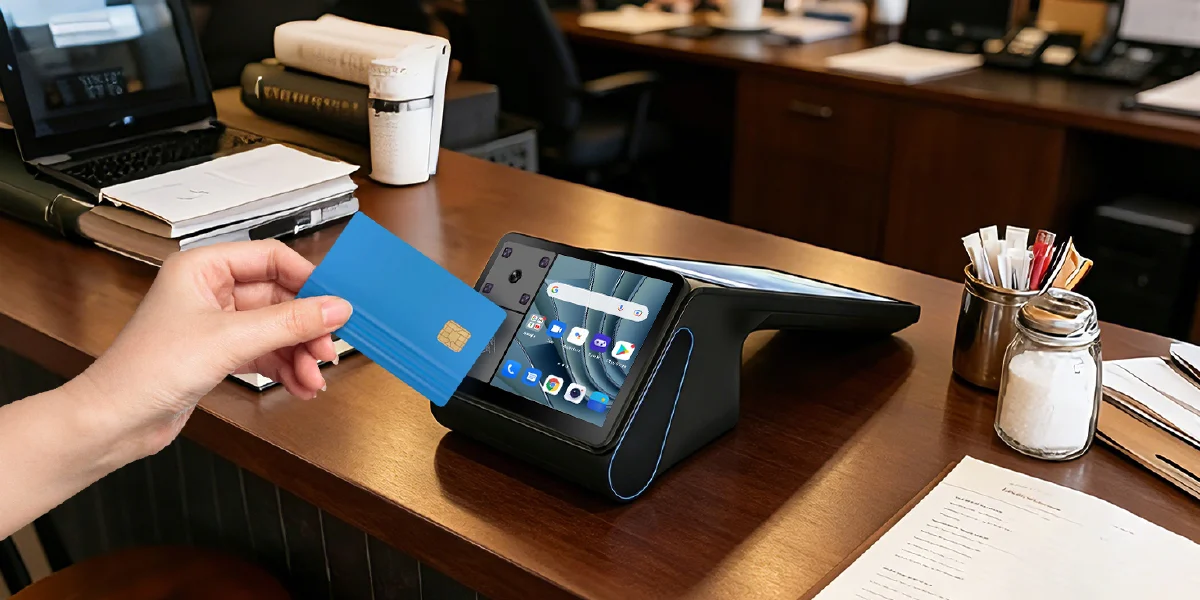
Mastercard’s June 1, 2026 announcement is about online checkout across Europe. The company described a path toward reducing manual card entry and static credentials by combining tokenization, Click to Pay, payment passkeys and Identity Check. The announcement did not say that European stores must install face cameras, fingerprint readers or palm scanners.
The distinction matters because the word *biometric* can make two unrelated customer experiences sound identical. A shopper who approves an online order with a fingerprint on a phone has used a biometric locally. A shopper who looks at a retail camera or presents a palm to a reader has interacted with a biometric system operated for the store checkout environment.
Mastercard reported that three in five Mastercard e-commerce transactions in Europe were tokenized, merchant tokenization was live in 45 European countries and territories, and Click to Pay was available in 32 European markets. Those figures in the 2026 European checkout update describe digital commerce infrastructure. They do not measure adoption of biometric readers at physical counters.
The 2030 goal is also narrower than a general “biometric future” claim. Mastercard is working toward tokenized e-commerce and less dependence on manually entered card numbers. A payment passkey can authenticate an online transaction within that model, but the passkey does not turn a conventional card terminal into a facial-recognition terminal.
A Mastercard payment passkey is a cryptographic credential used to authenticate an online purchase. The shopper normally approves the request with the same local mechanism used to unlock a trusted device, such as a fingerprint, face scan or device PIN.
The biometric is not the passkey itself. The passkey consists of cryptographic keys associated with the service and stored or managed through a device or passkey provider. The fingerprint sensor or face-recognition system allows the device to use that credential after local user verification.
Mastercard describes the consumer flow in three broad steps:
Mastercard’s payment passkey explanation states that biometric data stays on the device and is not shared with Mastercard or the merchant. The remote service receives evidence that the authentication requirement was satisfied rather than a copy of the shopper’s fingerprint or face image.
The passkey therefore changes how an online payment is authenticated, not where the underlying account balance is held. The card account, tokenized credential, merchant checkout, issuer decision and payment network still have separate roles.
The phone sends a cryptographic response, not the shopper’s face or fingerprint. A payment service issues a challenge, and the device uses the relevant private key after local verification. The service checks the resulting response against the corresponding public key.
That architecture reduces dependence on passwords and one-time codes that can be copied or phished. It also limits the amount of biometric information available to the online merchant because the merchant does not need to receive or compare the user’s biometric template.
FIDO Alliance explains that a passkey is a device-held credential unlocked through a biometric, PIN, pattern or other device mechanism. Its passkey technical overview also distinguishes synced passkeys from device-bound passkeys and confirms that local biometric processing remains on the user’s device.
A payment passkey and a payment token solve different problems. The passkey helps prove that an authorized user approved the checkout. The payment token represents payment credentials without exposing the original card number in the same way as manual card entry.
The two controls can operate together. Click to Pay can organize the checkout experience, tokenization can protect the card credential, and a payment passkey can support authentication. An issuer or risk system can still make a separate authorization decision after those steps.
The layers can be summarized as follows:
| Layer | Main job | Typical party responsible |
|---|---|---|
| Checkout interface | Presents eligible payment choices | Merchant or checkout provider |
| Payment passkey | Authenticates the user through a trusted device | Device, passkey provider and payment service |
| Tokenization | Replaces the exposed card number with a payment token | Network, issuer and token service participants |
| Authorization | Approves or declines the transaction | Issuer and payment network participants |
| Settlement | Moves and reconciles funds after authorization | Acquirer, network, issuer and merchant provider |
Mastercard’s Biometric Checkout Program is a framework for participating in-store biometric payment services. A shopper enrolls a face, palm or another supported biometric with a service and links that identity record to a payment credential. Compatible store equipment can then recognize the shopper during checkout.
Mastercard launched the program as a set of standards and guidelines for banks, merchants and technology providers. The framework addresses areas such as security, biometric performance and data protection, while implementation partners provide the recognition system, enrollment experience and merchant integration.
The basic customer journey is different from a payment passkey:
Mastercard’s original Biometric Checkout Program announcement described enrollment through a merchant or identity-provider application and checkout through a smile or hand gesture at compatible equipment. Mastercard also named technology partners because the network does not supply every camera, sensor, matching engine or merchant application by itself.
The biometric system therefore sits beside the conventional payment chain rather than replacing the entire chain. Identification can select a linked credential, but transaction processing still depends on merchant acceptance, an acquirer, the payment network and the issuer.
Payment passkeys and biometric checkout differ most in where recognition occurs and who operates the enrollment relationship. The comparison below separates the two models without assuming that one is universally safer or more convenient.
| Question | Mastercard payment passkey | In-store biometric checkout |
|---|---|---|
| Primary environment | Online or app-based checkout | Participating physical store |
| Capture hardware | Shopper’s phone, computer or security device | Store camera, palm reader or integrated biometric terminal |
| What the biometric unlocks | A cryptographic credential on the device | An enrolled identity or payment profile in the checkout service |
| Does the merchant receive the biometric? | The merchant should receive an authentication result, not the local biometric | Data handling depends on the biometric service architecture and privacy terms |
| Enrollment relationship | Cardholder, device/passkey provider and supported payment service | Shopper, merchant or identity provider, biometric operator and payment partners |
| New hardware at checkout | Usually none beyond the shopper’s existing device | Compatible capture hardware and store integration are required |
| Typical fallback | Device PIN, another device, account recovery or another authentication route | Card, mobile wallet, QR payment, cash or assisted identity recovery |
| Main operational problem | Passwords, OTP friction and manual online card entry | Recognizing an enrolled shopper without a card or phone at the counter |
| Main privacy question | Security and recovery of the device-held credential | Consent, template custody, retention, matching and deletion across service partners |
The architecture produces a clear data boundary.
A payment passkey verifies control of a cryptographic credential on a personal device; local face or fingerprint data does not need to leave that device. In-store biometric checkout captures a customer at merchant equipment and compares the sample within an enrolled recognition service before retrieving or activating a linked payment profile.
The table also explains why the two systems require different merchant decisions. An online merchant may enable a supported checkout and authentication service without buying biometric hardware. A physical retailer must evaluate capture devices, lane layout, enrollment, notices, fallback payment, matching performance and operational support.
A payment passkey does not normally give the merchant a copy of the shopper’s face or fingerprint. The device performs local user verification and releases a cryptographic response. The merchant or payment service checks that response rather than matching a biometric image.
This separation is central to the passkey model. A phone may use facial recognition to authorize use of a passkey, but the face is not automatically converted into a merchant loyalty identity. The merchant may know the customer through an account, email address, card token or delivery information, yet that data relationship is separate from the device’s biometric template.
In-store biometric checkout works differently because recognizing the shopper is the intended function. The service needs an enrolled reference and a live capture route at the store. The responsible parties must therefore explain who stores the reference, where matching happens, which partners can access results and how a customer can withdraw consent or delete enrollment.
A face or palm does not contain a payment balance. The biometric helps find or verify an enrolled identity record. The linked card, wallet or account remains the source of the payment credential and ultimately determines where the money comes from.
This distinction prevents a common misunderstanding. The biometric template is not a card number, and a successful biometric match is not the same as issuer authorization. A valid match can identify the intended payment profile, while the issuer can still decline the transaction for insufficient funds, risk controls, account status or another reason.
The broader contactless and biometric payment overview describes several payment interfaces that can coexist at one counter. A merchant may accept cards, phones, QR codes and a biometric service through different technical paths even when the customer experiences each option as a quick checkout gesture.
A conventional POS terminal does not become a biometric checkout terminal through a software label alone. A store-based system needs a suitable camera or palm sensor, positioning that supports reliable capture, a biometric application, enrollment and matching services, payment integration and a fallback route.
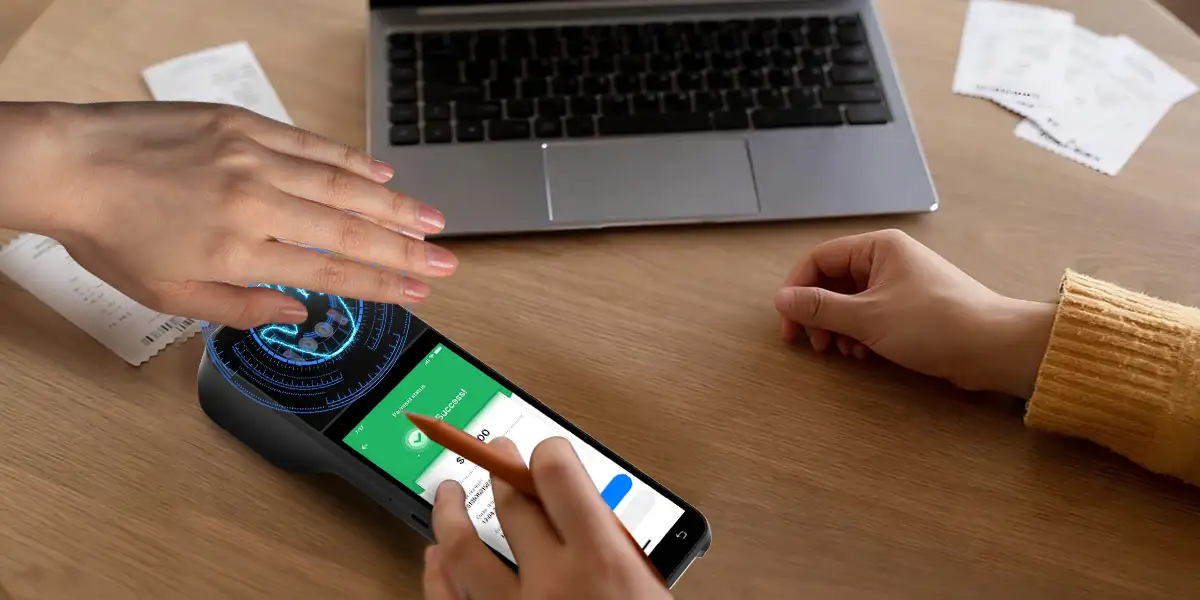
The merchant should map responsibilities before deployment:
Payment-terminal security remains a separate workstream. The contactless POS security guide explains why NFC capability, EMV behavior and PCI controls address different parts of card acceptance. A biometric match does not remove those payment requirements.
A front camera proves only that the terminal can capture images. Reliable face payment may also require controlled image quality, presentation-attack detection, protected template processing, a supported recognition provider, consent records and payment integration approved for the target deployment.
The same rule applies to a palm reader. A sensor can capture palm data without being connected to a Mastercard program, a card token or an acquiring service. Buyers need evidence for the complete workflow rather than a peripheral specification viewed in isolation.
Biometric checkout should preserve a non-biometric payment route. A customer may decline enrollment, use an unsupported card, present an injured hand, encounter a camera problem or fail matching. The store still needs a way to complete the sale without forcing biometric participation.
Fallback design is also an operational control. A cashier needs to know when to retry the biometric capture, when to switch tender types and when to stop an uncertain payment from being submitted twice. The system should expose transaction status clearly before another attempt begins.
The most important privacy question is where biometric data is processed. Payment passkeys usually rely on the security boundary of the personal device. In-store biometric checkout introduces a separate enrollment and recognition service whose policies must be evaluated directly.
The privacy assessment follows the architecture.
Payment passkeys keep biometric processing on the user’s device and send a cryptographic proof to the service. In-store biometric checkout requires a store-facing capture path plus an enrolled reference, so deployment review must cover consent, template protection, retention, deletion, partner access, breach response and jurisdiction-specific biometric rules.
Neither architecture should be described as risk-free. A passkey service needs secure account recovery and device-change handling. A store biometric service needs strong controls over enrollment, template custody and matching. Both models also need clear handling for disputed transactions and unauthorized use.
The word *encrypted* is not a complete privacy answer. Buyers should ask whether raw images are retained, whether templates can be reused across contexts, whether matching is one-to-one or one-to-many, how long records remain after account closure and which organization answers a deletion request.
Mastercard’s European roadmap predicts broader tokenized and authenticated online checkout, not universal biometric capture in stores. Payment passkeys can scale through existing consumer devices because the device already contains the sensor and local authentication system.
Store-based biometric checkout faces a different adoption path. Each deployment needs compatible merchant hardware, customer enrollment, privacy governance, integration partners and sufficient repeat use to justify the added system. A supermarket chain, stadium, campus or membership venue may have a stronger case than a store visited once by a tourist.
The two models can still converge at the account level. A customer might use a payment passkey to enroll or manage a payment profile online and later use a face or palm at a participating venue. That possibility does not make the capture systems identical; it only means that identity, token and payment services can exchange approved results within a designed workflow.
The safest forecast is therefore architectural rather than promotional. Device-based passkeys are suited to broad online authentication because they reuse hardware customers already own. In-store biometric checkout is more likely to grow through controlled venues where repeat visits, enrollment value and dedicated equipment can support the operating cost.
A useful proposal should identify the exact biometric flow before discussing speed or convenience. The following questions expose whether the project concerns device authentication, store identification or an unsupported mixture of both.
The answers should form one end-to-end diagram. A proposal that describes “Mastercard biometrics” without naming the capture point, matching service and payment credential has not yet defined a deployable system.
Mastercard presents payment passkeys primarily as an online purchase authentication method. The shopper uses a fingerprint, face scan or PIN on a trusted device to approve use of the credential. That process should not be confused with a store camera or palm reader identifying the shopper at a physical checkout.
Mastercard states that biometric data used for a payment passkey remains on the user’s device. The payment service receives proof that local verification succeeded, not the fingerprint or face template used by the device.
Mastercard Biometric Checkout and Click to Pay are different services. Click to Pay supports digital checkout and stored payment choices. Biometric Checkout concerns enrolled face or palm recognition at participating physical merchants. A wider payment architecture may connect several services, but their functions remain separate.
Mastercard has not announced a requirement for every physical POS terminal to add a biometric reader by 2030. The stated European goal concerns e-commerce tokenization, reduced manual card entry and authenticated digital checkout. Physical biometric deployment remains a separate merchant and partner program.
A palm scan normally identifies or verifies an enrolled customer profile; it does not hold funds. The service must retrieve a linked payment credential and submit a transaction through the applicable wallet, acquirer, network and issuer flow.
Cross-merchant use depends on the service design and participating ecosystem. A face or palm enrolled with one provider is not automatically portable to every Mastercard-accepting store. Merchant participation, customer consent, provider agreements, technical compatibility and local law all matter.
A biometric checkout and a contactless card protect different points in the transaction. Biometric recognition can add identity assurance, while the card-payment system manages credential protection and issuer authorization. Overall security depends on enrollment, matching, template protection, terminal controls and payment processing together.
The merchant should offer a documented retry and fallback process. A customer may use a card, mobile wallet, QR payment or another accepted tender after the system confirms that no biometric transaction is pending. Clear status handling reduces the risk of duplicate charges.
Mastercard biometric payments use two distinct architectures that should not be collapsed into one trend. Payment passkeys use local device verification to authorize a cryptographic credential for online checkout. In-store biometric checkout uses merchant-facing capture equipment to recognize an enrolled customer and retrieve a linked payment profile.
Mastercard’s 2026 European update supports the first path through tokenization, Click to Pay and payment passkeys. Mastercard’s Biometric Checkout Program supports the second path through partners, enrollment services and compatible store hardware. Understanding where the biometric is captured and who controls the matching process is the fastest way to tell the two systems apart.







 Home
 What Is a POS Barcode Scanner and How Do 1D, 2D and Camera Scanning Differ?

