
2026-06-26 Author : ZCS
Every receipt you pull from a POS terminal, every shipping label on a package, every hospital wristband — almost all of them were printed by a thermal printer. Yet most people have never heard the term, and fewer still know why these printers work without a single drop of ink.
The answer is straightforward: thermal printers use heat, not ink, to create images. No cartridges, no toner — in the most common type, no consumables at all beyond the paper roll. That simplicity is why they dominate high-volume, low-maintenance environments: retail counters, logistics warehouses, food trucks, hospital admissions desks.
Thermal printing splits into two methods. Both use a heated printhead, but they differ in what that heat acts on.
The paper itself is the active ingredient. Direct thermal paper is coated with heat-sensitive chemicals — leuco dyes and a developer compound — that react to heat by turning dark. As the paper feeds past the printhead, hundreds of tiny heating elements switch on and off in precise patterns, burning the image line by line into the surface. No ribbon, no ink, no consumable except the paper roll.
As documented in the Wikipedia entry on thermal printing, the printhead activates the paper's thermochromic layer selectively, causing the leuco dye coating to darken only where the elements fire.
Used for:
Key limitation: The paper stays heat-sensitive after printing. Sunlight, heat, or friction can trigger the reaction again — fading or darkening the print. This is why old receipts become illegible over time.
Thermal transfer adds one component: a ribbon coated with wax, resin, or a wax-resin blend. The heating elements melt the coating off the ribbon and press it onto the label or paper beneath. The ink bonds to the substrate and solidifies, creating a durable, permanent mark. The used ribbon winds onto a take-up spool and must be replaced periodically.
According to the Wikipedia article on thermal-transfer printing, thermal transfer is preferred when higher durability is required — particularly resistance to heat and abrasion. It remains the most widely used process for high-quality barcode printing globally. Labels on resin ribbon stock typically last 5–10 years under standard conditions.
Used for:
| Factor | Direct Thermal | Thermal Transfer |
|---|---|---|
| Consumables | Paper only | Paper + ribbon |
| Print durability | Months to 1–2 years | 5–10+ years |
| Heat/UV resistance | Poor | Excellent |
| Running cost | Lower | Higher |
| Colour printing | Black only (standard) | Multiple colours possible |
| Typical use | Receipts, short-term labels | Product labels, medical, industrial |
The decision comes down to one question: how long does the print need to last, and under what conditions? Direct thermal for short-life, high-volume applications. Thermal transfer for anything requiring multi-year legibility under heat, UV, or abrasion.
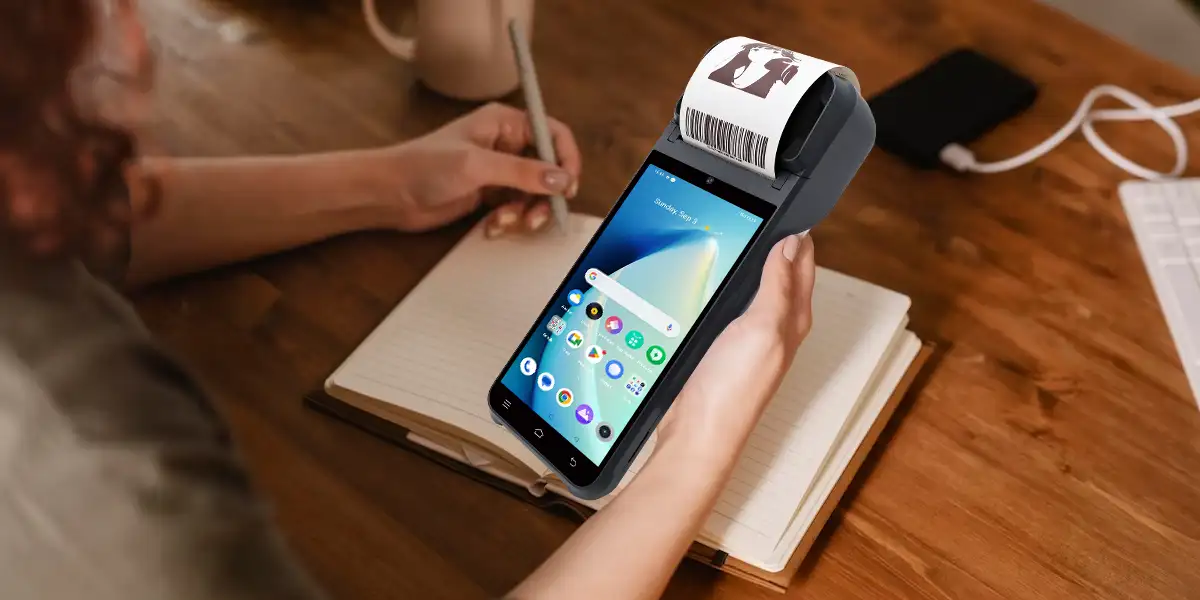
Retail and food service: POS receipt printing is almost universally direct thermal — fast, zero consumable management, ideal for the checkout counter. Android POS terminals with integrated thermal printers — such as those across the ZCS product range, which support both 58mm and 80mm paper widths — are a common hardware choice for these environments.
Logistics and e-commerce: thermal transfer is standard for shipping labels that need to survive handling, outdoor exposure, and temperature variation from warehouse to doorstep.
Healthcare: thermal transfer handles patient wristbands and specimen labels, which must withstand water, cleaning agents, and extended wear.
Manufacturing: asset tags and compliance labels in industrial environments use thermal transfer for longevity under heat, chemicals, and abrasion.
Q1. Why do old receipts turn black or fade?
Direct thermal paper stays chemically active after printing. Heat, sunlight, or friction can trigger the reaction again across the whole surface — turning it dark — or cause the printed image to fade as the compounds break down.
Q2. What are the disadvantages of a thermal printer?
Direct thermal prints fade under heat, UV, or friction — unsuitable for long-term storage or outdoor use. Both types are limited in colour output. Upfront hardware costs are higher than entry-level inkjets, and thermal paper or ribbons must be sourced as ongoing consumables.
Q3. Do you need a computer to use a thermal printer?
Not for daily operation. Most commercial thermal printers connect to a POS terminal or host device via USB or Bluetooth and print without a separate computer. Initial setup and firmware updates typically require one, but day-to-day use does not.
Q4. How long will thermal prints last?
Direct thermal prints remain legible for 1–3 years under normal indoor storage. Exposure to sunlight or temperatures above 40°C accelerates fading significantly. Thermal transfer labels on resin ribbon stock last 5–10 years under typical conditions.
Q5. What happens if you put regular paper in a thermal printer?
Nothing prints. A direct thermal printer needs thermochromic paper to produce an image — plain paper passes through blank. Thermal transfer can technically print on plain paper since the image comes from the ribbon, but adhesion is poor; purpose-made label stock is required for reliable results.
Q6. What is the difference between 58mm and 80mm thermal paper?
58mm is common in compact handheld and mobile POS terminals. 80mm is the standard for countertop retail and restaurant printers, providing space for itemised receipts with tax breakdowns, loyalty points, and promotional content. In markets with complex receipt requirements — Japan's dual consumption tax display, for instance — 80mm is effectively mandatory.
Thermal printing replaces ink with a controlled application of heat — to chemically treated paper in the direct method, or to a ribbon that transfers durable ink onto a substrate in the transfer method. Fewer moving parts, no ink management, and speeds that match high-volume commercial environments.






 Home
Home  Is Your Food Truck POS Terminal Costing You Sales? 5 Hardware Problems Operators Overlook
