
2026-08-28 Author : ZCS
A cashier processing a card at the counter and a warehouse worker scanning a pallet barcode are both holding something that looks, at a glance, like the same rectangular slab of glass and plastic. The internals, certifications, and intended job could not be more different. Merchants comparing hardware as part of a broader Android POS system selection process often run into this exact confusion when a vendor's spec sheet uses "handheld terminal" to describe both device types interchangeably.
The confusion is understandable given how similar the two device families look in a product photo, but the certification and hardware paths underneath diverge from the first design decision onward.
Handheld POS terminals use PCI PTS and EMV-certified hardware to accept card payments for retail and hospitality checkout. Handheld inventory terminals, commonly called PDAs, use rugged Android hardware with a dedicated scan engine, certified under IP65 or higher ratings, represented by industrial mobile computers from Zebra and Honeywell rather than payment-focused manufacturers.
The rest of this comparison breaks that split down by certification, hardware, and the handful of devices now trying to do both jobs at once.
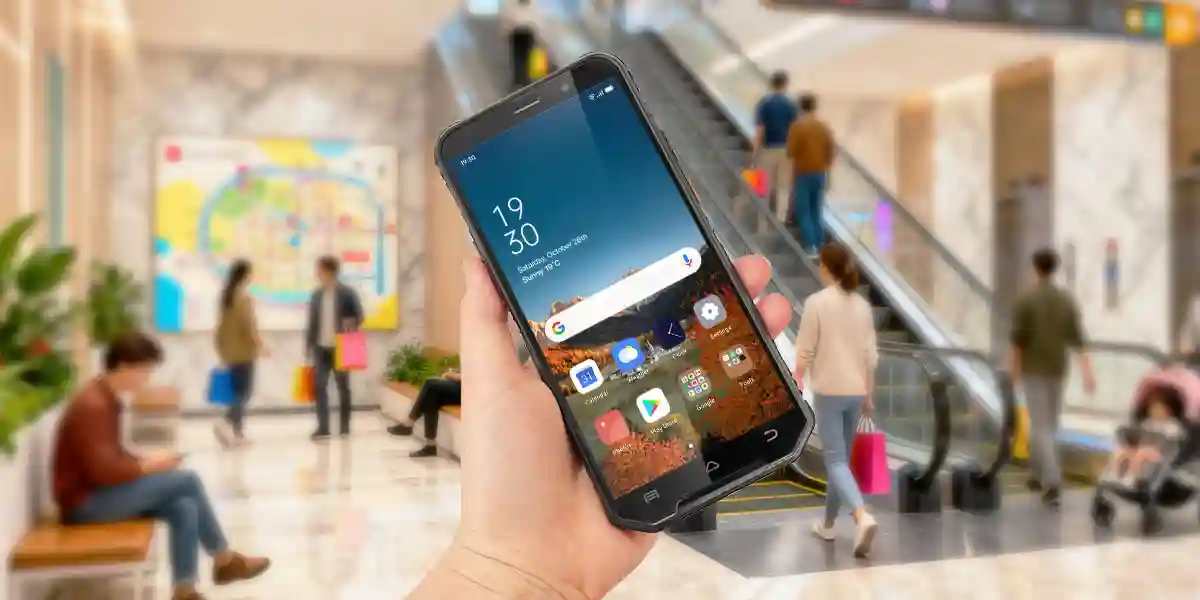
A handheld POS terminal is a portable device built specifically to accept and process card payments away from a fixed checkout counter. The device carries a secure payment reader — supporting NFC/contactless, EMV chip, and often magnetic stripe — inside a PCI PTS-certified enclosure that protects the encryption keys and cardholder data path. Restaurants use handheld POS units for tableside ordering and payment; retailers use them for line-busting during peak traffic; delivery and field-sales teams use them to close a sale without a fixed terminal.
Software on a handheld POS terminal centers on transaction processing: order entry, payment authorization, receipt printing, and integration with a point-of-sale backend. Barcode scanning, when present, is usually a secondary camera-based feature rather than the device's core function.
A handheld inventory terminal, almost universally called a PDA in logistics and retail operations, is a rugged mobile computer built around a dedicated barcode or RFID scan engine rather than a payment reader. The device runs Android or a similar mobile OS, integrates natively with warehouse management (WMS) or enterprise resource planning (ERP) systems, and prioritizes fast, reliable data capture over payment processing.
| Attribute | Handheld POS Terminal | Handheld Inventory Terminal (PDA) |
|---|---|---|
| Primary function | Card payment processing | Barcode / RFID data capture |
| Core certification | PCI PTS, EMV L1/L2 | None required; IP65+ ruggedization common |
| Typical software | POS transaction app | WMS / ERP client |
| Built-in printer | Common | Rare |
| Payment reader | Standard (NFC/chip/magstripe) | Not standard |
The certification requirement is the single biggest divergence between the two categories, since it determines what a device is legally permitted to do with a customer's card data. A PDA with excellent barcode-scanning range still cannot process a card payment without a certified payment reader and PCI PTS validation on the enclosure itself, regardless of how capable its Android build otherwise is.
Standard handheld POS terminals typically output NFC read ranges under 4 cm and EMV contact-chip processing in under 2 seconds per transaction. Selecting a PDA equipped with a dedicated laser or 2D imager scan engine instead of camera-based scanning prevents mis-reads and slow lookups during high-volume warehouse picking. The PCI Security Standards Council's PTS point-of-interaction requirements govern the payment side of that split, defining the physical and logical security a device needs before an acquirer will approve it for card-present transactions. That approval process covers everything from the tamper-detection mesh embedded under the keypad to how quickly the device erases stored encryption keys if someone attempts to pry open the casing.
None of that PTS testing has any bearing on how well a device reads a barcode, because the two certification tracks were built to solve completely different failure modes. A payment terminal's PTS lab evaluates what happens when someone tries to extract cardholder data; a scan-engine benchmark evaluates read speed, angle tolerance, and misread rates under warehouse lighting conditions. Vendors occasionally blur this distinction in marketing copy, implying that a device's payment certification says something about its scanning reliability, when the two ratings are entirely independent of each other.
Barcode symbology and scan-engine performance instead answer to GS1's global barcode standards, which define how 1D and 2D codes encode data regardless of which manufacturer's scan engine reads them. A PDA's certification burden sits almost entirely on the durability and scanning side rather than on data-security compliance, since it typically never touches raw payment card data in the way a POS terminal does. That difference in certification scope is also why PDA hardware tends to be priced lower than a comparably rugged handheld POS terminal: the payment-security lab testing and ongoing PCI compliance renewal add cost that a pure scanning device never has to absorb.
Durability requirements separate the two categories almost as sharply as payment certification does. A handheld POS terminal used at an indoor restaurant counter rarely needs more than splash resistance, while a PDA destined for a loading dock needs to survive drops onto concrete on a daily basis.
The IP Code standard defines ingress protection using a two-digit rating: the first digit covers dust resistance, the second covers water resistance. Indoor retail and restaurant handheld POS terminals commonly carry an IP54 rating, sufficient for splashes and light dust, while warehouse PDAs are typically specified at IP65 or IP67, protecting against sustained dust exposure and direct water jets.
The gap between those ratings shows up quickly in the field rather than only on a spec sheet. An IP54-rated handheld POS terminal left near a restaurant dish pit or exposed to a sudden downpour on an outdoor patio can fail within a single shift, while an IP65 device shrugs off the same exposure without issue. That is precisely why hardware built for logistics and warehouse floors, discussed further in the sourcing guidance most operations reference, is specified several IP grades above what a typical indoor checkout counter would ever need.
Drop and shock resistance follows a separate framework entirely. MIL-STD-810, a U.S. Department of Defense test method standard, is the reference point most rugged-device manufacturers cite for drop-height and vibration tolerance, even though the devices themselves are commercial rather than military hardware. A PDA rated to MIL-STD-810H for 1.5-meter drops onto concrete is built for a warehouse floor; a handheld POS terminal built to the same standard is solving for accidental drops behind a counter rather than sustained industrial abuse.
The deployment of a payment-capable device in a PIN-required environment depends on PCI PTS certification, not IP or MIL-STD rating. A rugged PDA with an IP68 rating cannot process a PIN transaction without separate PCI PTS validation, while a PCI-certified handheld POS terminal with only an IP54 rating satisfies payment compliance despite lighter ruggedization.
That distinction matters because a buyer chasing a high IP rating alone can end up with a device that survives a warehouse drop test but is still unauthorized to take a customer's card.
A small but growing category of Android-based handheld devices tries to bridge both worlds rather than forcing a choice between them. These units pair a certified payment reader with a camera-based or dedicated scan engine, letting a single device ring up a sale and check stock on the same trip down an aisle.
The trade-off is real rather than cosmetic. A device optimized primarily for payment security tends to use a camera for barcode reading rather than a dedicated laser or 2D imager, which reads slower and less reliably at odd angles than purpose-built scan hardware. A device optimized primarily for scanning speed and ruggedization, conversely, rarely carries PCI PTS certification at all, since that certification adds cost and design complexity a pure data-capture device doesn't need. Grocery and mid-size retail operations, where staff both ring up items and check stock levels, are the main beneficiaries of this hybrid category; high-volume distribution centers and high-transaction retail counters still tend to deploy dedicated hardware for each job.
Naming actual hardware makes the category distinction more concrete rather than purely theoretical.
| Handheld POS Terminals | Handheld Inventory Terminals (PDAs) |
|---|---|
| PAX A-series Android handhelds, widely deployed across retail and hospitality payment networks | Zebra TC-series mobile computers, a long-standing warehouse and logistics standard |
| SUNMI V-series handhelds, popular for Android-based mobile checkout in Asia-Pacific retail | Honeywell CT-series rugged mobile computers, built around dedicated 2D imaging engines |
| ZCS Z90 handhelds, open-Android POS terminals that combine PCI-certified payment processing with secondary 1D/2D barcode-scanning support | ZCS PDA products for barcode scanning, inventory management, logistics, and enterprise mobile-data-capture applications; contact ZCS for available models and configuration details |
| Verifone handheld payment terminals, established in banking-grade card acceptance | CipherLab RS-series and RK-series handhelds, frequently deployed in mid-size warehouse operations |
The overlap worth noting sits with devices such as the ZCS Z90 series. Built and certified primarily as a payment terminal, the open-Android Z90 handheld also supports secondary 1D/2D barcode scanning. This makes it a practical hybrid option for retailers that need to accept payments while handling occasional stock checks or item lookups.
However, the Z90 should not be treated as a substitute for a dedicated warehouse PDA in high-frequency or harsh industrial environments. A true PDA is designed around durable enterprise data capture, often with a dedicated scan engine, higher ruggedization ratings, and WMS/ERP-oriented workflows. ZCS also provides PDA products for inventory, warehousing, logistics, and mobile data-collection applications. Please contact ZCS directly for current PDA model availability, scanner configurations, ruggedization options, and project-specific recommendations.

The decision comes down to what the device spends most of its day doing, not what it is theoretically capable of.
Retail counters and restaurants processing payments as the primary task need a certified handheld POS terminal, since a PDA cannot legally substitute for one regardless of its scanning capability. Throughput is usually the deciding factor at this end of the spectrum: a single handheld POS unit can clear a line of ten customers faster than staff running back and forth to a fixed terminal, but only if the device's battery and NFC read range hold up across a full dinner rush. Staff turnover also plays a bigger role than most buyers expect, since a handheld with a cluttered menu interface slows down a new hire far more than it slows an experienced cashier. Businesses working through this exact decision can review whether handheld POS devices suit high-traffic stores for a deeper look at the throughput math involved.
Warehouses and distribution centers running high-frequency scanning need a dedicated PDA, since forcing a payment-certified handheld into that role wastes the payment hardware's cost premium on a job that never touches a card. The calculation shifts entirely toward scan volume per shift, drop frequency, and how quickly a device's battery degrades under continuous barcode-heavy use rather than idle standby. A distribution center running three shifts a day puts far more cumulative drop and vibration stress on a device than a boutique retailer ever will, which is exactly the gap a payment-grade handheld's lighter IP54 rating was never designed to absorb. Replacement cycles factor into the total cost picture too: a PDA rated for 5+ years of daily industrial use spreads its purchase price across a far longer service life than a consumer-grade device pressed into the same role would survive. Operations weighing durability requirements specifically can reference this breakdown of why logistics and warehouse businesses need rugged POS devices, which covers the operational cost of choosing under-specified hardware for that environment.
Small retailers managing light stock counts alongside checkout occupy the middle ground between those two extremes, and are the segment best served by a hybrid device. Neither a full industrial PDA nor a payment-only terminal matches their actual workload, since a boutique or small grocery counter running occasional stock checks between sales rarely justifies the cost of maintaining two separate device fleets and two separate support contracts. A single Android handheld that covers both jobs adequately, even if it excels at neither in isolation, is usually the more sensible purchase once total cost of ownership across a small staff is factored in. Training time drops as well, since staff only need to learn one interface for both ringing up sales and checking whether an item is in stock, rather than switching between two unrelated pieces of hardware during a shift. A closer look at that middle ground is covered in this guide to a portable NFC inventory management cashier terminal.
Budget allocation should follow the primary task rather than the device's full spec sheet. A business buying rugged PDAs because "they seem more durable" ends up paying an industrial-hardware premium for a payment function those devices were never certified to perform.

Q1. Can a PDA process credit card payments?
Not without a separate, PCI PTS-certified payment reader attached or integrated. A standard barcode-scanning PDA has no certified path for handling card data and cannot legally process a card-present transaction on its own.
Q2. Can a handheld POS terminal replace a warehouse PDA?
Only for light-duty scanning. A handheld POS terminal's camera-based scanner reads barcodes far slower than a PDA's dedicated laser or 2D imager, and most POS units lack the IP65+ ruggedization a warehouse floor requires for daily use.
Q3. What IP rating should a warehouse PDA have?
IP65 is the practical minimum for daily warehouse and distribution-center use, protecting against dust ingress and low-pressure water jets. Operations with heavier exposure to washdown or outdoor conditions often specify IP67 or IP68.
Q4. Do handheld POS terminals and PDAs run the same operating system?
Both commonly run Android today, but the certification layered on top differs completely. A payment app on a handheld POS terminal must meet PCI security requirements the OS itself doesn't enforce, while a PDA's Android build is typically optimized for WMS/ERP integration and MDM management instead.
Q5. Is a rugged rating like MIL-STD-810 the same as a PCI certification?
No. MIL-STD-810 tests physical durability — drops, vibration, temperature extremes — and has nothing to do with payment data security. A device can pass MIL-STD-810 drop testing and still be completely uncertified to process card payments.






 Home
Home  Utility Bill Collection POS Terminal: How to Choose Hardware for Field and Agent Payments
