
2026-09-02 Author : ZCS
● Tanzania tax projects must separate TRA fiscalization from local-government revenue collection because the two deployments can use different compliance and integration paths.
● TRA EFD rules require approved hardware, protected fiscal memory, Tanzania-specific device identification, GPRS communication, Z-report transmission and recovery after network failure.
● A 2026 National Audit Office review found major POS shortages and defective units in four visited local authorities, making serviceability a procurement requirement rather than an after-sales detail.
● Android provides application, SDK and fleet-management flexibility, but an Android POS terminal is not automatically a TRA-approved Electronic Fiscal Device.
Tanzania revenue-collection projects do not have one universal POS architecture. A taxpayer-facing TRA deployment, a local-government fee-collection project and a software-led VFD rollout can all use handheld Android hardware, but the fiscal logic, certification path and backend integration are not identical. Teams new to the category should first review EFD, ETR and VFD terminology before freezing a hardware bill of materials.
Fiscal POS systems in Tanzania combine regulated transaction recording with field connectivity, receipt generation and central reporting. Hardware-based EFD deployments depend on approved fiscal-device components and protected records, while virtual or software-led deployments can place more fiscal logic in a server/API layer. Local-government collection adds a separate operational problem: keeping enough working devices in collectors' hands.
That distinction changes procurement. A fast CPU or large touchscreen can improve usability, but neither solves fiscal approval, unreliable connectivity, printer downtime, spare-parts shortages or remote management across hundreds of terminals.
A fiscal POS terminal is a point-of-sale device used in a legally controlled transaction-recording workflow, not simply a payment terminal with a receipt printer. Under Tanzania's EFD framework, an approved Electronic Fiscal Device passes certification and licensing procedures and forms part of the Electronic Fiscal Device Management System. The technical schedule specifies protected fiscal memory, receipt functions, connectivity and reporting behavior. Tanzania's Tax Administration (General) Regulations
An EFD places regulated fiscal functions in approved hardware; a VFD or taxpayer-system connection can shift more work to software and a government interface; a local-government POS may focus on collecting fees, levies, parking charges or other non-tax revenue. TRA's current taxpayer portal still exposes Electronic/Virtual Fiscal Device management, and the agency also operates an EFD receipt API for taxpayer systems. TRA Electronic/Virtual Fiscal Device services
The procurement rule is simple: "fiscal-ready Android POS" and "TRA-approved EFD" are not interchangeable claims. A manufacturer can supply hardware suitable for integration, but approval depends on the specific Tanzania project, fiscal module, software stack and certification route.

TRA's technical schedule treats transaction storage as a compliance component. The fiscal memory is specified as read-only, capable of retaining data for at least five years, and unable to reverse entered sales data. The schedule also calls for at least 2,400 daily Z sales reports, reconnection records and protected historical information.
Tanzania EFD identification is tied to the market, not just the model name. The regulations require a unique manufacturer serial number allocated per country, with the Tanzania serial intended for use in Tanzania rather than being reused elsewhere. That requirement affects factory serialization, configuration records and project traceability.
Connectivity is part of the fiscal workflow rather than a convenience feature. The regulations specify an internal GPRS modem for transmitting daily Z data to TRA over GSM, confirmation from the system, re-transmission after network failure and the ability to answer status queries. A procurement specification should therefore test recovery behavior, not only whether a terminal shows a 4G icon.
Standard Tanzania EFD hardware uses protected fiscal memory, country-specific identification, GPRS/GSM communication and Z-report transmission with retry after network failure. These controls make fiscal compliance a hardware-and-system property; Android, 4G and a thermal printer alone do not establish TRA approval.
Receipt printing is also defined by regulated data, not paper width alone. The technical schedule requires daily, monthly and annual reports, automatic daily Z reports, a unique device licence number on fiscal receipts, reprint capability after disconnection or paper jam, easy roll replacement and English or Kiswahili output. Current TRA verification pages also expose fields such as seller TIN, EFD serial, receipt number, Z number, tax values and verification code.
Field availability can be as important as certification in a government collection project. The National Audit Office of Tanzania published a performance audit on non-tax revenue collection on April 10, 2026. Physical checks in four local authorities found that limited device numbers and defective POS units were restricting electronic collection. 2026 National Audit Office performance audit
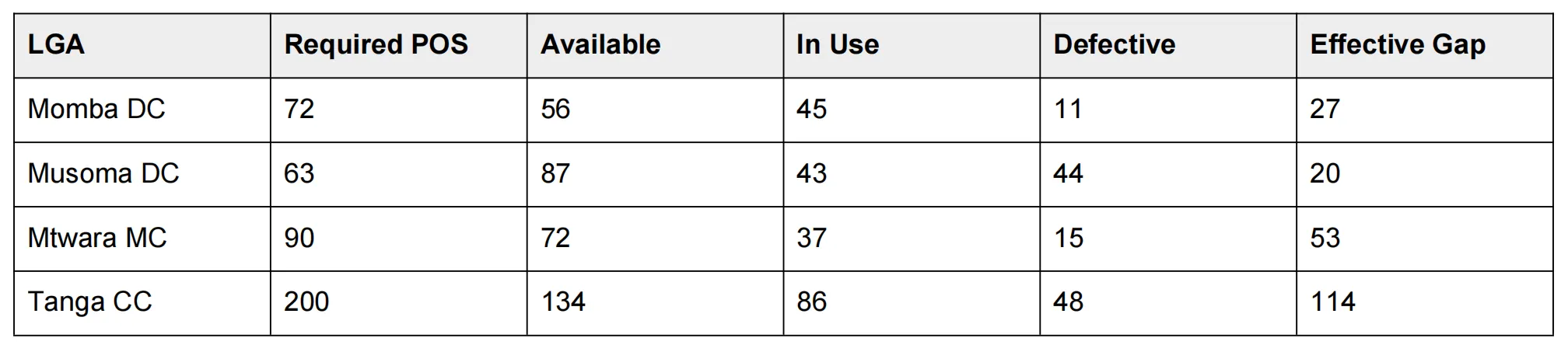
The audit changes the hardware buying question. A low unit price is not a low project cost when printer assemblies fail, batteries cannot sustain field use, replacement units are unavailable or repairs take weeks. For large deployments, buyers should score spare-parts policy, repair turnaround, device health monitoring and replacement logistics alongside processor, memory and screen size.
Tanzania's 2026 non-tax revenue audit found 11, 44, 15 and 48 defective POS units respectively in Momba DC, Musoma DC, Mtwara MC and Tanga CC. The evidence links device availability directly to collection coverage, making maintainability and fleet uptime measurable procurement criteria for public-sector POS projects.
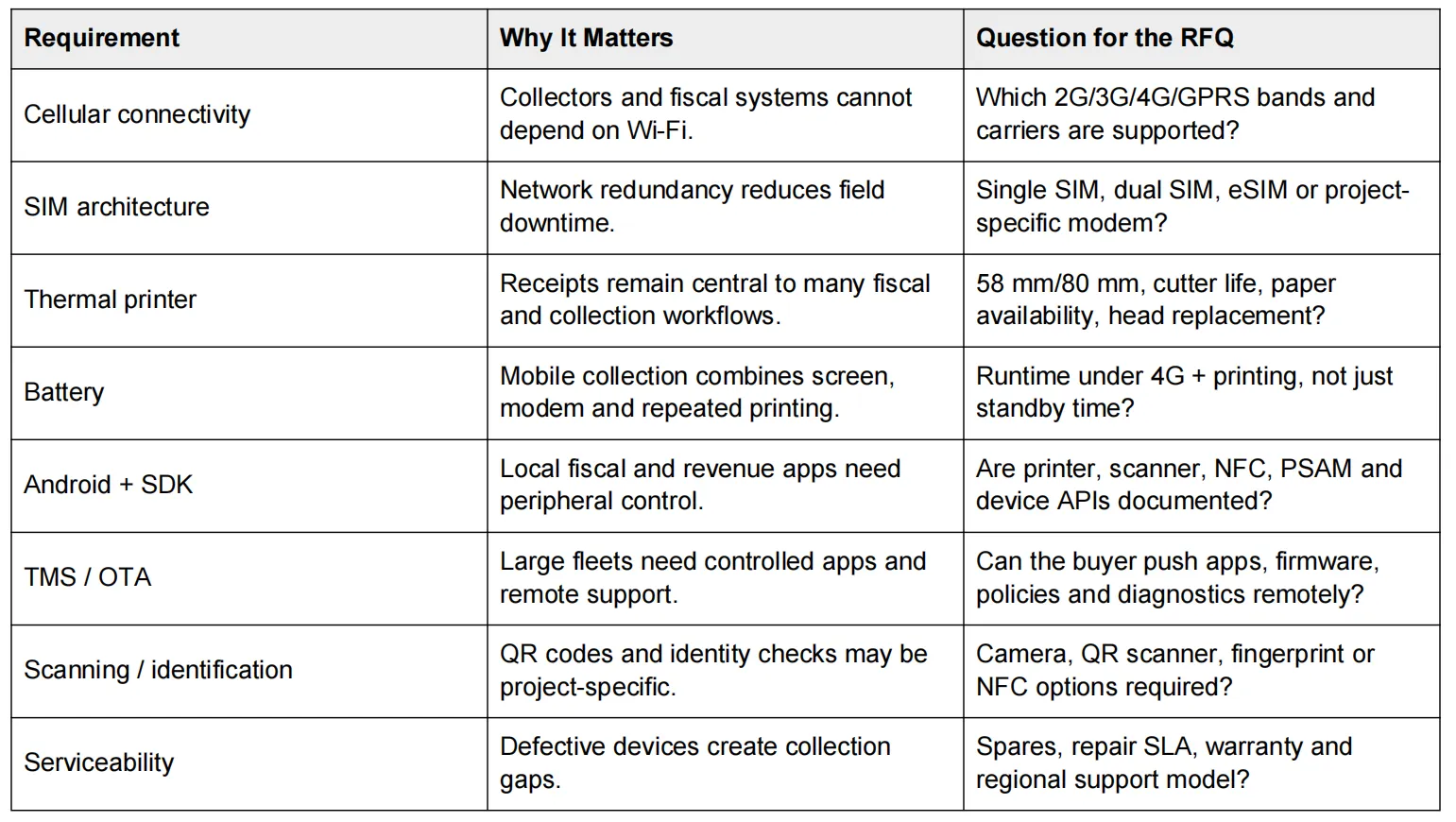
A field terminal should be tested for bad-network behavior before benchmark scores. The pilot should simulate signal loss during receipt submission, queued transactions, SIM switching where relevant, reconnect timing and duplicate-prevention logic. The backend must distinguish a delayed submission from a second transaction.
Printer wear is a fleet risk because each failure can remove a collector from service. Buyers should confirm print-head access, cutter or tear-bar design, paper-roll dimensions, spare assemblies, expected maintenance procedure and whether a technician can replace the printer module without replacing the entire terminal.
A 1,000-device deployment cannot be managed like 1,000 independent smartphones. The TMS should provide inventory visibility, application control, firmware distribution, remote configuration and diagnostic information. Those functions shorten incident triage and reduce the number of units that must return to a service center for software-only faults.
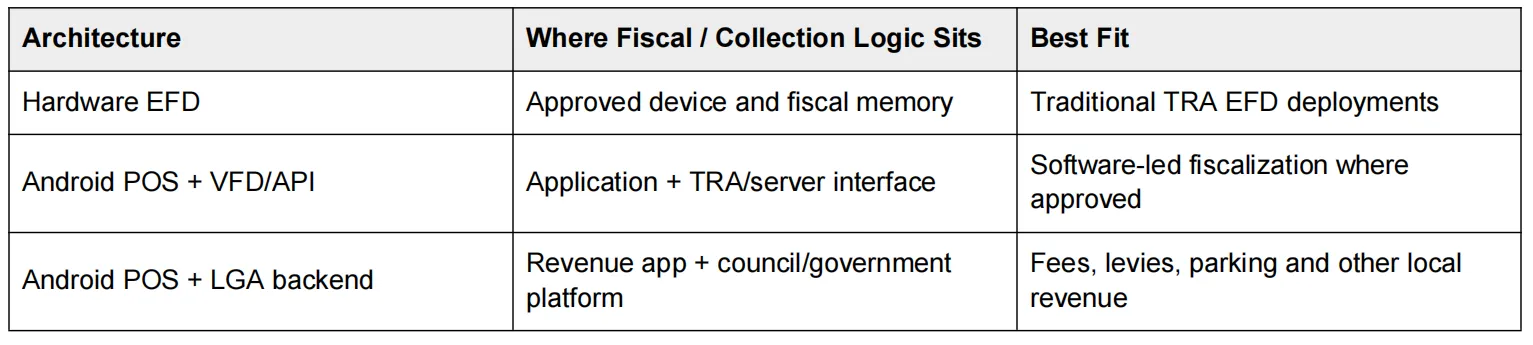
Architecture should be fixed before selecting the enclosure. A buyer using a hardware EFD path needs to verify approved fiscal components and the certification chain. A VFD/API project needs secure application integration and reliable server communication. A local revenue project may need a different backend, collector login model, payment workflow and reconciliation logic.
This is also where a fiscal printer versus fiscal POS terminal decision belongs. Existing desktop systems may justify a separate fiscal printer, while new mobile collection projects often benefit from an all-in-one Android terminal with printer, modem and project application in one enclosure.
ZCS Z92 can be evaluated as a fiscal-ready Android hardware platform, not as a pre-approved Tanzania EFD. The current product page lists Android 14-based ZOS, 4 GB RAM + 32 GB ROM, 2G/3G/4G including GPRS, dual SIM, a 58 mm thermal printer, 7.4 V/3020 mAh battery, optional NFC, optional PSAM and optional fingerprint collection. ZCS Z92 product specifications
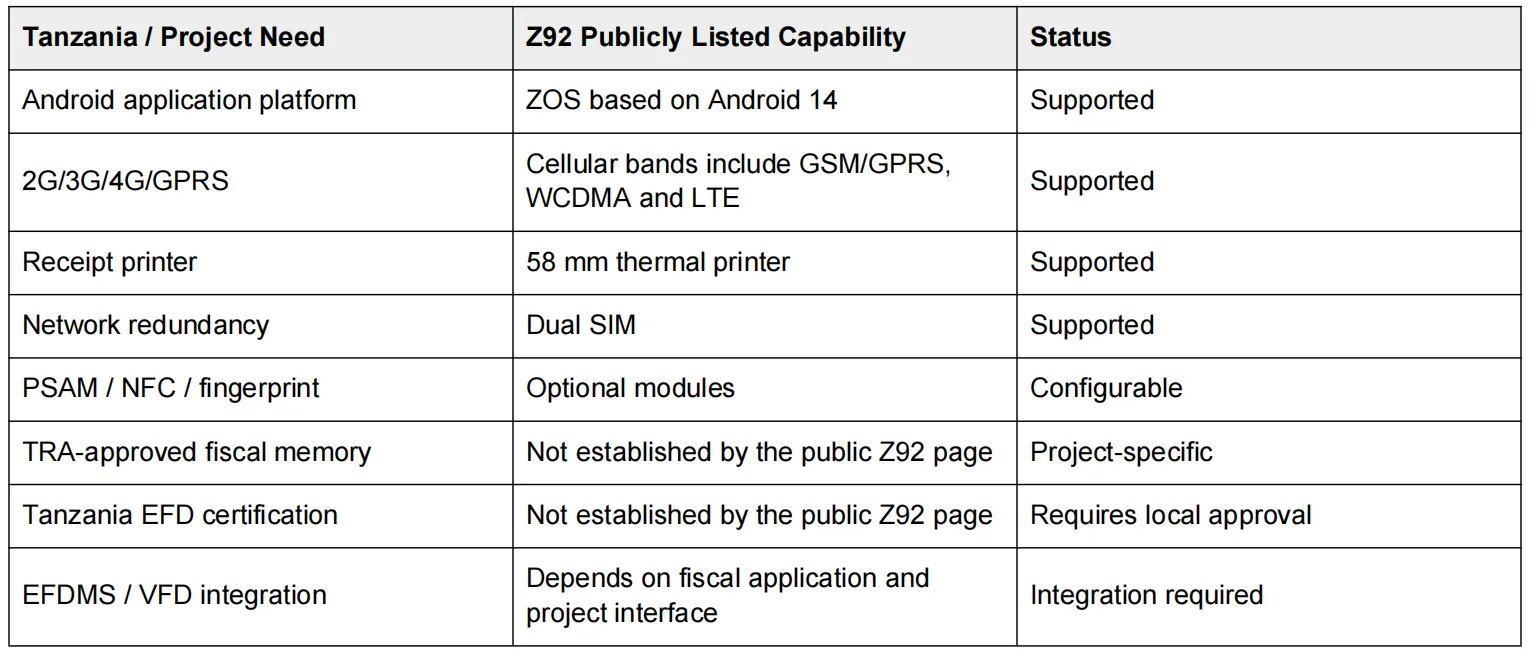
The last three rows are the critical ones. CE, FCC, EMV, PCI or a fiscal-module option does not by itself prove TRA approval. A Tanzania deployment should treat the Z92 as a candidate hardware platform and then validate the exact fiscal module, software integration, device certification and local supplier route required by the tender.
A pilot should reproduce the worst field conditions before mass production starts. The test plan should cover network loss during submission, transaction replay protection, continuous thermal printing, battery drain under cellular load, SIM behavior, QR scanning, application recovery after reboot, remote app update, device lock, log retrieval and backend reconciliation.
The pilot should also measure support operations. Record how long it takes to identify a failed printer, replace a battery or printer assembly, restore a corrupted application and return a terminal to service. The 2026 audit evidence shows why this matters: a device in storage or awaiting repair is functionally equivalent to a device that was never purchased.

● Confirm whether the project is TRA EFD, VFD/API, local-government revenue collection or a hybrid.
● Obtain the current Tanzania certification and approved-supplier requirements before finalizing hardware.
● Validate fiscal-memory, serial-number, receipt and Z-report requirements for the chosen architecture.
● Test 2G/3G/4G/GPRS behavior, network loss, retry logic and duplicate prevention in Tanzania.
● Benchmark battery life under real printing and cellular workloads.
● Confirm thermal-paper size, printer maintenance, spare parts and replacement procedures.
● Run the buyer's application against the Android SDK before issuing the production purchase order.
● Verify TMS capabilities for app control, OTA updates, device inventory and remote diagnostics.
● Define warranty, repair SLA, spare-unit ratio and escalation ownership in the supply contract.
● Complete a controlled pilot before scaling to hundreds or thousands of devices.
No. Android is an operating system, while an EFD is a regulated fiscal device. TRA approval depends on certification, fiscal hardware or approved software architecture, registration and the applicable project requirements.
Potentially, yes, when the project uses an approved taxpayer-system or virtual fiscal interface and the required software integration is completed. Hardware compatibility alone does not establish authorization.
Many field and fiscal workflows still require physical receipts or reports, but the exact requirement depends on the tender and architecture. The printer should be specified around the regulated receipt workflow rather than added as a generic accessory.
No. TRA's technical rules address reporting behavior, confirmation, retry after failure, secure communication and device status queries. A cellular modem is only one part of that chain.
An overseas manufacturer can supply candidate hardware, OEM/ODM customization and integration support, but the local EFD approval, supplier status and certification chain must be verified for the specific Tanzania deployment.
Test network failure and recovery, fiscal or revenue-app integration, receipt printing, battery endurance, remote management, security modules, device serialization, repair workflows and backend reconciliation under realistic field conditions.
Procurement bottom line: select the fiscal architecture first, validate Tanzania-specific compliance second, and only then compare Android terminal specifications. That order prevents a technically capable POS from becoming an expensive re-certification or integration problem after the tender is awarded.






 Home
Home  Canteen POS Terminal: How to Choose Hardware for Schools, Factories and Corporate Cafeterias
