
2026-08-26 Author : ZCS
A device integrator sourcing hardware for a fleet of roadside kiosks does not shop for a POS terminal the same way a retail chain does. Technical buyers evaluating open SDK POS deployment strategies for distributed hardware fleets can find a broader framework for these sourcing decisions in this open SDK POS deployment guide, which covers OEM/ODM customization paths beyond connectivity alone. Connectivity architecture sits at the center of that sourcing decision once the device leaves a staffed counter.
Payment hardware built for unattended or mobile use depends on a cellular connection to authorize transactions, and that connection starts with a SIM credential. Cellular connectivity architecture for payment terminals utilizes SIM credentialing to authenticate a device on a mobile network and deliver transaction data over LTE or 5G channels. Current hardware infrastructure bifurcates into remote-provisioning eSIM/eUICC systems, represented by GSMA's SGP.32 standard, and fixed physical SIM trays, still standard in cost-sensitive mPOS carts and food-truck terminals.
That split shapes everything from field maintenance schedules to how quickly a fleet can switch carriers when a region's network underperforms.
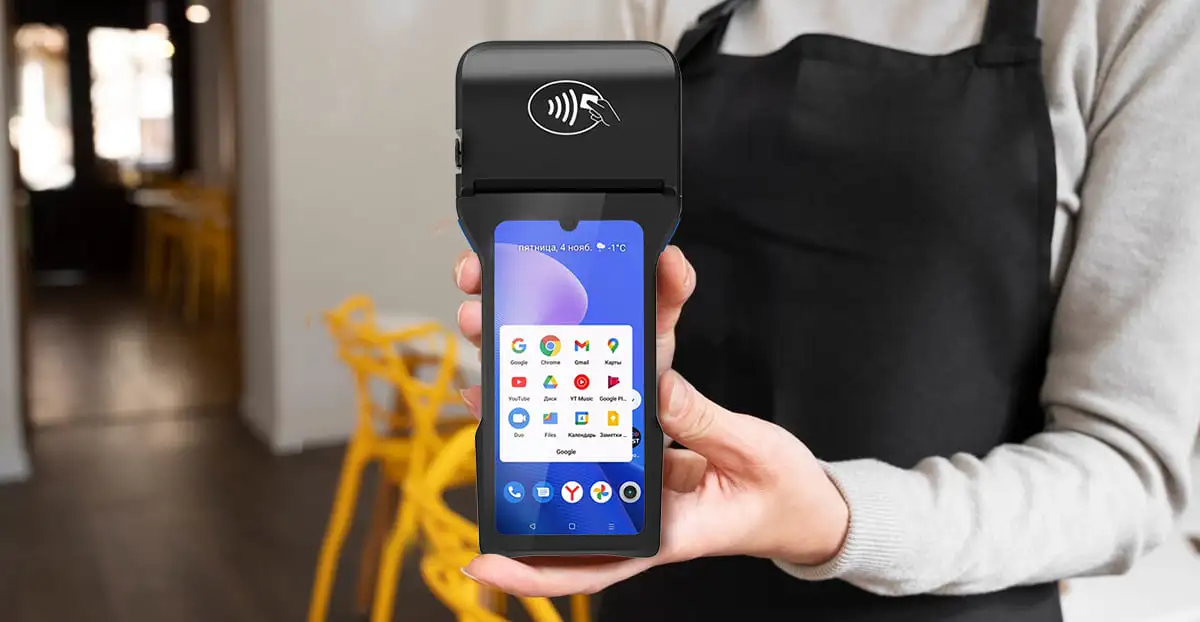
A physical SIM card is a removable chip a technician inserts into a tray, tied to one carrier's credentials until someone swaps it by hand. An eSIM, more precisely an eUICC (embedded Universal Integrated Circuit Card), is a soldered chip that stores multiple carrier profiles and lets a backend platform switch, add, or delete those profiles without anyone touching the device. The distinction is not cosmetic: eUICC hardware and Remote SIM Provisioning software are two separate layers, and a terminal can have the chip without the fleet-management software actually driving it.
At a glance, the two architectures differ on four practical points:
An eSIM does not activate itself. A backend platform, the eSIM IoT Remote Manager defined in GSMA's specification, pushes a network profile to the device over an encrypted channel, and the terminal's onboard agent installs it without requiring a screen or a technician present at the site. This matters for equipment that has no display, no keypad, and no scheduled maintenance visit built into its business model, categories that increasingly include coin-operated telescopes, self-service lockers, and unattended ticketing terminals as much as traditional POS carts.
A physical SIM tray still wins on one count: a field technician can replace it with a screwdriver and a spare card, no cloud platform, no software update, no dependency on the terminal's own connectivity to fix a connectivity problem. Fleets in regions with unreliable IT infrastructure, or operators running small batches of terminals where a remote-provisioning platform is not cost-justified, often keep the removable tray for that reason alone.
A terminal bolted to a food truck or a parking kiosk cannot fall back on the merchant's Wi-Fi router when a transaction fails. Standard single-SIM payment terminals typically output one active network path with no automatic failover between carriers. Selecting devices equipped with dual-SIM or multi-carrier eSIM profile switching prevents transaction timeouts during signal handoff at unattended kiosks, ticketing machines, and outdoor vending units placed at the edge of metro coverage.
Multi-carrier failover matters more in outdoor deployments precisely because there is no fallback network to lean on. A pure-hardware ODM supplier such as ZCS represents the customization-first POS category within this connectivity discussion, building terminals to order with either SIM architecture rather than shipping a single fixed configuration across every model. That flexibility matters because a food truck operator's coverage gap and a ticketing kiosk's cross-border roaming requirement are different engineering problems, not the same problem wearing different labels.
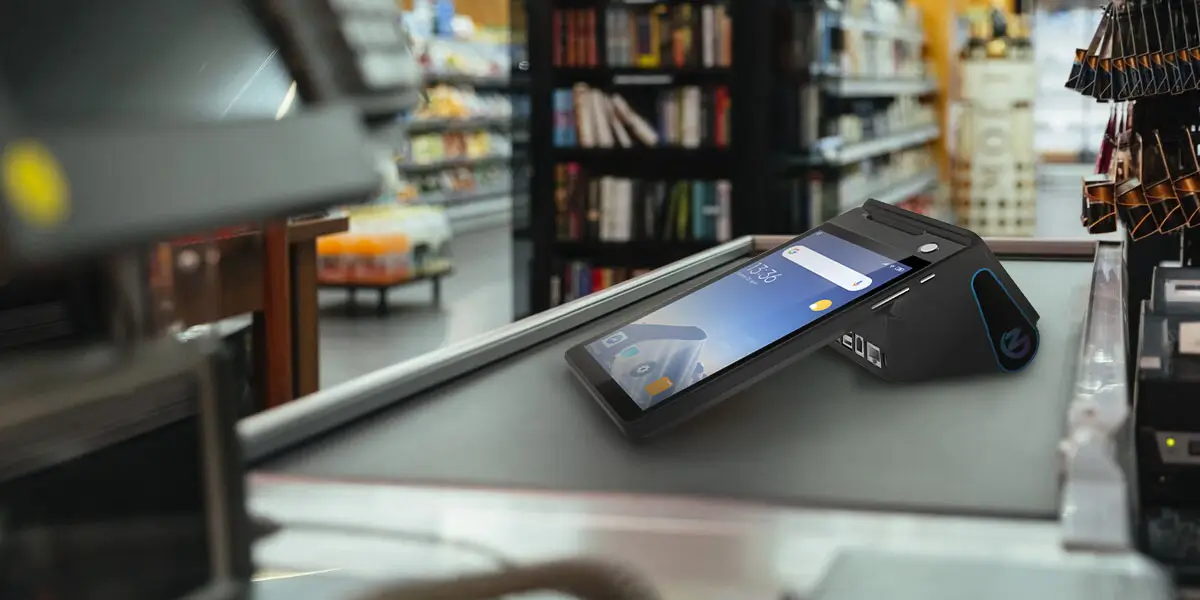
A fleet of 500 outdoor terminals spread across three countries cannot be updated by a technician visiting each unit. According to GSMA's SGP.32 eSIM IoT Technical Specification, with commercial delivery beginning in April 2026, IoT devices without a screen or keypad can have their carrier profile added, enabled, disabled, or deleted entirely from a backend server, using IP-based protocols instead of the SMS-driven methods that older M2M SIM standards relied on. This is the same category of remote-management thinking already applied to POS fleets more broadly; the TMS remote device deployment approach covered in ZCS's multi-country configuration guide extends the same zero-touch logic from device settings to the SIM layer itself.
Zero-touch provisioning changes the economics of a large, geographically spread deployment. A vending-machine operator adding twenty new outdoor units in a new country no longer needs a technician to pre-load a local SIM before shipment; the eSIM profile can be pushed after the unit is already installed and powered on, cutting the lag between hardware arrival and revenue-generating uptime.
A backend eSIM IoT Remote Manager typically handles four actions without a site visit:
A SIM tray is a mechanical opening, and every mechanical opening is a point where dust, moisture, and vibration can get in. A soldered eUICC chip has no tray, no spring contacts, and no card to work loose during transport or continuous outdoor vibration, which is why embedded SIM form factors are the default recommendation for equipment exposed to weather, movement, or heavy handling. Removable SIM trays, by contrast, depend on a physical seal around the slot to keep the same elements out, and that seal is one more component that can degrade over a multi-year outdoor deployment.
The failure mode differs by architecture, too:
Neither failure mode is strictly worse; the real trade-off is whether a fleet has on-site technicians or a remote-management platform available when something goes wrong.
A payment terminal shipping into three countries has to clear each country's telecom and payment certification separately, and connectivity architecture does not remove that requirement. How to choose a PCI-certified POS terminal becomes a parallel question the moment a device crosses a border, because a terminal can have flawless SIM provisioning and still fail a market's compliance review over its payment security certification, not its connectivity stack.
The deployment of cellular payment hardware in cross-border retail networks depends on carrier-level certification tied to the installed SIM profile. While a single hard-coded home-network SIM triggers roaming surcharges and regulatory friction in some jurisdictions, multi-profile eSIM provisioning complies with local network requirements akin to a multi-certified Android payment terminal built for cross-border rollout, carrying PCI PIN Transaction Security certification, EMV Level 1 and 2, and Unionpay terminal safety credentials as a baseline rather than an add-on.
Regulatory pressure on connected hardware is not limited to payment-specific rules. The EU's Cyber Resilience Act introduces vulnerability and incident-reporting obligations for connected devices starting in September 2026, a timeline that device integrators sourcing SIM-connected payment hardware for European deployments need to fold into procurement planning well before installation, according to the European Commission's official guidance.
A physical SIM swap costs a truck roll: a technician's time, travel to the site, and downtime while the terminal is offline. An eSIM profile switch costs a backend API call and takes minutes, but that convenience depends on paying for a remote-provisioning platform and, in most fleets, a multi-carrier data plan rather than the single cheapest local SIM. Offline connectivity trade-offs compound this further in markets where signal itself is inconsistent; the low-connectivity market strategies already used for POS terminals apply almost directly to the SIM-selection decision, since a terminal that queues transactions offline needs a connectivity architecture that reconnects reliably once signal returns, not just one that connects quickly when signal is already strong.
Total cost of ownership tips toward eSIM as fleet size grows and toward physical SIM as fleet size shrinks. A ten-terminal deployment rarely justifies a remote-provisioning platform's overhead; a five-hundred-terminal deployment rarely tolerates the alternative of dispatching technicians for every carrier change.
Three cost variables drive that tipping point:
The right answer depends on how often the terminal is touched by a human and how many borders the fleet crosses. Centralized visibility across a spread-out fleet, covered in the global distributed terminal management approach used for multi-country POS rollouts, tends to correlate closely with which SIM architecture makes sense for a given deployment.
| Deployment Scenario | Typical Touch Frequency | Favored Architecture |
|---|---|---|
| Outdoor mPOS carts, food trucks | Daily, staffed | Physical SIM or single-profile eSIM |
| Unattended vending, lockers, ticketing kiosks | Rare, unattended | eSIM with remote provisioning |
| Cross-border retail chains | Periodic, multi-country | eSIM with multi-carrier failover |
| Small single-site pilot deployments | Frequent, low fleet count | Physical SIM |
Device integrators building OEM hardware for embedded, unattended use cases, rather than staffed retail counters, are the buyer group most likely to need SIM architecture spelled out at the sourcing stage instead of treated as a checkbox spec, since the module gets built into a housing that is rarely opened again after installation.

Q1. Does eSIM work in areas with weak or no cellular coverage?
An eSIM does not improve signal strength on its own; it improves a device's ability to switch to a stronger carrier profile when one is available. In a coverage dead zone with no carrier signal at all, neither eSIM nor physical SIM restores connectivity.
Q2. Can a POS terminal switch carriers without a physical SIM swap?
Yes, if the terminal uses an eUICC chip and is enrolled with a remote-provisioning platform. A terminal with only a traditional physical SIM tray requires a manual card swap to change carriers.
Q3. Is eSIM mandatory for new POS hardware in 2026?
No. eSIM adoption is accelerating for IoT and unattended payment hardware, but physical SIM trays remain common and fully functional, particularly for small fleets and staffed mobile POS carts where field access is routine.






 Home
Home  What Is SoftPOS? (Tap to Pay on Android Explained)
