
2026-09-28 Author : ZCS
An agent submits a cash withdrawal, the terminal waits, and the response never appears. The customer may already have received a debit alert. The agent still holds the cash. Pressing the withdrawal button again could create a second debit, while paying cash immediately could create a loss if the first request never reached the bank. This is the central problem behind an agent banking POS timeout: the device knows that the reply failed, but it does not yet know the financial outcome.
A robust system moves the transaction into an uncertain state, preserves the original reference and asks the host for status. The transaction is completed only when the system can prove approval and the agent finishes the cash or receipt step. If approval occurred but completion did not, a reversal releases the authorization or restores the account according to the bank’s processing rules.
The wider device, application and host relationship is covered in the agent banking POS hardware guide. Timeout recovery depends on every layer sharing the same transaction identity and state model; a faster terminal cannot compensate for an application that treats silence as failure.
The screen may show one timeout message, but several links can fail. The request may never leave the terminal. The gateway may receive it but fail to reach the core banking system. The core may approve it while the response is lost on the return path. The terminal may receive approval and then crash before recording completion. Each case looks similar to the agent and requires different backend action.
A decline is a final negative response. A timeout is the absence of a final response within the application’s waiting period. The application should therefore label a timeout as pending or unknown, prevent immediate resubmission and expose a status-enquiry action tied to the original transaction reference.
Visa’s public rules address the card-payment version of this problem: a late approval received after a POS timeout requires an authorization reversal. Agent banking systems may use different rails, but the same control principle applies—an approval that cannot be completed must not remain as an unexplained hold or debit.
The terminal first freezes the transaction state and stores the original reference, amount, account token, agent, device, timestamp and request sequence. The application then sends a status enquiry instead of another financial request. A definitive host response determines the next action: complete the customer service, reverse the approved transaction, or escalate the case if the host still cannot determine the outcome.
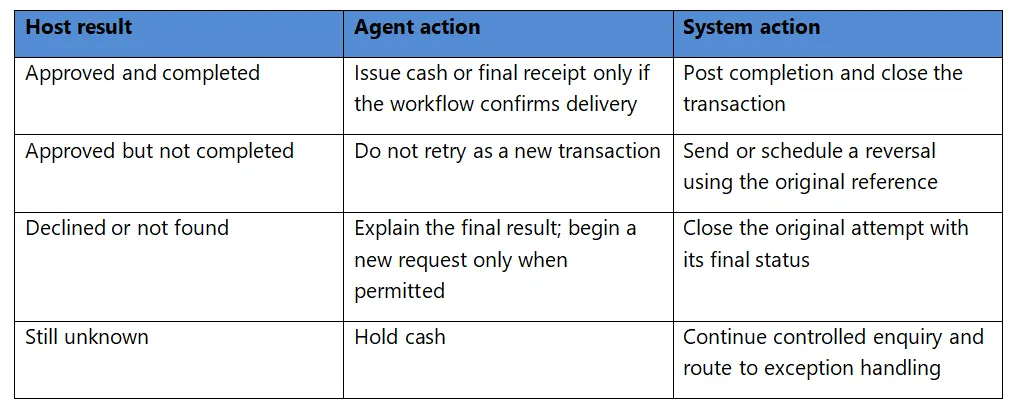
The host must make retries idempotent. If the same request arrives again with the same unique key, the system returns the original result rather than posting another withdrawal or deposit. A new key should represent a genuinely new customer instruction, not an agent’s attempt to escape a spinning screen.
A reversal cancels or releases a transaction that was authorized but could not be completed correctly. A refund is a later customer-facing return of money after a completed purchase or service. A chargeback is a dispute process governed by a payment network or issuer. Using the terms interchangeably creates bad support scripts and incorrect ledger entries.
The interface should distinguish Processing, Approved, Declined, Reversal Pending and Status Unknown. Red text alone is insufficient because agents often interpret any error as permission to retry. The screen should display a short instruction such as “Do not repeat this withdrawal; check status,” together with a reference that support staff can locate.
Receipts require the same discipline. A pending slip must not look like proof that cash changed hands. A final receipt should include the bank or program, masked customer identifier, agent identifier, amount, fees, time, unique reference and final status. Reprints should retain the original transaction identity and be marked as copies.
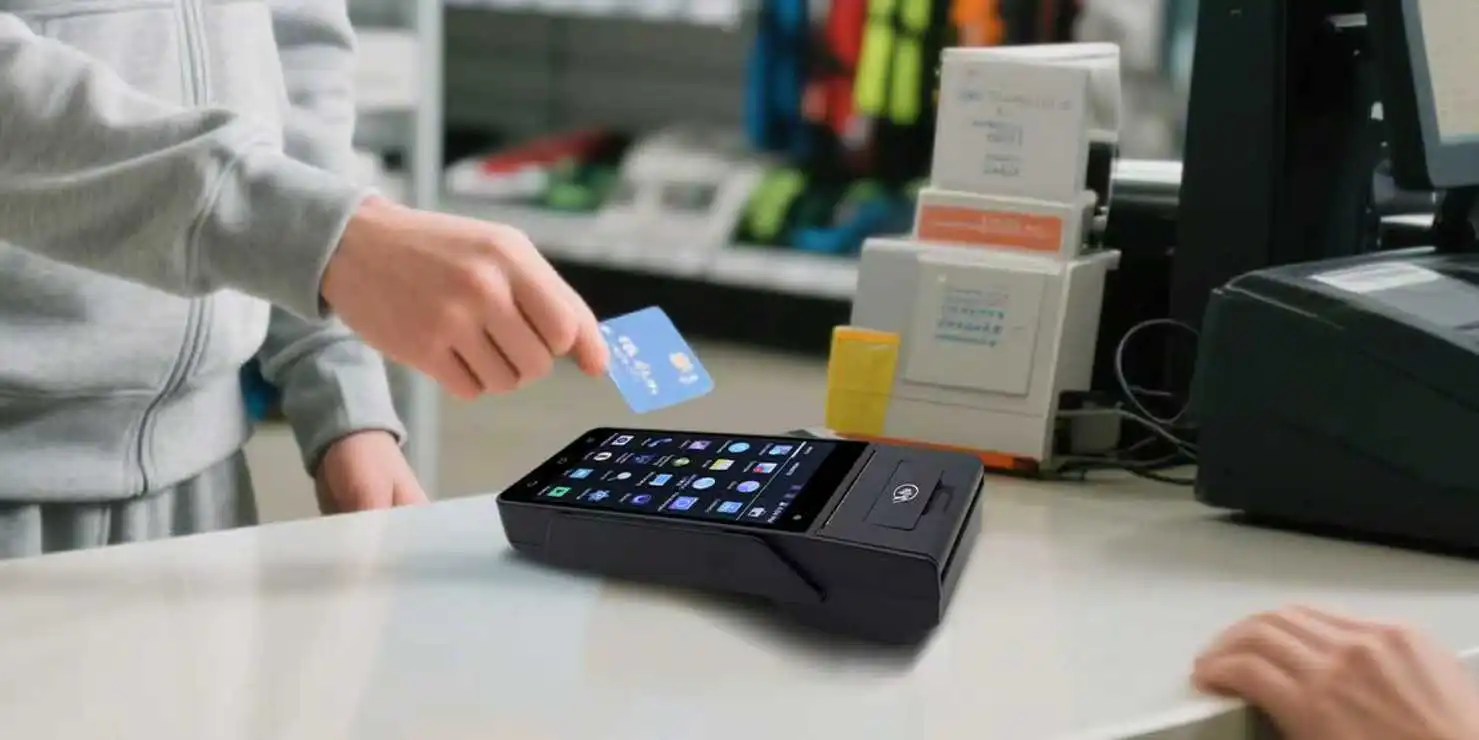
The ZCS Z90 payment terminal is a practical handheld platform for agent banking workflows that combine card acceptance, barcode or QR capture and printed customer evidence. Its built-in 58 mm printer helps the application distinguish a final receipt from a pending notice, while the camera and optional fingerprint module can support approved customer or account-identification steps.
The published Z90 configuration lists PCI PTS 5.x, EMV contact and contactless approvals, PayWave and PayPass. Those approvals support defined payment-security and interoperability functions; they do not create the bank’s timeout logic. The bank or integrator must implement unique references, status enquiry, idempotency, reversal messages and ledger reconciliation in the application and host.
Procurement teams can use the POS certification guide to separate terminal approval from payment-application and processor acceptance. The exact Z90 hardware, firmware, certificate status and acquiring path should be checked for the intended deployment before volume rollout.
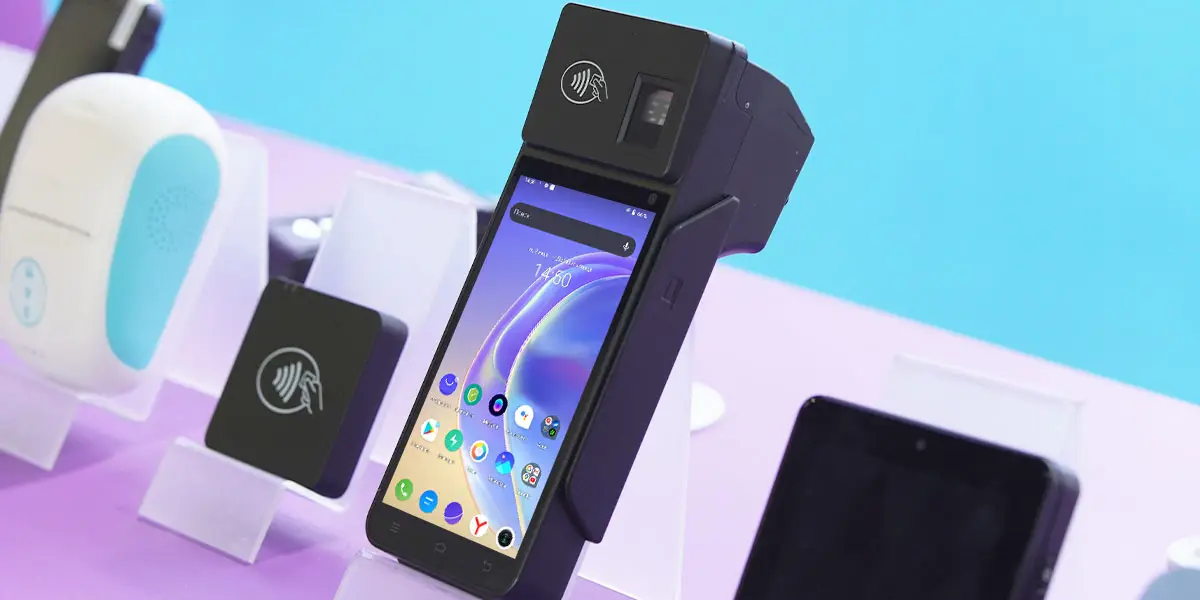
The Z90NP palm vein payment POS adds contactless palm vein and palm-print recognition to a portable payment terminal with a built-in printer. An agent banking project can use biometric confirmation before a high-risk withdrawal or during customer identification, subject to the bank’s enrollment, privacy and fallback rules.
A successful palm vein match does not prove that the financial request completed. The application must keep identity state and transaction state separate, then bind the confirmed customer to one specific request. After a timeout, repeating biometric capture must not generate a second withdrawal. The terminal should reopen the original pending record and perform status enquiry.
Agent reconciliation is more than comparing cash with a total of successful transactions. The closing report should separate completed deposits, completed withdrawals, reversals, reversal-pending items, declined requests and unresolved timeouts. The agent’s cash position should change only when the operating procedure says value was delivered or received.
The bank should reconcile the terminal journal, switch or gateway, core ledger and agent cash record. Differences need an owner and deadline. A reversal acknowledged by the switch but missing from the customer account should not be closed simply because the terminal says success. Conversely, a duplicate customer credit can create another loss if support staff compensate before checking the original reference.

A customer who sees a debit alert but receives no cash experiences the event as lost money, even when the bank expects an automatic reversal. The receipt, agent script and support message should use the same reference and status. They should state what the customer should do, how the bank will communicate the result and the applicable resolution window under local rules.
Support should not promise a new credit until the original transaction has been traced. A premature manual adjustment can be followed by an automatic reversal and create a double credit. The case-management system should link any compensation, fee waiver or provisional credit to the original request, with approval and recovery rules clearly recorded.
Customer care metrics should separate technical recovery from customer recovery. The switch may close a reversal in minutes while the customer’s available balance remains affected longer. Banks should monitor time to final account value, repeat contacts and aged cases, then use those findings to improve processor escalation and agent instructions.
Agents need a short script: stop, keep the cash, preserve the reference, check status and call the defined support route if the outcome remains unknown. Support teams need search access by reference, device, agent, customer token and time. Operations teams need dashboards for timeout rate, average resolution time, aged pending items and locations with repeated connectivity failures.
Automatic reversal timers can reduce manual work, but the timer must match the payment rail and host behavior. Reversing too early can conflict with a late completion; waiting too long harms customers and ties up balances. Scheme rules, local regulation and processor agreements determine the permitted sequence and timing.
A pilot should interrupt communications at several points: before the request reaches the gateway, after the gateway forwards it, after host approval, during receipt printing and during application restart. Test the same reference after reboot, after an agent logs out and after the terminal reconnects. The expected result is one financial event with a traceable final state.
Testing should also cover duplicate taps, impatient button presses, low battery, full local storage, clock drift and delayed host replies. Confirm that TMS updates cannot erase pending journals and that support staff can recover evidence without exposing account credentials or biometric templates.
Q1.Should an agent retry immediately after a POS timeout?
No. The agent should check the original transaction status. A fresh financial request can create a duplicate debit or withdrawal.
Q2.Does a timeout mean the customer was not charged?
No. The host may have approved or posted the request even though the response never reached the terminal.
Q3.Can a biometric match prevent transaction reversals?
No. Biometrics can confirm identity, while reversals correct an authorization or posting that could not be completed. The controls solve different problems.
Q4.What should appear on a pending receipt?
A clear pending or status-unknown label, the original reference, time, amount and support route. It should not resemble a final proof of cash delivery.
Q5.What is the most important technical control?
A shared unique transaction reference with idempotent host processing, status enquiry and a tested reversal path.
A reliable agent banking system never asks the agent to guess whether silence means success. It preserves the original request, checks the authoritative host, reverses incomplete approvals and reconciles every exception. Z90 and Z90NP provide suitable payment, identity and receipt hardware for these workflows; the bank’s application and processing architecture determine whether a timeout becomes a controlled exception or a customer dispute.






 Home
Home  POS Terminal Certifications: PCI PTS, EMV, CE and FCC Explained
