
2026-09-14 Author : ZCS
An agent banking POS terminal is a secure portable device that enables an authorized banking agent to provide selected financial services outside a conventional branch. Depending on local regulations and the bank's application, customers may use an agent to open or update an account, make deposits and withdrawals, transfer funds, repay a microfinance loan, pay bills or print a transaction receipt.
The World Bank’s account of agent banking in Nigeria shows why this model matters: local agents can extend formal financial services into communities where opening and operating a full branch is uneconomic. The terminal becomes the field interface between the customer, the agent and the financial institution.
The device is only one layer of the service. The bank or fintech provider still needs an agent banking application, identity-verification service, transaction switch or core-banking connection, agent-liquidity controls and operational support. A capable terminal captures information and protects the point of interaction; it does not replace the institution's banking platform or compliance program.
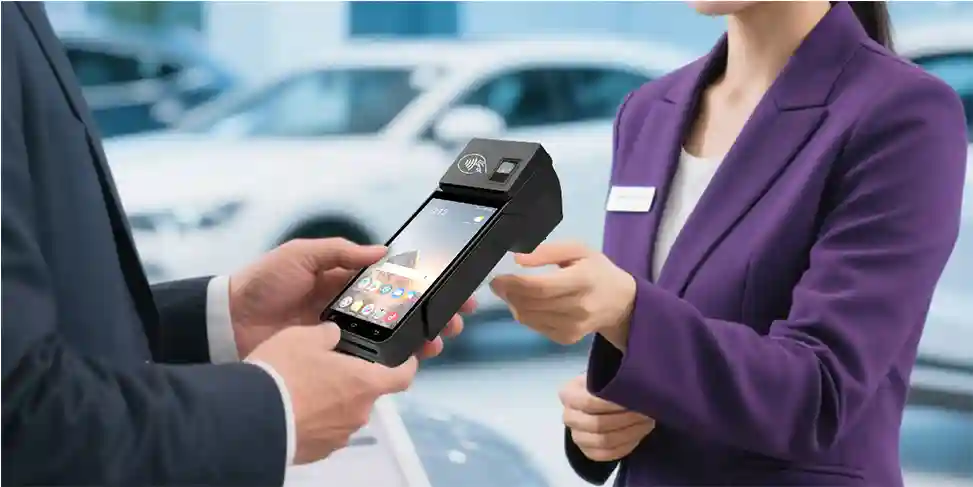
A typical transaction begins when an agent signs in with an assigned credential. The customer then presents an account number, card, mobile number, QR code or identity document. For higher-risk services, the application may request a PIN, fingerprint, facial image or another identity factor. The application sends the request to the bank or processor, receives the result, updates the agent's position and produces a printed or digital receipt.
This flow makes agent banking different from ordinary retail checkout. A retail POS mainly records a sale. An agent banking terminal may release cash, accept a deposit or submit identity information connected to a regulated account. Transaction limits, agent permissions, reconciliation and exception handling therefore influence the hardware specification as much as processor speed or screen size.
Where bank cards form part of the service, the terminal may need contact EMV, contactless NFC and—in markets where legacy cards remain in circulation—magnetic-stripe reading. Secure PIN entry is also necessary for applicable transactions. Procurement teams should map every reader to the payment methods and card schemes actually supported by the local acquirer instead of assuming that an NFC label guarantees payment readiness.
Biometric capture can support customer onboarding, agent authentication and selected high-risk transactions. Fingerprint is common, while facial or palm-vein recognition may suit specific identity programs. A camera, barcode scanner or identity-card reader can also capture documents and customer references. These components collect information; a verified KYC result still depends on compatible software, an approved matching service, lawful access to the relevant identity registry and a fallback for customers who cannot complete biometric verification.
The World Bank’s digital identity research explains that biometric-compatible technology connected to an authoritative identity system can support customer onboarding at agent locations. This connection to an approved identity source is more important than the presence of a sensor by itself.
Agent locations often depend on mobile networks, so a field terminal should support the frequency bands and operators used in the target country. The application must also handle weak signals without creating duplicate deposits, withdrawals or transfers. A timed-out request is not necessarily a failed transaction; it may have reached the bank even when the response did not return to the device.
Offline operation must be defined precisely. Some systems only capture forms while disconnected, while others queue non-financial requests or permit limited store-and-forward transactions. The bank should specify which functions remain available, the local limits, how records are encrypted, what appears on a provisional receipt and how the application checks transaction status after reconnection.
A built-in thermal printer gives customers immediate evidence of a transaction and helps agents reconcile activity. Receipts should show the institution, agent, transaction type, amount, fee, reference and final status without exposing full account, card or identity numbers. Battery performance should be tested while the screen, cellular modem, scanner, biometric module and printer are all in normal use. Standby capacity alone does not predict a full working shift.
Payment-terminal certifications have different scopes. EMV Contact Level 1 evaluates communication between a chip card and terminal, while Level 2 covers the payment kernel. Contactless interfaces and kernels have their own approval processes, and a production deployment may still require Level 3, acquirer or payment-scheme testing. EMVCo maintains the specifications and evaluation framework for contact and contactless acceptance.
PCI PTS addresses another part of the risk. According to the PCI Security Standards Council, the PTS Point of Interaction standard contains security requirements for devices that protect PINs, account information and other payment data at the point of interaction. A PCI PTS-approved terminal does not make the complete agent banking environment PCI DSS compliant; the application, key management, communications and backend systems remain within the wider security assessment.
Before approving a terminal, a bank should request certificate numbers and confirm the exact hardware model, firmware version, approval scope and expiration date in official listings. The institution should also obtain written confirmation from its acquirer or processor that the proposed configuration is acceptable for the target market.

The ZCS Z90 Smart Payment Terminal is one example of hardware designed for mobile financial services. Its core agent-banking features include contact and contactless card interfaces, a built-in 58mm thermal printer, 2G/3G/4G and Wi-Fi connectivity, GPS, barcode and QR scanning, and an optional fingerprint module. The published product specification lists PCI PTS 5.x, EMV Contact Terminal Level 1 and Level 2, EMV Contactless Terminal Level 1, PayWave, PayPass and UnionPay among its payment-related qualifications.
Those features make the Z90 relevant where an institution needs card acceptance, receipt printing and identity capture in one portable terminal. Suitability still depends on the chosen configuration, current certificate status, local banking rules and successful integration with the institution's own application and transaction host. Banks should validate a sample against their payment processor and identity workflow before ordering at scale.
A small pilot can be managed manually, but a distributed network of hundreds or thousands of agents requires central control. A terminal management system should enroll devices, group them by region, distribute approved applications, schedule updates, show version and connectivity status, assist diagnosis and restrict unauthorized software.
Device-management records should not be confused with the financial ledger. A TMS can show whether a terminal is online or running the correct application, while transaction amounts, customer balances and settlement records normally remain in the banking application, processor or core system. Defining that boundary early prevents gaps in audit and support responsibilities.
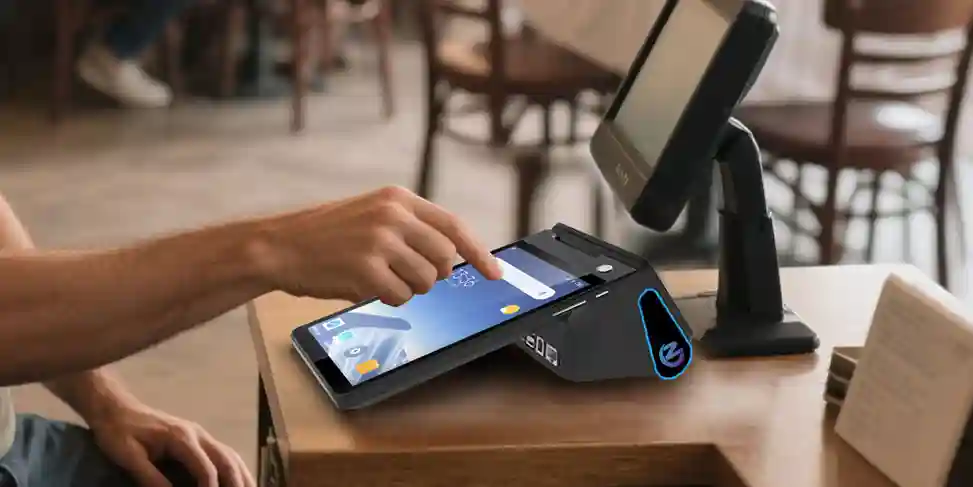
The most useful evaluation is a controlled pilot in representative agent locations. Test the actual banking application with local SIM cards, identity services, payment host and receipt format. Interrupt connectivity during transactions and confirm how the application checks status, prevents duplicates and reconciles after recovery. Measure battery life while printing and scanning, and test the screen and biometric module in the lighting, heat and dust expected in the field.
Security testing should cover agent login, session timeout, application installation controls, encrypted storage, lost-device suspension and the information retained after logout. Operational testing should examine cash reconciliation, agent liquidity, paper replacement, support response and device replacement. The difficult locations should be part of the pilot; a terminal that only works well beside a branch router has not been tested for agent banking.
Q1.Can an agent banking POS open customer accounts?
The terminal can capture forms, documents, signatures and biometrics. Final account creation depends on the bank's KYC service, approval rules and core-banking system.
Q2.Can an agent banking terminal work without internet access?
Some deployments support offline data capture or tightly controlled queued transactions. The institution must define which services are permitted offline and how uncertain transactions are resolved.
Q3.Is PCI PTS the same as PCI DSS?
No. PCI PTS evaluates payment-device security. PCI DSS applies to the wider environment that stores, processes or transmits payment account data.
Q4.Does EMV certification mean the terminal can be deployed immediately?
No. The complete solution may still require payment-application, Level 3, acquirer, processor and regional approval.
Q5.Can the ZCS Z90 be used for agent banking?
The Z90 has payment, printing, connectivity, scanning and optional biometric capabilities relevant to agent banking. Final suitability depends on the selected configuration, verified approvals, local requirements and integration testing.
Q6.Does the terminal include a microfinance system?
No. Loan accounts, interest, repayments, customer records and portfolio reporting are functions of the institution’s microfinance software and backend platform.

An effective agent banking terminal combines secure payment interfaces, practical identity capture, resilient communications, clear receipts and manageable fleet operations. The strongest procurement decisions start with the institution's transaction and compliance model, then select hardware that supports it.
Banks, microfinance institutions and fintech integrators evaluating a portable certified platform can review the ZCS Z90 specifications and request the relevant certificate documents, SDK package and sample configuration. The final decision should follow end-to-end testing with the real banking application, acquirer, mobile networks and identity services intended for production.






 Home
Home  Cash on Delivery POS Terminal: How to Reconcile Cash, Card and QR Payments
