
2026-08-21 Author : ZCS
payabl., a Cyprus fintech provider, launched Tap to Pay on March 25, 2026 — a free Android app that turns NFC-enabled phones into contactless terminals for micro and SME merchants, with no dongle and no added hardware cost. Eight weeks later, Adyen and Starling Bank shipped a near-identical feature built directly into the Starling banking app, with no monthly fee and next-day settlement.
Two launches from unrelated companies, aimed at the same UK SME segment, inside two months, is not a coincidence — it's a signal that the cost of entry for card acceptance has dropped to zero for a specific tier of merchant. Industry researchers size the global SoftPOS market at roughly $534 million in 2026 revenue, growing at more than 20% annually, with retail and delivery-adjacent use cases leading adoption. The question for hardware manufacturers isn't whether this trend is real — it clearly is — but where its growth actually stops.
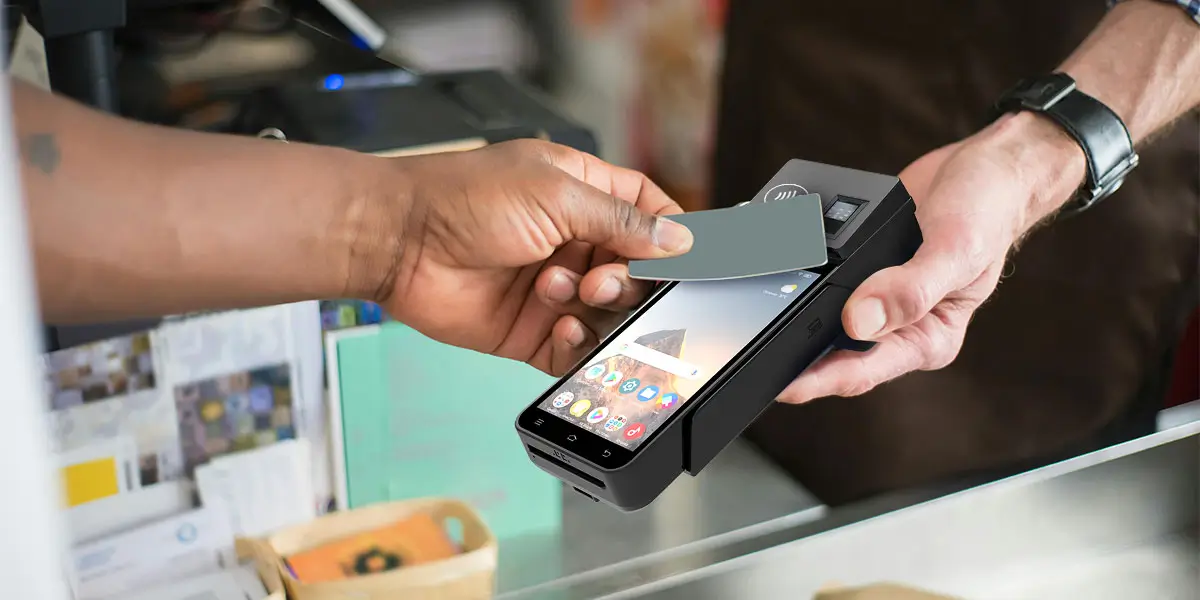
The FCA lifted its mandatory £100 single-transaction contactless limit on March 19, 2026, six days before payabl.'s launch, letting banks with "strong fraud controls" set their own thresholds instead of operating under one national ceiling unchanged since October 2021. Barclays, HSBC, Lloyds, NatWest, and Santander have all held the £100 limit in place regardless, treating the change as permission rather than a mandate, according to the Financial Conduct Authority.
That gap between regulatory flexibility and bank inertia is the more useful signal than the rule change itself. 94.6% of UK in-store card payments under £100 already run contactless, so the cap removal doesn't change how most transactions happen today — it just removes a future ceiling. What actually gates SoftPOS deployment is certification: uncertified tap-to-phone software carries card-network liability exposure, while PCI MPoC-listed solutions meet the fraud-control bar the FCA cited when it eased the limit. The PCI Security Standards Council's MPoC standard — not the contactless cap — is what acquirers actually check before onboarding a SoftPOS provider, and it will remain the binding constraint on growth even if UK banks eventually raise their limits. The fraud-control obligations behind that certification are the same category of requirement covered in what POS security actually means for a business accepting card payments, whether the acceptance device is a phone or a dedicated terminal.
SoftPOS and dedicated terminal hardware aren't competing for the same merchant — they're sorting merchants by transaction frequency. A market-stall vendor processing a handful of sales a day never recovers the cost of a dedicated mobile payment terminal, so a free app is the correct tool. A merchant running dozens of transactions an hour needs a built-in thermal printer, a swappable battery, and housing rated for outdoor exposure — none of which a commercial off-the-shelf phone provides, because continuous NFC scanning drains a phone's battery faster than a device built around a single job.
Couriers sit in the middle of that split, and it's the segment worth watching most closely. payabl. explicitly named delivery riders as a target user for Tap to Pay, but a rider making 40 drop-offs a day with cash-on-delivery collections has more in common with a logistics fleet than a pop-up retailer. Route density, proof-of-delivery capture, and end-of-shift reconciliation all push toward purpose-built hardware once a single rider's volume climbs past occasional use — which is exactly where gig-economy delivery headcounts have been trending through 2025 and 2026. Logistics mobile POS terminals solve that problem by combining payment acceptance with barcode scanning, GPS, and proof-of-delivery in one ruggedized device — a use case no phone app currently replicates end to end.
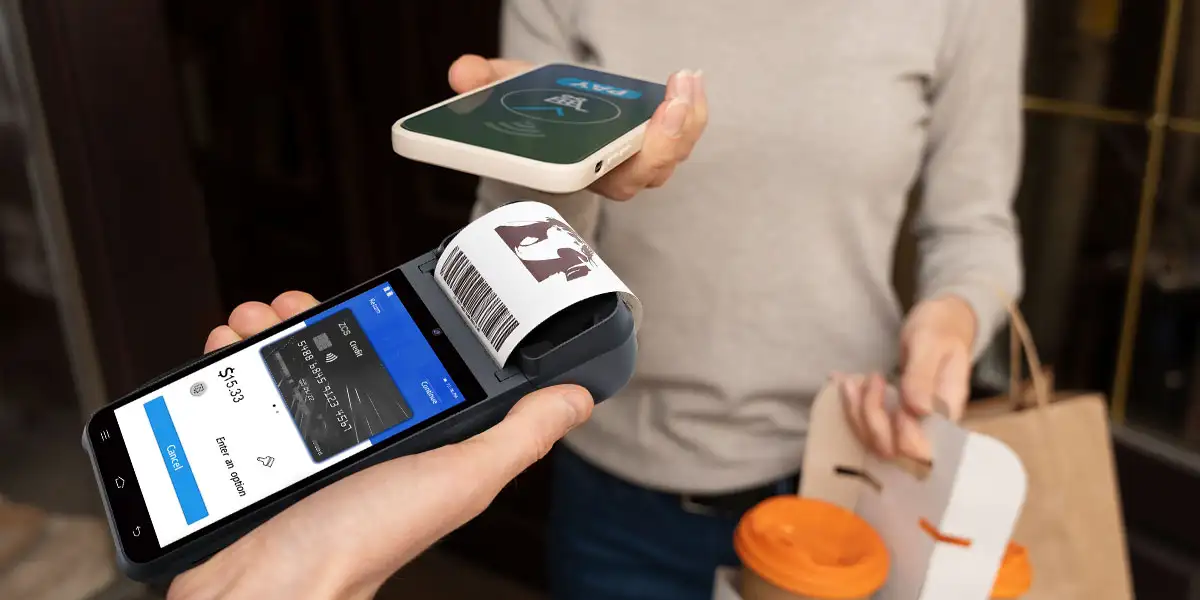
Three structural limits cap how far phone-based acceptance can expand before it runs into the same problems dedicated hardware was built to solve:
Battery life is shared, not dedicated — a phone running a payment app is also running calls, navigation, and order management, so continuous transaction volume competes with every other function the device performs. Durability is absent by design, since a SoftPOS app optimizes for zero upfront cost rather than a device rated to survive a wet market stall or a full outdoor shift. And neither payabl. nor Adyen/Starling has disclosed merchant activation numbers since launch, which means the actual conversion rate from terminal to phone app — as opposed to net-new card acceptance among merchants who previously took cash only — remains unverified.
That last point matters more than it looks. If SoftPOS growth is mostly net-new acceptance rather than terminal displacement, it expands the overall card-payments market without shrinking the addressable base for hardware manufacturers. The data to confirm or rule that out isn't public yet.
The divide between phone apps and dedicated terminals is set to sharpen, not blur, as both categories mature over the next several quarters — vendors on each side are more likely to specialize further than to converge on a single form factor. For manufacturers building PCI PTS-certified terminals, the practical implication is that SoftPOS isn't a competitive threat to the high-frequency, all-day segment — it's a filter that pushes occasional-use merchants toward free apps and leaves durability, uptime, and integrated hardware (printers, scanners, GPS) as the deciding factors for everyone above that volume line.
ZCS builds into that higher-volume segment directly: devices like the Z90 are designed around continuous field use rather than the occasional-transaction case SoftPOS apps target, with ODM/OEM customization letting fiscal modules or certified ports be positioned at the hardware mold stage — a level of adaptation a commercial off-the-shelf phone cannot offer regardless of which payment app runs on it.
iOS support for payabl.'s Tap to Pay arrives later in 2026, putting it in direct competition with Apple's own Tap to Pay on iPhone, which already has a multi-year head start across the US and parts of Europe — the outcome will show whether SoftPOS providers can win share from a platform-native incumbent or mainly compete with each other. Whether UK high-street banks move off the £100 limit, rather than continuing to hold it as they have since March, will indicate whether regulatory flexibility translates into real transaction-size growth or stays theoretical. And any acquirer beyond Adyen and Starling entering the UK SME tap-to-phone space within the next two quarters would confirm this is a durable structural shift rather than a two-company trend — the count so far is still small enough that either outcome remains plausible.

Q1. Will SoftPOS apps replace dedicated POS terminals for most merchants?
No. Adoption splits by transaction volume: occasional or seasonal acceptance favors free apps, while continuous high-frequency use still requires the durability, battery life, and integrated hardware that dedicated terminals provide.
Q2. Does the UK's contactless cap removal directly drive SoftPOS growth?
Not yet. Major UK banks have kept the £100 limit in place since the March 2026 rule change, so certification standards like PCI MPoC currently matter more to SoftPOS deployment than the cap itself.
Q3. Which merchant segment is most likely to shift from hardware to phone apps?
Micro and occasional-use merchants — pop-up retailers, weekend market stalls, and low-volume service providers — see the clearest cost benefit, since a dedicated terminal rarely pays for itself at their transaction frequency.
Q4. Why don't couriers fit cleanly into either category?
High-volume couriers need proof-of-delivery capture, GPS tracking, and barcode scanning alongside payment acceptance, which pushes their requirements toward ruggedized hardware once daily transaction counts rise past occasional use.
Q5. Is the SoftPOS market growing by displacing terminals or by expanding overall card acceptance?
That remains unconfirmed. Neither payabl. nor Adyen/Starling has disclosed merchant activation data, so whether SoftPOS growth comes from terminal displacement or net-new acceptance among previously cash-only merchants is not yet publicly verifiable.






 Home
Home  What Is a Fiscal POS Machine? EFD, ETR and VFD Explained for 2026
