
2025-04-21 Author : ZCS
The best mobile POS system in 2026 is not decided by software subscription price alone. Hardware certifications, battery life, and build durability determine whether a device survives daily commercial use. This guide compares six mobile POS options — Square, Clover, Toast, PayPal, and ZCS — by hardware specification rather than transaction fees. Most buying guides rank mobile POS solutions by processing rates and monthly software cost. This one starts from the terminal itself: what it is certified to do, how long it runs on a single charge, and what happens when it drops.
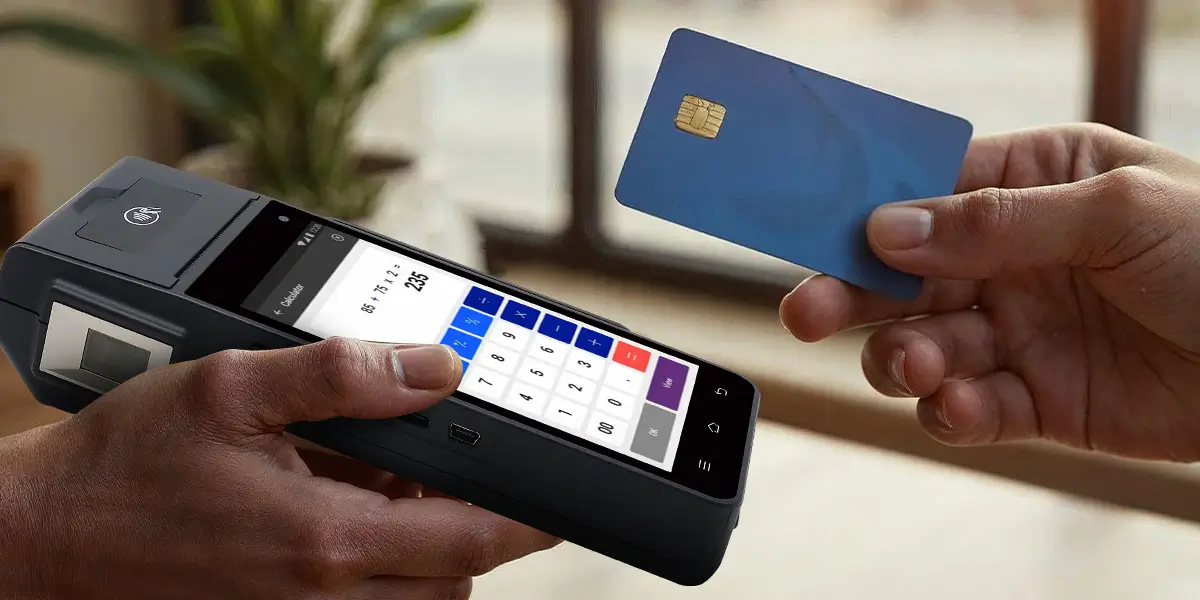
A mobile POS system is a portable point-of-sale device or reader that accepts card payments away from a fixed checkout counter. It combines a payment-capable terminal or card reader with POS software, and typically connects via Wi-Fi, cellular data, or Bluetooth. Mobile POS systems are used for tableside ordering, curbside pickup, delivery, trade shows, and pop-up retail.
Two hardware categories fall under this term. A handheld terminal is a self-contained device with its own screen, battery, and operating system. A mobile card reader is a smaller accessory that pairs with a smartphone or tablet over Bluetooth and depends on that paired device for the user interface.
This comparison scores hardware on five dimensions instead of software pricing tiers.
Certification coverage measures which payment certifications a terminal publicly discloses — PCI PTS version, EMV Level 1 and Level 2, and GMS certification where applicable. Battery life measures manufacturer-stated runtime in hours, not battery capacity alone, because raw mAh figures are not directly comparable across devices with different power draws. Build durability measures published drop rating and IP ingress protection rating. Software compatibility measures whether the terminal supports third-party POS or ERP software beyond the manufacturer's own app. Customization capability measures whether a buyer can specify hardware configuration, branding, or firmware at the OEM/ODM level.
Certification transparency varies sharply across brands. Only two of the five terminals compared here publish a specific PCI PTS version number on their public specification pages.
| Dimension | Square Terminal | Clover Flex | Toast Go 3 | PayPal Terminal | ZCS Z90 |
|---|---|---|---|---|---|
| Brand positioning | Broad small-business recognition, simple setup | Wide hardware variety across retail and restaurant use | Restaurant-industry-specific hardware | Consumer payment brand, low entry barrier | ODM/OEM hardware manufacturer, factory-direct sourcing |
| Screen size | 5.5 in | ~6 in LCD color touchscreen | 6.52 in | Not disclosed | 5.0 in (720×1280) |
| Weight | 417 g | Not disclosed | 426 g | 209 g | 424 g |
| Dimensions | 142.2 × 63.5 × 86.4 mm | Not disclosed | 189 × 90 × 35 mm | 137 × 76 × 15 mm | 191.6 × 80.2 × 46 mm |
| Drop rating | Not disclosed | Not disclosed | 5 ft | Not disclosed | Not disclosed |
| IP rating | Not disclosed | Not disclosed | IP65 | Not disclosed | Not disclosed |
| Battery life | Not stated in hours | 8+ hours typical SMB use | 24+ hours | 48 h standby / 12 h operational | 2800 mAh (hours not disclosed) |
| Built-in printer | Yes (57 mm) | Yes (thermal dot) | Not listed in this spec set | No — requires optional dock | Yes (58 mm thermal) |
| Camera / scanner | Not disclosed | 1D/2D barcode + camera | Front 5MP, rear 8MP | Not disclosed | Rear 5MP with flash, 1D/2D scanner |
| Connectivity | Wi-Fi, Ethernet (via optional hub) | Wi-Fi, LTE | Wi-Fi 6 2×2 MIMO, 4G | Wi-Fi, 3G/4G with preloaded SIM | 4G/3G/2G, Wi-Fi 2.4GHz, Bluetooth, GPS |
| Payment methods | Magstripe, EMV chip, NFC contactless | Chip, swipe, NFC contactless | Swipe, NFC, dip, PIN on glass | Not disclosed in detail | Magstripe (1/2/3 track), IC chip, NFC |
| Payment certification | PCI version not disclosed | PCI version not disclosed | PCI PTS approved (version not specified) | Not disclosed | PCI PTS 5.x, EMV L1 & L2, Visa payWave, Mastercard PayPass, UnionPay |
| Operating temperature | Not disclosed | Not disclosed | Not disclosed | Not disclosed | 0°C to 50°C operating, -10°C to 60°C storage |
| Starting price | $299 | ~$199 | Not disclosed | Not disclosed | B2B/OEM pricing, not fixed retail |
Two gaps are worth naming directly. Drop rating and IP rating are undisclosed for four of the five terminals compared, including the ZCS Z90. Buyers who need this data for outdoor, delivery, or field-service deployments should request it directly from the manufacturer rather than assume it based on similar-looking devices.
Small businesses processing under $10,000 in monthly card volume should prioritize upfront hardware cost and built-in printing over battery capacity, since most single-location use cases stay within reach of a charging dock during a shift.
Businesses operating fully mobile — food trucks, delivery fleets, trade show booths — should prioritize battery life above all other specifications, since a terminal that dies mid-shift has no fallback.
Multi-location or franchise operators should prioritize third-party software compatibility and certification documentation, since these buyers typically need to integrate with an existing POS or ERP stack rather than adopt the terminal vendor's proprietary software.
PCI PTS is a device-level security certification that protects PIN and cardholder data during a transaction. The PCI Security Standards Council maintains the PTS Point of Interaction standard, which independent PCI-recognized laboratories test payment devices against before approval. A terminal without a disclosed PCI PTS version has not necessarily failed certification — but the buyer has no way to verify compliance without contacting the vendor directly.
EMV Level 1 and Level 2 are separate certifications that test different parts of a chip-card transaction. EMVCo certifies EMV Level 1 testing on the mechanical and electrical protocol between the card and the terminal, and EMV Level 2 testing on the software kernel that processes the transaction inside the terminal. A terminal needs both to process EMV chip payments correctly across regions.
GMS certification is a separate, non-payment certification that determines whether an Android-based terminal can run Google Mobile Services — the Play Store, Google Maps, and related apps and APIs. Google's Android Compatibility Definition Document sets the technical requirements a device must meet before Google issues this certification. GMS-certified terminals also affect what merchants can install after deployment — why GMS-certified Android POS terminals give merchants more software freedom explains the practical difference between a GMS-certified and a closed-firmware device.
Fixed retail counters benefit most from terminals with built-in printers and Ethernet fallback, since a stable power and network source is available.
Delivery and food-service riders need terminals with long standalone battery life and cellular connectivity independent of the merchant's Wi-Fi network. Businesses integrating with delivery platforms in Southeast Asia should evaluate terminal-side compatibility separately from payment hardware specs — what to look for in an Android POS terminal for Grab merchant integration covers app-level requirements that a hardware spec sheet does not.
Trade shows and pop-up retail favor lightweight, all-in-one terminals with preloaded cellular connectivity, since Wi-Fi setup is often unavailable on-site.
Cross-border B2B buyers sourcing hardware for deployment across multiple countries typically need to understand SDK access and firmware customization scope before ordering in volume. The open SDK and custom ODM guide for ZCS Android POS terminals walks through what a buyer can and cannot modify at the OEM/ODM level — branding, preloaded software, and hardware configuration.

None of the five terminals compared in this article's hardware table include biometric authentication as a standard feature. PIN entry and password authentication remain the default, both of which carry known weaknesses — PINs can be observed or shared, and passwords can be forgotten or written down insecurely.
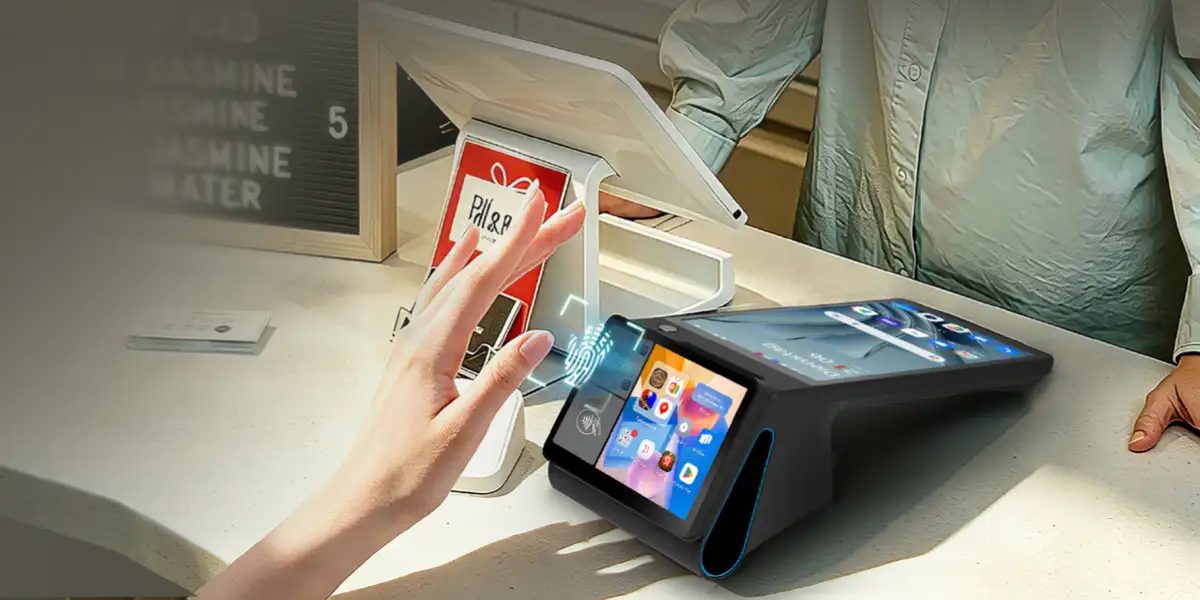
Palm vein recognition is one biometric alternative gaining adoption in POS deployments that require stronger identity verification, such as staff clock-in or high-value transaction approval. What is palm biometrics for identity verification explains how the technology compares to fingerprint and password authentication. ZCS's Z108P is one example of a GMS-certified terminal built around this capability — it is a separate model from the Z90 compared in this article's hardware table.
Q1: What is a mobile POS system?
A mobile POS system is a portable payment terminal or card reader that processes transactions away from a fixed checkout counter. It typically connects via Wi-Fi, cellular, or Bluetooth and pairs payment hardware with POS software for order and inventory management.
Q2: What is the best mobile POS system for small business?
The best option depends on transaction volume and mobility needs. Businesses with a fixed location benefit from terminals with built-in printers, while fully mobile businesses should prioritize battery life and cellular connectivity over other specifications.
Q3: Does a mobile POS system need PCI certification?
Any terminal that captures or transmits cardholder payment data should carry PCI PTS certification. Buyers should confirm the specific PCI PTS version directly with the vendor, since not all manufacturers publish this on their spec sheets.
Q4: How long does a mobile POS system battery last?
Battery life varies by device, ranging from roughly 8 hours of typical use to 24 hours or more on longer-runtime models. Manufacturer-stated hours are a more reliable comparison point than raw battery capacity in mAh.
Q5: Can a mobile POS system process payments offline?
Some mobile POS terminals support temporary offline payment processing, holding transactions locally until reconnected to a network within a set time window, typically 24 to 72 hours. Offline capability varies by manufacturer and specific hardware model.






 Home
Home  Most Popular Restaurant POS Systems in 2025: What You Need to Know
